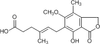
TCI America Mycophenolic Acid M2216

Description
Mycophenolic Acid / (E)-6-(1,3-Dihydro-4 -hydroxy-6-methoxy-7 -methyl-3-oxo-5-isob enzofuranyl)-4-methy l-4-hexenoic Acid In this section, proteases are categorized into three modes of actions: (1) serine protease; (2) cysteine protease; (3) metalloprotease.1) Serine proteases are inhibited by AEBSF, benzamidine, etc.2) Cysteine proteases are inhibited by compounds which react with SH groups such as 2-iodoacetamide or 2-iodoacetic acid.3) Metalloproteases are inhibited by chelating agents, EDTA or 1,10-phenanthroline. 4) In the course of protein extraction, proteolysis is considered to be a major problem because it leads to decreasing yields. Addition of protease inhibitors helps to avoid the proteolysis and improves recovery of the desired protein.5) In the experiment of immunoprecipitation, protease inhibitors are also used to avoid decomposition of antigens or antibodies by proteolytic impurities.6) Protease inhibitors which are frequently used in biochemical research are illustrated in this section. Thiol protease inhibitors, 2-iodoacetamide and 2-iodoacetic acid, cannot be used in protein extraction, because they form covalent bonds to the SH group of the proteins. In protein research, they are used as an alkylation reagent to derivatize the proteins which are extracted from an electrophoresis gel for mass spectrometric analysis.7)

Suppliers

Company
Product
Description
Supplier Links
Mycophenolic Acid - M2216 - TCI America
Portland, OR, USA
Mycophenolic Acid
M2216
Mycophenolic Acid M2216
Mycophenolic Acid / (E)-6-(1,3-Dihydro-4 -hydroxy-6-methoxy-7 -methyl-3-oxo-5-isob enzofuranyl)-4-methy l-4-hexenoic Acid In this section, proteases are categorized into three modes of actions: (1) serine protease; (2) cysteine protease; (3) metalloprotease.1) Serine proteases are inhibited by AEBSF, benzamidine, etc.2) Cysteine proteases are inhibited by compounds which react with SH groups such as 2-iodoacetamide or 2-iodoacetic acid.3) Metalloproteases are inhibited by chelating agents, EDTA or 1,10-phenanthroline. 4) In the course of protein extraction, proteolysis is considered to be a major problem because it leads to decreasing yields. Addition of protease inhibitors helps to avoid the proteolysis and improves recovery of the desired protein.5) In the experiment of immunoprecipitation, protease inhibitors are also used to avoid decomposition of antigens or antibodies by proteolytic impurities.6) Protease inhibitors which are frequently used in biochemical research are illustrated in this section. Thiol protease inhibitors, 2-iodoacetamide and 2-iodoacetic acid, cannot be used in protein extraction, because they form covalent bonds to the SH group of the proteins. In protein research, they are used as an alkylation reagent to derivatize the proteins which are extracted from an electrophoresis gel for mass spectrometric analysis.7)

Mycophenolic Acid / (E)-6-(1,3-Dihydro-4-hydroxy-6-methoxy-7-methyl-3-oxo-5-isobenzofuranyl)-4-methyl-4-hexenoic Acid
In this section, proteases are categorized into three modes of actions: (1) serine protease; (2) cysteine protease; (3) metalloprotease.1)
Serine proteases are inhibited by AEBSF, benzamidine, etc.2) Cysteine proteases are inhibited by compounds which react with SH groups such as 2-iodoacetamide or 2-iodoacetic acid.3) Metalloproteases are inhibited by chelating agents, EDTA or 1,10-phenanthroline.4)
In the course of protein extraction, proteolysis is considered to be a major problem because it leads to decreasing yields. Addition of protease inhibitors helps to avoid the proteolysis and improves recovery of the desired protein.5) In the experiment of immunoprecipitation, protease inhibitors are also used to avoid decomposition of antigens or antibodies by proteolytic impurities.6) Protease inhibitors which are frequently used in biochemical research are illustrated in this section.
Thiol protease inhibitors, 2-iodoacetamide and 2-iodoacetic acid, cannot be used in protein extraction, because they form covalent bonds to the SH group of the proteins. In protein research, they are used as an alkylation reagent to derivatize the proteins which are extracted from an electrophoresis gel for mass spectrometric analysis.7)

Supplier's Site
Mycophenolic Acid - M2216 - TCI America
Portland, OR, USA
Mycophenolic Acid
M2216
Mycophenolic Acid M2216
Mycophenolic Acid / (E)-6-(1,3-Dihydro-4 -hydroxy-6-methoxy-7 -methyl-3-oxo-5-isob enzofuranyl)-4-methy l-4-hexenoic Acid Since the completion of the Human Genome Project in 2003, post genome and next generation post genome have been studied extensively. The reagents that are used for these studies require further refinement and diversification, including reagents for DNA / RNA, peptide synthesis and glyco-chemistry research.

Mycophenolic Acid / (E)-6-(1,3-Dihydro-4-hydroxy-6-methoxy-7-methyl-3-oxo-5-isobenzofuranyl)-4-methyl-4-hexenoic Acid
Since the completion of the Human Genome Project in 2003, post genome and next generation post genome have been studied extensively. The reagents that are used for these studies require further refinement and diversification, including reagents for DNA / RNA, peptide synthesis and glyco-chemistry research.

Supplier's Site

Technical Specifications

  TCI America
Product Category Chemical Additives and Agents
Product Number M2216
Product Name Mycophenolic Acid
Unlock Full Specs
to access all available technical data

Similar Products

Polyaphaolefin (PAO) Base Stock - SpectraSyn Plus™ 6 - ExxonMobil Chemical Company - Synthetic Base Stocks
ExxonMobil Chemical Company - Synthetic Base Stocks
Specs
Applications Oils & Fuels
Form & Features Liquids
View Details
LUMIFLON™ Fluoropolymer Resins - FE-4300 - AGC Chemicals Americas, Inc.
Specs
Applications Coatings or Paint; Industrial Maintenance, Transportation, Architectural, Alternative Energy
Form & Features Liquids
View Details
Enable™ Performance PE Polymers - Enable™ 2703MC - ExxonMobil - Polyethylene Products
Specs
Applications Agriculture; Cosmetics / Personal Care; MRO / Construction
View Details