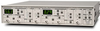
Stanford Research Systems, Inc. (SRS) Filter SR650

Description
The SR650 is a Variable filter from Stanford Research. Electronic filters perform a variety of signal-processing functions with the purpose of removing a signal’s unwanted frequency components, enhance desired ones, or both. There are many types of electronic test equipment filters, including those that are passive, active, analog, digital, low pass, high pass, linear, and nonlinear. Linear filters are the most commonly used for most electronic equipment applications. Additional Features: Frequency range: 1 Hz to 100 kHz Two independent filter channels 115 dB/octave rolloff 0.1 dB passband ripple 80 dB stopband attenuation 6 nV/√Hz input noise Up to 80 dB of gain GPIB and RS-232 interfaces Impedance 1 Mω // 15 pF Type 8-pole, 6-zero elliptic On the Stanford Research Systems SR650, each instrument channel has a low-noise preamplifier, a precision high-pass or low-pass filter section, and an output amplifier. The filters are 8-pole, 6-zero elliptic-type with 115 dB per octave rolloff, 0.1 dB of passband ripple, and 80 dB stopband attenuation. Cutoff frequencies can be set between 1 Hz and 100 kHz, making the SR650 ideal for applications including anti-aliasing, audio analysis, and general frequency-domain signal conditioning.
Description
The SR650 is a Variable filter from Stanford Research. Electronic filters perform a variety of signal-processing functions with the purpose of removing a signal’s unwanted frequency components, enhance desired ones, or both. There are many types of electronic test equipment filters, including those that are passive, active, analog, digital, low pass, high pass, linear, and nonlinear. Linear filters are the most commonly used for most electronic equipment applications. Additional Features: Frequency range: 1 Hz to 100 kHz Two independent filter channels 115 dB/octave rolloff 0.1 dB passband ripple 80 dB stopband attenuation 6 nV/√Hz input noise Up to 80 dB of gain GPIB and RS-232 interfaces Impedance 1 Mω // 15 pF Type 8-pole, 6-zero elliptic On the Stanford Research Systems SR650, each instrument channel has a low-noise preamplifier, a precision high-pass or low-pass filter section, and an output amplifier. The filters are 8-pole, 6-zero elliptic-type with 115 dB per octave rolloff, 0.1 dB of passband ripple, and 80 dB stopband attenuation. Cutoff frequencies can be set between 1 Hz and 100 kHz, making the SR650 ideal for applications including anti-aliasing, audio analysis, and general frequency-domain signal conditioning.

Suppliers

Company
Product
Description
Supplier Links
Filter SR650
The SR650 is a Variable filter from Stanford Research. Electronic filters perform a variety of signal-processing functions with the purpose of removing a signal’s unwanted frequency components, enhance desired ones, or both. There are many types of electronic test equipment filters, including those that are passive, active, analog, digital, low pass, high pass, linear, and nonlinear. Linear filters are the most commonly used for most electronic equipment applications. Additional Features: Frequency range: 1 Hz to 100 kHz Two independent filter channels 115 dB/octave rolloff 0.1 dB passband ripple 80 dB stopband attenuation 6 nV/√Hz input noise Up to 80 dB of gain GPIB and RS-232 interfaces Impedance 1 Mω // 15 pF Type 8-pole, 6-zero elliptic On the Stanford Research Systems SR650, each instrument channel has a low-noise preamplifier, a precision high-pass or low-pass filter section, and an output amplifier. The filters are 8-pole, 6-zero elliptic-type with 115 dB per octave rolloff, 0.1 dB of passband ripple, and 80 dB stopband attenuation. Cutoff frequencies can be set between 1 Hz and 100 kHz, making the SR650 ideal for applications including anti-aliasing, audio analysis, and general frequency-domain signal conditioning.

The SR650 is a Variable filter from Stanford Research. Electronic filters perform a variety of signal-processing functions with the purpose of removing a signal’s unwanted frequency components, enhance desired ones, or both. There are many types of electronic test equipment filters, including those that are passive, active, analog, digital, low pass, high pass, linear, and nonlinear. Linear filters are the most commonly used for most electronic equipment applications.

Additional Features:

  • Frequency range: 1 Hz to 100 kHz
  • Two independent filter channels
  • 115 dB/octave rolloff
  • 0.1 dB passband ripple
  • 80 dB stopband attenuation
  • 6 nV/√Hz input noise
  • Up to 80 dB of gain
  • GPIB and RS-232 interfaces
  • Impedance 1 MΩ // 15 pF
  • Type 8-pole, 6-zero elliptic

On the Stanford Research Systems SR650, each instrument channel has a low-noise preamplifier, a precision high-pass or low-pass filter section, and an output amplifier. The filters are 8-pole, 6-zero elliptic-type with 115 dB per octave rolloff, 0.1 dB of passband ripple, and 80 dB stopband attenuation. Cutoff frequencies can be set between 1 Hz and 100 kHz, making the SR650 ideal for applications including anti-aliasing, audio analysis, and general frequency-domain signal conditioning.

Supplier's Site

Technical Specifications

  ValueTronics International, Inc.
Product Category RF Filters and Microwave Filters
Product Number SR650
Product Name Filter
Unlock Full Specs
to access all available technical data

Similar Products

L2 Low Loss GPS SAW Filter - QPQ1061 - Qorvo
Specs
Filter Technology Passive Filter
Filter Design Saw Filter
Fc 1212 to 1243 MHz
View Details
RF Band Stop Filter - UIYBSF202152A - UIY Inc.
Specs
Filter Type Band Reject
Operating Temperature -40 to 85 C (-40 to 185 F)
Fc 1025 to 1035 MHz
View Details
Discrete Filters: Bandpass, Low Pass, High Pass, or Notch -  - Smiths Interconnect, a Molex company
Specs
Filter Type Bandpass; Low Pass
Fc 5 to 10000 MHz
View Details
FB-2400, 24 GHz Bandpass Filter - FB-2400 - Marki Microwave LLC
Specs
Filter Type Bandpass
Fc 24000 to ? MHz
Package Type Connectorized
View Details