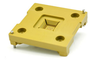
Smiths Interconnect, a Molex company Peripheral Tri-Temp Test: Celsius Series

Description
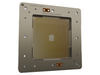
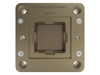
Celsius test sockets feature a wiping contact technology perfect for QFN testing. The elastomer is utilized for load board compliance only and allows the contact to be cycled in temperature extremes with no change in contact force or reliability. Featruing 5A continues current carrying capacity and capable -50 to 170deg C test environment. Proprietary contact design with wiping action at device pad to ensure consistent contact resistance. Minimal scrub action to the PCB pad. Features & Benefits Smiths Interconnect's Celsius contact takes advantage of a slightly longer signal path to offer significant advantages in compliance, temperature handling, and current carrying capacity. A self-contained contact, Celsius uses an elastomer only for compliance to the load board and is not repeatedly cycled. This allows the contact to be used at much higher (and lower) temperatures with no change in contact force or reliability. Celsius also has spring probe-like compliance. This can be an advantage in multi-site applications, where nest-to-nest discoplanarity causes yield disparities between sites
Request a Quote Datasheet

Suppliers

Company
Product
Description
Supplier Links
Peripheral Tri-Temp Test: Celsius Series -  - Smiths Interconnect, a Molex company
London, United Kingdom
Peripheral Tri-Temp Test: Celsius Series
Celsius test sockets feature a wiping contact technology perfect for QFN testing. The elastomer is utilized for load board compliance only and allows the contact to be cycled in temperature extremes with no change in contact force or reliability. Featruing 5A continues current carrying capacity and capable -50 to 170deg C test environment. Proprietary contact design with wiping action at device pad to ensure consistent contact resistance. Minimal scrub action to the PCB pad. Features & Benefits Smiths Interconnect's Celsius contact takes advantage of a slightly longer signal path to offer significant advantages in compliance, temperature handling, and current carrying capacity. A self-contained contact, Celsius uses an elastomer only for compliance to the load board and is not repeatedly cycled. This allows the contact to be used at much higher (and lower) temperatures with no change in contact force or reliability. Celsius also has spring probe-like compliance. This can be an advantage in multi-site applications, where nest-to-nest discoplanarity causes yield disparities between sites

Celsius test sockets feature a wiping contact technology perfect for QFN testing. The elastomer is utilized for load board compliance only and allows the contact to be cycled in temperature extremes with no change in contact force or reliability. Featruing 5A continues current carrying capacity and capable -50 to 170deg C test environment. Proprietary contact design with wiping action at device pad to ensure consistent contact resistance. Minimal scrub action to the PCB pad.

Features & Benefits

Smiths Interconnect's Celsius contact takes advantage of a slightly longer signal path to offer significant advantages in compliance, temperature handling, and current carrying capacity. A self-contained contact, Celsius uses an elastomer only for compliance to the load board and is not repeatedly cycled. This allows the contact to be used at much higher (and lower) temperatures with no change in contact force or reliability. Celsius also has spring probe-like compliance. This can be an advantage in multi-site applications, where nest-to-nest discoplanarity causes yield disparities between sites

Supplier's Site Datasheet

Technical Specifications

  Smiths Interconnect, a Molex company
Product Category IC Interconnect Components
Product Name Peripheral Tri-Temp Test: Celsius Series
Product Type IC Socket
Unlock Full Specs
to access all available technical data

Similar Products

Thermal Management Lid Capabilities: IC Test Solutions -  - Smiths Interconnect, a Molex company
Specs
Product Type IC Socket
Socket Type Test
View Details
ESJ Series H-Pin Socket -  - Smiths Interconnect, a Molex company
Smiths Interconnect, a Molex company
Specs
Product Type IC Socket
Operating Temperature 200 C (392 F)
View Details
Array High Speed Test - DaVinci Gen V -  - Smiths Interconnect, a Molex company
Smiths Interconnect, a Molex company
Specs
Product Type IC Socket
Socket Type BGA; LGA; Test
Contact Resistance 55 milliohms
View Details
Levan Elastomeric Contact Test Socket: High Bandwidth Test Socket for IC Testing -  - Smiths Interconnect, a Molex company
Specs
Product Type IC Socket
Socket Type BGA; LGA; QFNL; Test
Operating Temperature -55 to 160 C (-67 to 320 F)
View Details