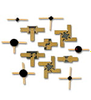
Skyworks Solutions, Inc. DME, DMF, DMJ Series: Silicon Beam-Lead Schottky Mixer Diodes—Singles, Pairs and Quads Bondable and Packaged Chips DMJ2502 Series

Description
Skyworks beam-lead silicon Schottky barrier mixer diodes are designed for applications through 40 GHz. The beam-lead design reduces the problem of bonding to the very small area characteristic of the low capacitance junctions. Beam-lead Schottky barrier mixer diodes are made by the deposition of a suitable barrier metal on an epitaxial silicon substrate to form the junction. The process and choice of materials result in low series resistance with a narrow spread of capacitance values for close impedance control. A variety of forward voltages are available, ranging from low values for low, or starved, local oscillator drive levels to high values for high drive, low distortion mixer applications. Beam-lead diodes are available in a wide range of packages. Capacitance ranges and series resistances are comparable with the packaged devices that are available through K-band. Unpackaged diodes are well suited for use in microwave integrated circuits. The packaged devices are designed to be inserted as hybrid elements in strip, transmission line applications. Beam-lead Schottky barrier diodes are categorized by universal mixer applications in four frequency ranges: S, X, Ku and Ka bands. They may also be used as modulators and high-speed switches. Beam-lead diodes are suited for balanced mixers, due to their low parasitics and uniformity. A typical VF vs. IF curve is shown in Figure 1. Typical noise figures vs. LO drive is shown in Figure 2 for single N-type, low drive diode types. DMJ2502 Series includes DMJ2502-224 and DMJ2502-254.
Request a Quote
Description
Skyworks beam-lead silicon Schottky barrier mixer diodes are designed for applications through 40 GHz. The beam-lead design reduces the problem of bonding to the very small area characteristic of the low capacitance junctions. Beam-lead Schottky barrier mixer diodes are made by the deposition of a suitable barrier metal on an epitaxial silicon substrate to form the junction. The process and choice of materials result in low series resistance with a narrow spread of capacitance values for close impedance control. A variety of forward voltages are available, ranging from low values for low, or starved, local oscillator drive levels to high values for high drive, low distortion mixer applications. Beam-lead diodes are available in a wide range of packages. Capacitance ranges and series resistances are comparable with the packaged devices that are available through K-band. Unpackaged diodes are well suited for use in microwave integrated circuits. The packaged devices are designed to be inserted as hybrid elements in strip, transmission line applications. Beam-lead Schottky barrier diodes are categorized by universal mixer applications in four frequency ranges: S, X, Ku and Ka bands. They may also be used as modulators and high-speed switches. Beam-lead diodes are suited for balanced mixers, due to their low parasitics and uniformity. A typical VF vs. IF curve is shown in Figure 1. Typical noise figures vs. LO drive is shown in Figure 2 for single N-type, low drive diode types. DMJ2502 Series includes DMJ2502-224 and DMJ2502-254.
Request a Quote

Suppliers

Company
Product
Description
Supplier Links
DME, DMF, DMJ Series: Silicon Beam-Lead Schottky Mixer Diodes—Singles, Pairs and Quads Bondable and Packaged Chips - DMJ2502 Series - Skyworks Solutions, Inc.
Irvine, CA, United States
DME, DMF, DMJ Series: Silicon Beam-Lead Schottky Mixer Diodes—Singles, Pairs and Quads Bondable and Packaged Chips
DMJ2502 Series
DME, DMF, DMJ Series: Silicon Beam-Lead Schottky Mixer Diodes—Singles, Pairs and Quads Bondable and Packaged Chips DMJ2502 Series
Skyworks beam-lead silicon Schottky barrier mixer diodes are designed for applications through 40 GHz. The beam-lead design reduces the problem of bonding to the very small area characteristic of the low capacitance junctions. Beam-lead Schottky barrier mixer diodes are made by the deposition of a suitable barrier metal on an epitaxial silicon substrate to form the junction. The process and choice of materials result in low series resistance with a narrow spread of capacitance values for close impedance control. A variety of forward voltages are available, ranging from low values for low, or starved, local oscillator drive levels to high values for high drive, low distortion mixer applications. Beam-lead diodes are available in a wide range of packages. Capacitance ranges and series resistances are comparable with the packaged devices that are available through K-band. Unpackaged diodes are well suited for use in microwave integrated circuits. The packaged devices are designed to be inserted as hybrid elements in strip, transmission line applications. Beam-lead Schottky barrier diodes are categorized by universal mixer applications in four frequency ranges: S, X, Ku and Ka bands. They may also be used as modulators and high-speed switches. Beam-lead diodes are suited for balanced mixers, due to their low parasitics and uniformity. A typical VF vs. IF curve is shown in Figure 1. Typical noise figures vs. LO drive is shown in Figure 2 for single N-type, low drive diode types. DMJ2502 Series includes DMJ2502-224 and DMJ2502-254.

Skyworks beam-lead silicon Schottky barrier mixer diodes are designed for applications through 40 GHz. The beam-lead design reduces the problem of bonding to the very small area characteristic of the low capacitance junctions.
Beam-lead Schottky barrier mixer diodes are made by the deposition of a suitable barrier metal on an epitaxial silicon substrate to form the junction. The process and choice of materials result in low series resistance with a narrow spread of capacitance values for close impedance control.
A variety of forward voltages are available, ranging from low values for low, or starved, local oscillator drive levels to high values for high drive, low distortion mixer applications. Beam-lead diodes are available in a wide range of packages. Capacitance ranges and series resistances are comparable with the packaged devices that are available through K-band. Unpackaged diodes are well suited for use in microwave integrated circuits. The packaged devices are designed to be inserted as hybrid elements in strip, transmission line applications. Beam-lead Schottky barrier diodes are categorized by universal mixer applications in four frequency ranges: S, X, Ku and Ka bands. They may also be used as modulators and high-speed switches.
Beam-lead diodes are suited for balanced mixers, due to their low parasitics and uniformity. A typical VF vs. IF curve is shown in Figure 1. Typical noise figures vs. LO drive is shown in Figure 2 for single N-type, low drive diode types.
DMJ2502 Series includes DMJ2502-224 and DMJ2502-254.

Supplier's Site

Technical Specifications

  Skyworks Solutions, Inc.
Product Category Schottky Diodes
Product Number DMJ2502 Series
Product Name DME, DMF, DMJ Series: Silicon Beam-Lead Schottky Mixer Diodes—Singles, Pairs and Quads Bondable and Packaged Chips
Applications Mixer
Unlock Full Specs
to access all available technical data

Similar Products

RF Diodes - SMS7621-006LF - 029463-SMS7621-006LF - Win Source Electronics
Specs
Life Cycle Stage Active
Package SOT23; SOT-23-3
Tj 150 C (302 F)
View Details
6 suppliers
Schottky 20V 75MW SOT23 Diode and Rectifier - 284-SMS3923-005LF - ERSAELECTRONICS PTE. LTD.
Specs
Applications Rectifier
Package Tape & Reel (TR)
RoHS Compliant RoHS
View Details
4 suppliers
