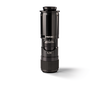
Shanghai Optics Achromatic Microscope Objectives SO-H63C-0068

Description
Objective lens is the most important part of a microscope and plays a central role in imaging an object onto the human eye or an image sensor for discerning the object’s detail. Microscope objectives are ideal for a range of science research, industrial, and general lab applications. Microscope objectives are typically composed of multiple lens elements and located closest to the object. Microscope objectives include infinite conjugate (infinite corrected) and finite conjugate, and these lenses are available in a range of magnifications from 2X to 200X. There are many types of microscope objectives for covering a wide variety of applications. The most basic and least expensive objectives, like you might find in a school science classroom, are achromatic objectives. Apochromatic objectives, on the other hand, provide a professional-grade level for aberration correction and feature comparatively high resolution. Most microscopes are equipped with multiple objectives with different magnifications, so specimens or samples can be examined with sufficient resolution. Microscope objectives are widely used in all sorts of applications including medical, scientific research, and industrial fields.
Description
Objective lens is the most important part of a microscope and plays a central role in imaging an object onto the human eye or an image sensor for discerning the object’s detail. Microscope objectives are ideal for a range of science research, industrial, and general lab applications. Microscope objectives are typically composed of multiple lens elements and located closest to the object. Microscope objectives include infinite conjugate (infinite corrected) and finite conjugate, and these lenses are available in a range of magnifications from 2X to 200X. There are many types of microscope objectives for covering a wide variety of applications. The most basic and least expensive objectives, like you might find in a school science classroom, are achromatic objectives. Apochromatic objectives, on the other hand, provide a professional-grade level for aberration correction and feature comparatively high resolution. Most microscopes are equipped with multiple objectives with different magnifications, so specimens or samples can be examined with sufficient resolution. Microscope objectives are widely used in all sorts of applications including medical, scientific research, and industrial fields.

Suppliers

Company
Product
Description
Supplier Links
Achromatic Microscope Objectives - SO-H63C-0068 - Shanghai Optics
North Plainfield, NJ, United States
Achromatic Microscope Objectives
SO-H63C-0068
Achromatic Microscope Objectives SO-H63C-0068
Objective lens is the most important part of a microscope and plays a central role in imaging an object onto the human eye or an image sensor for discerning the object’s detail. Microscope objectives are ideal for a range of science research, industrial, and general lab applications. Microscope objectives are typically composed of multiple lens elements and located closest to the object. Microscope objectives include infinite conjugate (infinite corrected) and finite conjugate, and these lenses are available in a range of magnifications from 2X to 200X. There are many types of microscope objectives for covering a wide variety of applications. The most basic and least expensive objectives, like you might find in a school science classroom, are achromatic objectives. Apochromatic objectives, on the other hand, provide a professional-grade level for aberration correction and feature comparatively high resolution. Most microscopes are equipped with multiple objectives with different magnifications, so specimens or samples can be examined with sufficient resolution. Microscope objectives are widely used in all sorts of applications including medical, scientific research, and industrial fields.

Objective lens is the most important part of a microscope and plays a central role in imaging an object onto the human eye or an image sensor for discerning the object’s detail. Microscope objectives are ideal for a range of science research, industrial, and general lab applications. Microscope objectives are typically composed of multiple lens elements and located closest to the object. Microscope objectives include infinite conjugate (infinite corrected) and finite conjugate, and these lenses are available in a range of magnifications from 2X to 200X.

There are many types of microscope objectives for covering a wide variety of applications. The most basic and least expensive objectives, like you might find in a school science classroom, are achromatic objectives. Apochromatic objectives, on the other hand, provide a professional-grade level for aberration correction and feature comparatively high resolution. Most microscopes are equipped with multiple objectives with different magnifications, so specimens or samples can be examined with sufficient resolution.

Microscope objectives are widely used in all sorts of applications including medical, scientific research, and industrial fields.

Supplier's Site

Technical Specifications

  Shanghai Optics
Product Category Microscope Lenses and Objectives
Product Number SO-H63C-0068
Product Name Achromatic Microscope Objectives
Lens Type Objective Lens
Unlock Full Specs
to access all available technical data

Similar Products

Industrial Microscope Objective Lens - LMPLFLN - Evident Scientific
Specs
Lens Type Objective Lens
Optical Type / Correction Factor Specialty / Other; Semi-Apochromatic
Magnification 5 to 100 X
View Details
Laser Focusing Objectives -  - Navitar, Inc.
Specs
Lens Type Objective Lens
Optical Type / Correction Factor Achromat Condenser
View Details
Long Working Distance Microscope Objectives Lenses -  - Newport MKS
Specs
Lens Type Objective Lens
Optical Type / Correction Factor Apochromat
Magnification 2 to 50 X
View Details
Specs
Lens Type Eyepiece Lens
View Details