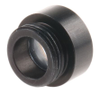
Shanghai Optics Optical Domes

Description
Optical domes are hemispheric windows which provide a protective boundary while allowing a clear field of view between two environments. They are typically made of two parallel surfaces. Shanghai Optics manufactures optical domes in a wide variety of substrates, suitable for visible, IR, or UV light. Our domes are available in sizes from 5 mm to over 200 mm diameter, with custom sizes possible on request. BK7 or fused silica is a good choice for an optical dome that will be used in situations where only visible light must be transmitted; for instance, on camera sensor or for meteorology applications. BK7 has good chemical durability, and provides excellent transmission for the 300nmto 2µm wavelength range. For UV- range light transmission, UV-grade fused silica is available. Our fused silica domes can withstand high pressure and are ideal for underwater application. This optical glass provides over 85 percent transmission for wavelengths up to 185 nm. We can also manufacture acrylic domes on request. These domes offer less light scattering than BK7 or fused silica, and are still highly durable. Factory Standard Material: BK7 and more Diameter: 20~300mm Wall Thickness>1mm(Diamet er20) Surface accuracy: 3lambda Dimensional Tolerance: +/-0.1mm scratch & dig: 60/40 C-A:145+0/-0.05mm Radius:R1=76mm,R2=80 mm Dome shall provide angular transmissions >=93%, between incident angles of ±25 degrees Contact us for manufacturing limit or custom specifications. Different Types of Optical Domes Infrared optical domes are important for defense applications, and here sapphire is often the material of choice. Aside from diamond, sapphire is the hardest natural substance, and it is resistant to scratching and abrasion. It is also capable of withstanding high pressure, and transmits eighty percent of light between the 2-5µm wavelength range.Other options for infrared domes are zinc selenide, germanium, calcium fluorite, zinc sulfide, and silicon. Silicon has primary transmission in the3-5μm range, and has low density and high thermal conductivity. It is the most budget friendly in our lineup of IR materials. Zinc Selenide domes have a broad wavelength length, from 3 µm to 16 µm, but ZnSe is softer than most other commonly used IR substrates and thus should not be used in harsh environments. It also a high index of refraction, but with an AR coating can achieve high transmission. It is a good choice for thermally demanding environments. Our Germanium IR domes have a transmission range of 2-14 μm. They are durable, and although they are not as hard as sapphire, we can provide diamond AR coatings (hard carbon or DLC) to provide optimal resistance to harsh environments. Our Polycrystalline Zinc Sulfide domes are hotpressed under vacuum, and provide multispectral transmission—an average of 70 % from 3-5µm and 8-12µm. This hotpressed zinc has good thermal properties, and a AR/AR coating can improve transmission. The manufacturing process allows us to customize dome shape and size, and enables us to manufacture larger domes or domes with various curvature radius. MgF2 translucent ceramic domes are also hot pressed, and these domes exhibit high transmission between 2-7.5mm. They are often used for missiles and launch tubes because of their high knoophardness and a flexural strength rating of 20,000 psi. On all our domes we are able to provide anti-reflection coatings. These coatings can provide better transmission of light and hence can greatly improveimagery. For harsh environments where optical transmission is secondary to robustness we can provide specialized coatings to improve durability.
Description
Optical domes are hemispheric windows which provide a protective boundary while allowing a clear field of view between two environments. They are typically made of two parallel surfaces. Shanghai Optics manufactures optical domes in a wide variety of substrates, suitable for visible, IR, or UV light. Our domes are available in sizes from 5 mm to over 200 mm diameter, with custom sizes possible on request. BK7 or fused silica is a good choice for an optical dome that will be used in situations where only visible light must be transmitted; for instance, on camera sensor or for meteorology applications. BK7 has good chemical durability, and provides excellent transmission for the 300nmto 2µm wavelength range. For UV- range light transmission, UV-grade fused silica is available. Our fused silica domes can withstand high pressure and are ideal for underwater application. This optical glass provides over 85 percent transmission for wavelengths up to 185 nm. We can also manufacture acrylic domes on request. These domes offer less light scattering than BK7 or fused silica, and are still highly durable. Factory Standard Material: BK7 and more Diameter: 20~300mm Wall Thickness>1mm(Diamet er20) Surface accuracy: 3lambda Dimensional Tolerance: +/-0.1mm scratch & dig: 60/40 C-A:145+0/-0.05mm Radius:R1=76mm,R2=80 mm Dome shall provide angular transmissions >=93%, between incident angles of ±25 degrees Contact us for manufacturing limit or custom specifications. Different Types of Optical Domes Infrared optical domes are important for defense applications, and here sapphire is often the material of choice. Aside from diamond, sapphire is the hardest natural substance, and it is resistant to scratching and abrasion. It is also capable of withstanding high pressure, and transmits eighty percent of light between the 2-5µm wavelength range.Other options for infrared domes are zinc selenide, germanium, calcium fluorite, zinc sulfide, and silicon. Silicon has primary transmission in the3-5μm range, and has low density and high thermal conductivity. It is the most budget friendly in our lineup of IR materials. Zinc Selenide domes have a broad wavelength length, from 3 µm to 16 µm, but ZnSe is softer than most other commonly used IR substrates and thus should not be used in harsh environments. It also a high index of refraction, but with an AR coating can achieve high transmission. It is a good choice for thermally demanding environments. Our Germanium IR domes have a transmission range of 2-14 μm. They are durable, and although they are not as hard as sapphire, we can provide diamond AR coatings (hard carbon or DLC) to provide optimal resistance to harsh environments. Our Polycrystalline Zinc Sulfide domes are hotpressed under vacuum, and provide multispectral transmission—an average of 70 % from 3-5µm and 8-12µm. This hotpressed zinc has good thermal properties, and a AR/AR coating can improve transmission. The manufacturing process allows us to customize dome shape and size, and enables us to manufacture larger domes or domes with various curvature radius. MgF2 translucent ceramic domes are also hot pressed, and these domes exhibit high transmission between 2-7.5mm. They are often used for missiles and launch tubes because of their high knoophardness and a flexural strength rating of 20,000 psi. On all our domes we are able to provide anti-reflection coatings. These coatings can provide better transmission of light and hence can greatly improveimagery. For harsh environments where optical transmission is secondary to robustness we can provide specialized coatings to improve durability.

Suppliers

Company
Product
Description
Supplier Links
Optical Domes -  - Shanghai Optics
North Plainfield, NJ, United States
Optical Domes
Optical Domes
Optical domes are hemispheric windows which provide a protective boundary while allowing a clear field of view between two environments. They are typically made of two parallel surfaces. Shanghai Optics manufactures optical domes in a wide variety of substrates, suitable for visible, IR, or UV light. Our domes are available in sizes from 5 mm to over 200 mm diameter, with custom sizes possible on request. BK7 or fused silica is a good choice for an optical dome that will be used in situations where only visible light must be transmitted; for instance, on camera sensor or for meteorology applications. BK7 has good chemical durability, and provides excellent transmission for the 300nmto 2µm wavelength range. For UV- range light transmission, UV-grade fused silica is available. Our fused silica domes can withstand high pressure and are ideal for underwater application. This optical glass provides over 85 percent transmission for wavelengths up to 185 nm. We can also manufacture acrylic domes on request. These domes offer less light scattering than BK7 or fused silica, and are still highly durable. Factory Standard Material: BK7 and more Diameter: 20~300mm Wall Thickness>1mm(Diamet er20) Surface accuracy: 3lambda Dimensional Tolerance: +/-0.1mm scratch & dig: 60/40 C-A:145+0/-0.05mm Radius:R1=76mm,R2=80 mm Dome shall provide angular transmissions >=93%, between incident angles of ±25 degrees Contact us for manufacturing limit or custom specifications. Different Types of Optical Domes Infrared optical domes are important for defense applications, and here sapphire is often the material of choice. Aside from diamond, sapphire is the hardest natural substance, and it is resistant to scratching and abrasion. It is also capable of withstanding high pressure, and transmits eighty percent of light between the 2-5µm wavelength range.Other options for infrared domes are zinc selenide, germanium, calcium fluorite, zinc sulfide, and silicon. Silicon has primary transmission in the3-5μm range, and has low density and high thermal conductivity. It is the most budget friendly in our lineup of IR materials. Zinc Selenide domes have a broad wavelength length, from 3 µm to 16 µm, but ZnSe is softer than most other commonly used IR substrates and thus should not be used in harsh environments. It also a high index of refraction, but with an AR coating can achieve high transmission. It is a good choice for thermally demanding environments. Our Germanium IR domes have a transmission range of 2-14 μm. They are durable, and although they are not as hard as sapphire, we can provide diamond AR coatings (hard carbon or DLC) to provide optimal resistance to harsh environments. Our Polycrystalline Zinc Sulfide domes are hotpressed under vacuum, and provide multispectral transmission—an average of 70 % from 3-5µm and 8-12µm. This hotpressed zinc has good thermal properties, and a AR/AR coating can improve transmission. The manufacturing process allows us to customize dome shape and size, and enables us to manufacture larger domes or domes with various curvature radius. MgF2 translucent ceramic domes are also hot pressed, and these domes exhibit high transmission between 2-7.5mm. They are often used for missiles and launch tubes because of their high knoophardness and a flexural strength rating of 20,000 psi. On all our domes we are able to provide anti-reflection coatings. These coatings can provide better transmission of light and hence can greatly improveimagery. For harsh environments where optical transmission is secondary to robustness we can provide specialized coatings to improve durability.

Optical domes are hemispheric windows which provide a protective boundary while allowing a clear field of view between two environments. They are typically made of two parallel surfaces. Shanghai Optics manufactures optical domes in a wide variety of substrates, suitable for visible, IR, or UV light. Our domes are available in sizes from 5 mm to over 200 mm diameter, with custom sizes possible on request.

BK7 or fused silica is a good choice for an optical dome that will be used in situations where only visible light must be transmitted; for instance, on camera sensor or for meteorology applications. BK7 has good chemical durability, and provides excellent transmission for the 300nmto 2µm wavelength range.

For UV- range light transmission, UV-grade fused silica is available. Our fused silica domes can withstand high pressure and are ideal for underwater application. This optical glass provides over 85 percent transmission for wavelengths up to 185 nm.

We can also manufacture acrylic domes on request. These domes offer less light scattering than BK7 or fused silica, and are still highly durable.

Factory Standard

  • Material: BK7 and more
  • Diameter: 20~300mm
  • Wall Thickness>1mm(Diameter20)
  • Surface accuracy: 3lambda
  • Dimensional Tolerance: +/-0.1mm
  • scratch & dig: 60/40
  • C-A:145+0/-0.05mm
  • Radius:R1=76mm,R2=80mm
  • Dome shall provide angular transmissions >=93%, between incident angles of ±25 degrees

Contact us for manufacturing limit or custom specifications.


Different Types of Optical Domes

Infrared optical domes are important for defense applications, and here sapphire is often the material of choice. Aside from diamond, sapphire is the hardest natural substance, and it is resistant to scratching and abrasion. It is also capable of withstanding high pressure, and transmits eighty percent of light between the 2-5µm wavelength range.Other options for infrared domes are zinc selenide, germanium, calcium fluorite, zinc sulfide, and silicon.

Silicon has primary transmission in the3-5μm range, and has low density and high thermal conductivity. It is the most budget friendly in our lineup of IR materials.

Zinc Selenide domes have a broad wavelength length, from 3 µm to 16 µm, but ZnSe is softer than most other commonly used IR substrates and thus should not be used in harsh environments. It also a high index of refraction, but with an AR coating can achieve high transmission. It is a good choice for thermally demanding environments.

Our Germanium IR domes have a transmission range of 2-14 μm. They are durable, and although they are not as hard as sapphire, we can provide diamond AR coatings (hard carbon or DLC) to provide optimal resistance to harsh environments.

Our Polycrystalline Zinc Sulfide domes are hotpressed under vacuum, and provide multispectral transmission—an average of 70 % from 3-5µm and 8-12µm. This hotpressed zinc has good thermal properties, and a AR/AR coating can improve transmission. The manufacturing process allows us to customize dome shape and size, and enables us to manufacture larger domes or domes with various curvature radius.

MgF2 translucent ceramic domes are also hot pressed, and these domes exhibit high transmission between 2-7.5mm. They are often used for missiles and launch tubes because of their high knoophardness and a flexural strength rating of 20,000 psi.

On all our domes we are able to provide anti-reflection coatings. These coatings can provide better transmission of light and hence can greatly improveimagery. For harsh environments where optical transmission is secondary to robustness we can provide specialized coatings to improve durability.

Supplier's Site

Technical Specifications

  Shanghai Optics
Product Category Optical Lenses
Product Name Optical Domes
Lens Type Spherical Lens
Unlock Full Specs
to access all available technical data

Similar Products

Cylindrical Plano-Concave Lenses -  - CeNing Optics Co., Ltd.
Specs
Lens Type Cylindrical Lens
Lens Application Visible
Focal Length -500 to -8 mm (-19.69 to -0.3150 inch)
View Details
Laser Lenses - 6973581 - RS Components, Ltd.
RS Components, Ltd.
Specs
Lens Type Moulded multi rod
Lens Features Laser / Heat Resistant
View Details
Custom Optical Lenses -  - Insaco, Inc.
Specs
Lens Type Spherical Lens
Materials Sapphire
View Details
Precision Aspherical Lenses - G974 - Gurley Precision Instruments
Gurley Precision Instruments
Specs
Lens Type Aspheric; Spherical Lens
Focal Length 27 mm (1.06 inch)
Center Thickness 12.3 mm (0.4843 inch)
View Details