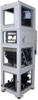
Utilizing proven germicidal UVC light for filter disinfection, the Model 300 UVC Room Air Cleaner provides additional safety precautions against microorganisms such as bacteria and viruses. The UVC Room Air Cleaner works by using a powerful fan to draw in airborne contaminants including dust, particulate, fumes, and microorganisms into the filtration chamber. The pre-filter removes larger sized airborne particles and the main filter (choice of HEPA or ULPA Filter) captures most of the remaining airborne contaminants before releasing the filtered air back into the surrounding room. The UVC light disinfection cycle uses a proven germicidal wavelength of 253.7 nm to remove bio-hazard accumulation on the HEPA or ULPA filter. The UVC light inactivates microorganisms by damaging or breaking the organisms DNA or RNA through a process called germicidal irradiation. This self-contained UVC filter disinfection process can only be operated in the system with the fan OFF and filter door closed. These multiple safety mechanisms help protect the operator from injuries from the misuse of the UVC light. The portability handle and heavy-duty casters allow this system to be moved to a different area as needed. This easy-to-install system is a simple and effective solution to help minimize airborne particulate in applications with microorganism concerns such as bacteria or viruses. Product Features:
Includes: Portability handle, heavy-duty casters, and Variable Speed Controller (115V only)
Quiet operation
Reliable, low maintenance operation
Energy efficient
Long filter life
Filter Choices:
ULPA [up to 99.9995% efficiency on particles 0.12 microns and larger]
HEPA [up to 99.97% efficiency on particles 0.3 microns and larger]
ASHRAE [up to 95% efficiency on particles 0.5 microns and larger]
Activated Carbon filters
Specialty-blended filtration media [i.e. acid gas, mercury, aldehyde, and ammonia].
Typical Uses:
Capturing dental aerosol
Capturing particulate from various medical procedures
Air filtration in laboratories, waiting rooms, doctors offices, salons, and hospitals
Other applications that require particulate removal with a concern for micro-organisms
Utilizing proven germicidal UVC light for filter disinfection, the Model 300 UVC Room Air Cleaner provides additional safety precautions against microorganisms such as bacteria and viruses. The UVC Room Air Cleaner works by using a powerful fan to draw in airborne contaminants including dust, particulate, fumes, and microorganisms into the filtration chamber. The pre-filter removes larger sized airborne particles and the main filter (choice of HEPA or ULPA Filter) captures most of the remaining airborne contaminants before releasing the filtered air back into the surrounding room.
The UVC light disinfection cycle uses a proven germicidal wavelength of 253.7 nm to remove bio-hazard accumulation on the HEPA or ULPA filter. The UVC light inactivates microorganisms by damaging or breaking the organism’s DNA or RNA through a process called germicidal irradiation. This self-contained UVC filter disinfection process can only be operated in the system with the fan OFF and filter door closed. These multiple safety mechanisms help protect the operator from injuries from the misuse of the UVC light.
The portability handle and heavy-duty casters allow this system to be moved to a different area as needed. This easy-to-install system is a simple and effective solution to help minimize airborne particulate in applications with microorganism concerns such as bacteria or viruses.
Product Features:
- Includes: Portability handle, heavy-duty casters, and Variable Speed Controller (115V only)
- Quiet operation
- Reliable, low maintenance operation
- Energy efficient
- Long filter life
Filter Choices:
- ULPA [up to 99.9995% efficiency on particles 0.12 microns and larger]
- HEPA [up to 99.97% efficiency on particles 0.3 microns and larger]
- ASHRAE [up to 95% efficiency on particles 0.5 microns and larger]
- Activated Carbon filters
- Specialty-blended filtration media [i.e. acid gas, mercury, aldehyde, and ammonia].
Typical Uses:
- Capturing dental aerosol
- Capturing particulate from various medical procedures
- Air filtration in laboratories, waiting rooms, doctor’s offices, salons, and hospitals
- Other applications that require particulate removal with a concern for micro-organisms