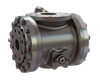
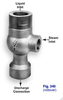
Direct Contact, High Capacity, Multi-Spray Steam Heater is suitable for very large quantities of hot water, a top vapor inlet is required, and steam pressure is atmospheric or above. Water is distributed peripherally to a series of converging spray nozzles which disperse the inlet water into very fine particles. Further dispersion is accomplished by a centrally placed deflection baffle. Steam enters at the top and passes through the water spray, condensing immediately and completely. The hot water is delivered to a tank through an outlet at the bottom of the heater. If internal pressure is below atmospheric pressure, a barometric leg, long enough to balance the pressure within the heater must be used to permit discharge of the hot water. The air vent prevents accumulation of non-condensables and balances the pressure of the heater.
Advantages
The Direct Contact, High Capacity, Multi-Spray Steam Heater is simple in design, having no moving parts. Heating is continuous and fast. Inspection and routine maintenance are greatly facilitated by conveniently placed access ports. Because of high heating efficiency, a relatively small, lightweight size can be used to deliver a large supply of heated liquid. Heat transfer in direct contact heaters is better than shell and tube heaters because heat transfer resistances like film, fouling, and wall, are not present. Since heat transfer is more effective, a small direct contact heater can be used thereby minimizing cost. Maintenance is low when compared with costly shutdowns needed to clean tube bundles, that act like strainers, when tube pitch is sacrificed for surface area in shell and tube heat exchangers.
Applications
Designed to prevent flooding, and to heat water close to the steam saturation temperature.
Heating large quantities of process water in oil refineries and chemical processing.
Used for mixing two process waters at different temperatures in power generating plants.
To heat H2 and SO4 with steam.
Heating of dimethyl amine with steam in chemical processing.
Used in the acid cleaning steam associated with boilers in power generation.
Heating of green liquor with steam in paper processing.
Direct Contact, High Capacity, Multi-Spray Steam Heater is suitable for very large quantities of hot water, a top vapor inlet is required, and steam pressure is atmospheric or above. Water is distributed peripherally to a series of converging spray nozzles which disperse the inlet water into very fine particles. Further dispersion is accomplished by a centrally placed deflection baffle. Steam enters at the top and passes through the water spray, condensing immediately and completely. The hot water is delivered to a tank through an outlet at the bottom of the heater. If internal pressure is below atmospheric pressure, a barometric leg, long enough to balance the pressure within the heater must be used to permit discharge of the hot water. The air vent prevents accumulation of non-condensables and balances the pressure of the heater.
Advantages
The Direct Contact, High Capacity, Multi-Spray Steam Heater is simple in design, having no moving parts. Heating is continuous and fast. Inspection and routine maintenance are greatly facilitated by conveniently placed access ports. Because of high heating efficiency, a relatively small, lightweight size can be used to deliver a large supply of heated liquid. Heat transfer in direct contact heaters is better than shell and tube heaters because heat transfer resistances like film, fouling, and wall, are not present. Since heat transfer is more effective, a small direct contact heater can be used thereby minimizing cost. Maintenance is low when compared with costly shutdowns needed to clean tube bundles, that act like strainers, when tube pitch is sacrificed for surface area in shell and tube heat exchangers.
Applications
- Designed to prevent flooding, and to heat water close to the steam saturation temperature.
- Heating large quantities of process water in oil refineries and chemical processing.
- Used for mixing two process waters at different temperatures in power generating plants.
- To heat H2 and SO4 with steam.
- Heating of dimethyl amine with steam in chemical processing.
- Used in the acid cleaning steam associated with boilers in power generation.
- Heating of green liquor with steam in paper processing.