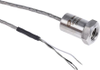
ROHM Semiconductor USA, LLC Tri-Axis, User Selectable ± 2g, 4g, 8g, Digital (I2C/SPI) Output, Integrated FIFO/FILO buffer, 3x3x0.9mm LGA KX124-1050

Description
The KX124-1050 is a tri-axis +/-2g, +/-4g or +/-8g silicon micromachined accelerometer with integrated 2048 byte buffer, orientation, tap/double tap, activity detecting, and Free fall algorithms. The sense element is fabricated using Kionix’s proprietary plasma micromachining process technology. Acceleration sensing is based on the principle of a differential capacitance arising from acceleration-induced motion of the sense element, which further utilizes common mode cancellation to decrease errors from process variation, temperature, and environmental stress. The sense element is hermetically sealed at the wafer level by bonding a second silicon lid wafer to the device using a glass frit. A separate ASIC device packaged with the sense element provides signal conditioning, and intelligent user-programmable application algorithms. The accelerometer is delivered in a 3 x 3 x 0.9 mm LGA plastic package operating from a 1.71 – 3.6V DC supply. Voltage regulators are used to maintain constant internal operating voltages over the range of input supply voltages. This results in stable operating characteristics over the range of input supply voltages. I2C or SPI digital protocol is used to communicate with the chip to configure and check for updates to the orientation, Directional TapTM detection, Free fall detection and activity monitoring algorithms. With user-selectable I2C address assignment, as many as 4 accelerometers can be placed on the same I2C serial bus when two KX124-1051 accelerometers are used in conjunction with two KX124-1050 accelerometers.
Description
The KX124-1050 is a tri-axis +/-2g, +/-4g or +/-8g silicon micromachined accelerometer with integrated 2048 byte buffer, orientation, tap/double tap, activity detecting, and Free fall algorithms. The sense element is fabricated using Kionix’s proprietary plasma micromachining process technology. Acceleration sensing is based on the principle of a differential capacitance arising from acceleration-induced motion of the sense element, which further utilizes common mode cancellation to decrease errors from process variation, temperature, and environmental stress. The sense element is hermetically sealed at the wafer level by bonding a second silicon lid wafer to the device using a glass frit. A separate ASIC device packaged with the sense element provides signal conditioning, and intelligent user-programmable application algorithms. The accelerometer is delivered in a 3 x 3 x 0.9 mm LGA plastic package operating from a 1.71 – 3.6V DC supply. Voltage regulators are used to maintain constant internal operating voltages over the range of input supply voltages. This results in stable operating characteristics over the range of input supply voltages. I2C or SPI digital protocol is used to communicate with the chip to configure and check for updates to the orientation, Directional TapTM detection, Free fall detection and activity monitoring algorithms. With user-selectable I2C address assignment, as many as 4 accelerometers can be placed on the same I2C serial bus when two KX124-1051 accelerometers are used in conjunction with two KX124-1050 accelerometers.

Suppliers

Company
Product
Description
Supplier Links
Tri-Axis, User Selectable ± 2g, 4g, 8g, Digital (I2C/SPI) Output, Integrated FIFO/FILO buffer, 3x3x0.9mm LGA - KX124-1050 - ROHM Semiconductor USA, LLC
Santa Clara, CA, USA
Tri-Axis, User Selectable ± 2g, 4g, 8g, Digital (I2C/SPI) Output, Integrated FIFO/FILO buffer, 3x3x0.9mm LGA
KX124-1050
Tri-Axis, User Selectable ± 2g, 4g, 8g, Digital (I2C/SPI) Output, Integrated FIFO/FILO buffer, 3x3x0.9mm LGA KX124-1050
The KX124-1050 is a tri-axis +/-2g, +/-4g or +/-8g silicon micromachined accelerometer with integrated 2048 byte buffer, orientation, tap/double tap, activity detecting, and Free fall algorithms. The sense element is fabricated using Kionix’s proprietary plasma micromachining process technology. Acceleration sensing is based on the principle of a differential capacitance arising from acceleration-induced motion of the sense element, which further utilizes common mode cancellation to decrease errors from process variation, temperature, and environmental stress. The sense element is hermetically sealed at the wafer level by bonding a second silicon lid wafer to the device using a glass frit. A separate ASIC device packaged with the sense element provides signal conditioning, and intelligent user-programmable application algorithms. The accelerometer is delivered in a 3 x 3 x 0.9 mm LGA plastic package operating from a 1.71 – 3.6V DC supply. Voltage regulators are used to maintain constant internal operating voltages over the range of input supply voltages. This results in stable operating characteristics over the range of input supply voltages. I2C or SPI digital protocol is used to communicate with the chip to configure and check for updates to the orientation, Directional TapTM detection, Free fall detection and activity monitoring algorithms. With user-selectable I2C address assignment, as many as 4 accelerometers can be placed on the same I2C serial bus when two KX124-1051 accelerometers are used in conjunction with two KX124-1050 accelerometers.
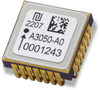
The KX124-1050 is a tri-axis +/-2g, +/-4g or +/-8g silicon micromachined accelerometer with integrated 2048 byte buffer, orientation, tap/double tap, activity detecting, and Free fall algorithms. The sense element is fabricated using Kionix’s proprietary plasma micromachining process technology. Acceleration sensing is based on the principle of a differential capacitance arising from acceleration-induced motion of the sense element, which further utilizes common mode cancellation to decrease errors from process variation, temperature, and environmental stress. The sense element is hermetically sealed at the wafer level by bonding a second silicon lid wafer to the device using a glass frit. A separate ASIC device packaged with the sense element provides signal conditioning, and intelligent user-programmable application algorithms. The accelerometer is delivered in a 3 x 3 x 0.9 mm LGA plastic package operating from a 1.71 – 3.6V DC supply. Voltage regulators are used to maintain constant internal operating voltages over the range of input supply voltages. This results in stable operating characteristics over the range of input supply voltages. I2C or SPI digital protocol is used to communicate with the chip to configure and check for updates to the orientation, Directional TapTM detection, Free fall detection and activity monitoring algorithms. With user-selectable I2C address assignment, as many as 4 accelerometers can be placed on the same I2C serial bus when two KX124-1051 accelerometers are used in conjunction with two KX124-1050 accelerometers.
Supplier's Site

Technical Specifications

  ROHM Semiconductor USA, LLC
Product Category Accelerometers
Product Number KX124-1050
Product Name Tri-Axis, User Selectable ± 2g, 4g, 8g, Digital (I2C/SPI) Output, Integrated FIFO/FILO buffer, 3x3x0.9mm LGA
Measurement Axes Triaxial
Unlock Full Specs
to access all available technical data

Similar Products

High Performance ±5 g Digital MEMS Accelerometer - AXO®305 - Tronics Microsystems
Specs
Measurement Axes Single
Sensor Technology MEMS
Device Category Sensor / Transducer
View Details
Accelerometer Input Module - SCM5B48-02 - Dataforth Corporation
Specs
Sensor Technology Piezoelectric
Device Category Transmitter
Sensor Outputs Acceleration
View Details
General Purpose Accelerometer - 3100D24 - Hottinger Brüel & Kjær A/S
Hottinger Brüel & Kjær A/S
Specs
Measurement Axes Single
Sensor Technology Piezoelectric; Piezoelectric CCLD (IEPE)
Sensor Mounting Stud/Bolt; Stud mounting
View Details