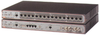
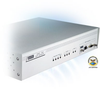
RAD Data Communications, Inc.Multiservice PDH Fiber MultiplexerOptimux-XLE1/XLT1
Description
FEATURES
Optimux-XLE1 provides a simple, flexible and cost-effective solution for transporting multiple E1 links and Ethernet at distances up to 110 km (69 miles). Two versions of the multiplexer are available: modular and non-modular.
Modular Version
The modular version of the Optimux-XLE1 integrates up to 12 E1 channels or up to four Ethernet LANs over a single E3 link. This provides an easily upgradable solution, flexible enough to meet the specific requirements of a broad range of applications.
The modular version supports one fixed 10BaseT Ethernet port and three additional plug-in channel modules. Available channel modules are:
Dual channel E1
Quad channel E1
10BaseT Ethernet.
Modules can be combined in various ways, ranging from four Ethernet ports to a single Ethernet port with up to 12 E1 channels.
Non-Modular Version
The non-modular version supports 16 E1 channels, and is designed for applications requiring the full E3 bandwidth for multiple E1 connectivity.
General
Various optical interfaces are available:
850 nm for multimode fiber
1300 nm for single or multi mode fiber
1300 nm and 1550 nm laser diode, long haul laser or WDM laser for extended range over single mode fiber
Two Optimux-XLE1 units can be connected over a single fiber (SF) using the WDM technology. (The transmit signal is at a different wavelength than the receive signal.)
All critical components can be automatically backed up. This ensures there is no single point of failure. An optional second link provides backup, using automatic switch-over upon link failure. An optional second power supply provides power redundancy and fail-safe operation.
Ethernet data is transmitted using a built-in bridging function. The bridge operates at "almost wire-speed" (8.4 Mbps) and supports up to 10,000 addresses.
Optimux-XLE1 transmits each of the E1 channels independently, such that the clock of each E1 channel is independent. The E1 interface can be 75( unbalanced or 120( balanced.
A single station clock module can be ordered to facilitate external clocking.
To facilitate system diagnostics, Optimux-XLE1 features LED status indicators, AIS alarm generation, recognition and dry contact closure upon link failure. In addition, the Optimux-XLE1 setup, control and diagnostics can be performed via:
A supervisory port using an ASCII terminal
An SNMP management station via the Ethernet ports
A dedicated separate Ethernet management port.
The SNMP management application offers the following options:
RADview-PC/TDM running in a Windows environment; or
RADview-HPOV/TDM for UNIX platforms.
Optimux-XLE1 is available as a compact 1U high unit for mounting in a 19" rack.
It is possible to add a redundant link to an existing unit or to replace the link modules by ordering E3 coax, multimode, or single mode AMC-101 modules.
Integrates multiple E1 and Ethernet links over a single cable
E3 transmission over coax or fiber optic cable
Supports multimode fiber, single mode fiber and single mode over single fiber (WDM)
Laser diode option
Range up to 110 km (69 miles)
Conforms to ITU G.703, G.742, G.751, G.823, G.956
Optional second E3 link provides automatic backup
Station clock module for external clock
Optional redundant power supply
Management using ASCII terminal or SNMP management station
Compact, 1U high enclosure
Data Connect Enterprise, Inc.
Done
Description
FEATURES
Optimux-XLE1 provides a simple, flexible and cost-effective solution for transporting multiple E1 links and Ethernet at distances up to 110 km (69 miles). Two versions of the multiplexer are available: modular and non-modular.
Modular Version
The modular version of the Optimux-XLE1 integrates up to 12 E1 channels or up to four Ethernet LANs over a single E3 link. This provides an easily upgradable solution, flexible enough to meet the specific requirements of a broad range of applications.
The modular version supports one fixed 10BaseT Ethernet port and three additional plug-in channel modules. Available channel modules are:
Dual channel E1
Quad channel E1
10BaseT Ethernet.
Modules can be combined in various ways, ranging from four Ethernet ports to a single Ethernet port with up to 12 E1 channels.
Non-Modular Version
The non-modular version supports 16 E1 channels, and is designed for applications requiring the full E3 bandwidth for multiple E1 connectivity.
General
Various optical interfaces are available:
850 nm for multimode fiber
1300 nm for single or multi mode fiber
1300 nm and 1550 nm laser diode, long haul laser or WDM laser for extended range over single mode fiber
Two Optimux-XLE1 units can be connected over a single fiber (SF) using the WDM technology. (The transmit signal is at a different wavelength than the receive signal.)
All critical components can be automatically backed up. This ensures there is no single point of failure. An optional second link provides backup, using automatic switch-over upon link failure. An optional second power supply provides power redundancy and fail-safe operation.
Ethernet data is transmitted using a built-in bridging function. The bridge operates at "almost wire-speed" (8.4 Mbps) and supports up to 10,000 addresses.
Optimux-XLE1 transmits each of the E1 channels independently, such that the clock of each E1 channel is independent. The E1 interface can be 75( unbalanced or 120( balanced.
A single station clock module can be ordered to facilitate external clocking.
To facilitate system diagnostics, Optimux-XLE1 features LED status indicators, AIS alarm generation, recognition and dry contact closure upon link failure. In addition, the Optimux-XLE1 setup, control and diagnostics can be performed via:
A supervisory port using an ASCII terminal
An SNMP management station via the Ethernet ports
A dedicated separate Ethernet management port.
The SNMP management application offers the following options:
RADview-PC/TDM running in a Windows environment; or
RADview-HPOV/TDM for UNIX platforms.
Optimux-XLE1 is available as a compact 1U high unit for mounting in a 19" rack.
It is possible to add a redundant link to an existing unit or to replace the link modules by ordering E3 coax, multimode, or single mode AMC-101 modules.
Integrates multiple E1 and Ethernet links over a single cable
E3 transmission over coax or fiber optic cable
Supports multimode fiber, single mode fiber and single mode over single fiber (WDM)
Laser diode option
Range up to 110 km (69 miles)
Conforms to ITU G.703, G.742, G.751, G.823, G.956
Optional second E3 link provides automatic backup
Station clock module for external clock
Optional redundant power supply
Management using ASCII terminal or SNMP management station
Compact, 1U high enclosure
FEATURES
Optimux-XLE1 provides a simple, flexible and cost-effective solution for transporting multiple E1 links and Ethernet at distances up to 110 km (69 miles). Two versions of the multiplexer are available: modular and non-modular.
Modular Version
The modular version of the Optimux-XLE1 integrates up to 12 E1 channels or up to four Ethernet LANs over a single E3 link. This provides an easily upgradable solution, flexible enough to meet the specific requirements of a broad range of applications.
The modular version supports one fixed 10BaseT Ethernet port and three additional plug-in channel modules. Available channel modules are:
Dual channel E1
Quad channel E1
10BaseT Ethernet.
Modules can be combined in various ways, ranging from four Ethernet ports to a single Ethernet port with up to 12 E1 channels.
Non-Modular Version
The non-modular version supports 16 E1 channels, and is designed for applications requiring the full E3 bandwidth for multiple E1 connectivity.
General
Various optical interfaces are available:
850 nm for multimode fiber
1300 nm for single or multi mode fiber
1300 nm and 1550 nm laser diode, long haul laser or WDM laser for extended range over single mode fiber
Two Optimux-XLE1 units can be connected over a single fiber (SF) using the WDM technology. (The transmit signal is at a different wavelength than the receive signal.)
All critical components can be automatically backed up. This ensures there is no single point of failure. An optional second link provides backup, using automatic switch-over upon link failure. An optional second power supply provides power redundancy and fail-safe operation.
Ethernet data is transmitted using a built-in bridging function. The bridge operates at "almost wire-speed" (8.4 Mbps) and supports up to 10,000 addresses.
Optimux-XLE1 transmits each of the E1 channels independently, such that the clock of each E1 channel is independent. The E1 interface can be 75( unbalanced or 120( balanced.
A single station clock module can be ordered to facilitate external clocking.
To facilitate system diagnostics, Optimux-XLE1 features LED status indicators, AIS alarm generation, recognition and dry contact closure upon link failure. In addition, the Optimux-XLE1 setup, control and diagnostics can be performed via:
A supervisory port using an ASCII terminal
An SNMP management station via the Ethernet ports
A dedicated separate Ethernet management port.
The SNMP management application offers the following options:
RADview-PC/TDM running in a Windows environment; or
RADview-HPOV/TDM for UNIX platforms.
Optimux-XLE1 is available as a compact 1U high unit for mounting in a 19" rack.
It is possible to add a redundant link to an existing unit or to replace the link modules by ordering E3 coax, multimode, or single mode AMC-101 modules.
Integrates multiple E1 and Ethernet links over a single cable
E3 transmission over coax or fiber optic cable
Supports multimode fiber, single mode fiber and single mode over single fiber (WDM)
Laser diode option
Range up to 110 km (69 miles)
Conforms to ITU G.703, G.742, G.751, G.823, G.956
Optional second E3 link provides automatic backup
Station clock module for external clock
Optional redundant power supply
Management using ASCII terminal or SNMP management station
Compact, 1U high enclosure
FEATURES
Optimux-XLE1 provides a simple, flexible and cost-effective solution for transporting multiple E1 links and Ethernet at distances up to 110 km (69 miles). Two versions of the multiplexer are available: modular and non-modular.
Modular Version
The modular version of the Optimux-XLE1 integrates up to 12 E1 channels or up to four Ethernet LANs over a single E3 link. This provides an easily upgradable solution, flexible enough to meet the specific requirements of a broad range of applications.
The modular version supports one fixed 10BaseT Ethernet port and three additional plug-in channel modules. Available channel modules are:
Dual channel E1
Quad channel E1
10BaseT Ethernet.
Modules can be combined in various ways, ranging from four Ethernet ports to a single Ethernet port with up to 12 E1 channels.
Non-Modular Version
The non-modular version supports 16 E1 channels, and is designed for applications requiring the full E3 bandwidth for multiple E1 connectivity.
General
Various optical interfaces are available:
850 nm for multimode fiber
1300 nm for single or multi mode fiber
1300 nm and 1550 nm laser diode, long haul laser or WDM laser for extended range over single mode fiber
Two Optimux-XLE1 units can be connected over a single fiber (SF) using the WDM technology. (The transmit signal is at a different wavelength than the receive signal.)
All critical components can be automatically backed up. This ensures there is no single point of failure. An optional second link provides backup, using automatic switch-over upon link failure. An optional second power supply provides power redundancy and fail-safe operation.
Ethernet data is transmitted using a built-in bridging function. The bridge operates at "almost wire-speed" (8.4 Mbps) and supports up to 10,000 addresses.
Optimux-XLE1 transmits each of the E1 channels independently, such that the clock of each E1 channel is independent. The E1 interface can be 75( unbalanced or 120( balanced.
A single station clock module can be ordered to facilitate external clocking.
To facilitate system diagnostics, Optimux-XLE1 features LED status indicators, AIS alarm generation, recognition and dry contact closure upon link failure. In addition, the Optimux-XLE1 setup, control and diagnostics can be performed via:
A supervisory port using an ASCII terminal
An SNMP management station via the Ethernet ports
A dedicated separate Ethernet management port.
The SNMP management application offers the following options:
RADview-PC/TDM running in a Windows environment; or
RADview-HPOV/TDM for UNIX platforms.
Optimux-XLE1 is available as a compact 1U high unit for mounting in a 19" rack.
It is possible to add a redundant link to an existing unit or to replace the link modules by ordering E3 coax, multimode, or single mode AMC-101 modules.
Integrates multiple E1 and Ethernet links over a single cable
E3 transmission over coax or fiber optic cable
Supports multimode fiber, single mode fiber and single mode over single fiber (WDM)
Laser diode option
Range up to 110 km (69 miles)
Conforms to ITU G.703, G.742, G.751, G.823, G.956
Optional second E3 link provides automatic backup
Station clock module for external clock
Optional redundant power supply
Management using ASCII terminal or SNMP management station