Features
230 mV Pulse Amplitude
20 ps to 25 ps Transition Time
Adjustable Delay
Low Jitter of 2.1 ps RMS
Long duration of 4 us Applications
High-Speed Pulse Testing
TDR and TDT Measurements
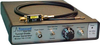
EMP, EMI, and EMC Testing The Picosecond Advantage: The Model TD1107C Tunnel Diode Pulse Head and the TD1110D Tunnel Diode Pulse Driver work together as a system to produce high speed pulses.Description: The Model TD1107C Tunnel Diode Pulse Head produces a step with an extremely fast edge. The output pulse amplitude is 230 mV into 50 Ohm. A 50 Ohm generator source impedance minimizes reflections. The use of a remote TD pulse head allows the pulse to be generated directly at the point of connection to the circuit under test. This eliminates the necessity of interconnecting coaxial cables which always slows down fast risetime pulses. The TD1110D, Tunnel Diode Driver, provides the DC bias and trigger signal to the TD Pulse Head. It also produces a Trigger Output pulse in advance of the drive output pulse to the TD pulse head. A fixed 65 ns delay results in a low jitter and thermal drift of typically 2.1 ps and 1.5 ps/C, respectively. An adjustable 40 ns – 140 ns delay is also provided. A special automatic, self-regulating TD bias current circuit is used. It senses the peak current of the particular TD head in use and then sets the bias to the correct level. The automatic circuit is thus able to track and correct for changes in temperature and TD loads. The TD1107C and TD1110D must be ordered as a set.
Picosecond Pulse Labs, Inc.
Done
Description
Features
230 mV Pulse Amplitude
20 ps to 25 ps Transition Time
Adjustable Delay
Low Jitter of 2.1 ps RMS
Long duration of 4 us Applications
High-Speed Pulse Testing
TDR and TDT Measurements
EMP, EMI, and EMC Testing The Picosecond Advantage: The Model TD1107C Tunnel Diode Pulse Head and the TD1110D Tunnel Diode Pulse Driver work together as a system to produce high speed pulses.Description: The Model TD1107C Tunnel Diode Pulse Head produces a step with an extremely fast edge. The output pulse amplitude is 230 mV into 50 Ohm. A 50 Ohm generator source impedance minimizes reflections. The use of a remote TD pulse head allows the pulse to be generated directly at the point of connection to the circuit under test. This eliminates the necessity of interconnecting coaxial cables which always slows down fast risetime pulses. The TD1110D, Tunnel Diode Driver, provides the DC bias and trigger signal to the TD Pulse Head. It also produces a Trigger Output pulse in advance of the drive output pulse to the TD pulse head. A fixed 65 ns delay results in a low jitter and thermal drift of typically 2.1 ps and 1.5 ps/C, respectively. An adjustable 40 ns – 140 ns delay is also provided. A special automatic, self-regulating TD bias current circuit is used. It senses the peak current of the particular TD head in use and then sets the bias to the correct level. The automatic circuit is thus able to track and correct for changes in temperature and TD loads. The TD1107C and TD1110D must be ordered as a set.
Features
230 mV Pulse Amplitude
20 ps to 25 ps Transition Time
Adjustable Delay
Low Jitter of 2.1 ps RMS
Long duration of 4 us Applications
High-Speed Pulse Testing
TDR and TDT Measurements
EMP, EMI, and EMC Testing The Picosecond Advantage:
The Model TD1107C Tunnel Diode Pulse Head and the TD1110D Tunnel Diode Pulse Driver work together as a system to produce high speed pulses.Description:
The Model TD1107C Tunnel Diode Pulse Head produces a step with an extremely fast edge. The output pulse amplitude is 230 mV into 50 Ohm. A 50 Ohm generator source impedance minimizes reflections. The use of a remote TD pulse head allows the pulse to be generated directly at the point of connection to the circuit under test. This eliminates the necessity of interconnecting coaxial cables which always slows down fast risetime pulses. The TD1110D, Tunnel Diode Driver, provides the DC bias and trigger signal to the TD Pulse Head. It also produces a Trigger Output pulse in advance of the drive output pulse to the TD pulse head. A fixed 65 ns delay results in a low jitter and thermal drift of typically 2.1 ps and 1.5 ps/C, respectively. An adjustable 40 ns – 140 ns delay is also provided. A special automatic, self-regulating TD bias current circuit is used. It senses the peak current of the particular TD head in use and then sets the bias to the correct level. The automatic circuit is thus able to track and correct for changes in temperature and TD loads. The TD1107C and TD1110D must be ordered as a set.