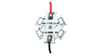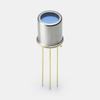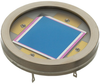
OSI Optoelectronics Tetra-Lateral Positions Sensing Detector SC-50D

Description
Tetra-lateral position sensing detectors are manufactured with one single resistive layer for both one and two dimensional measurements. They feature a common anode and two cathodes for one dimensional position sensing or four cathodes for two dimensional position sensing. These detectors are best when used in applications that require measurement over a wide spatial range. They offer high response uniformity, low dark current, and good position linearity over 64% of the sensing area. A reverse bias should be applied to these detectors to achieve optimum current linearity when large light signals are present. The circuit on the opposite page represents a typical circuit set up for two dimensional tetra-lateral PSDs. For further details as well as the set up for one dimensional PSDs refer t the "Photodiode Characteristics" section of the catalog. Note that the maximum recommended incident power density is 10 mW / cm2. Furthermore, typical uniformity of response for a 1 mm ? spot size is ± 5% for SC-25D and SC-50D and ± 2% for all other tetra-lateral devices.
Datasheet
Description
Tetra-lateral position sensing detectors are manufactured with one single resistive layer for both one and two dimensional measurements. They feature a common anode and two cathodes for one dimensional position sensing or four cathodes for two dimensional position sensing. These detectors are best when used in applications that require measurement over a wide spatial range. They offer high response uniformity, low dark current, and good position linearity over 64% of the sensing area. A reverse bias should be applied to these detectors to achieve optimum current linearity when large light signals are present. The circuit on the opposite page represents a typical circuit set up for two dimensional tetra-lateral PSDs. For further details as well as the set up for one dimensional PSDs refer t the "Photodiode Characteristics" section of the catalog. Note that the maximum recommended incident power density is 10 mW / cm2. Furthermore, typical uniformity of response for a 1 mm ? spot size is ± 5% for SC-25D and SC-50D and ± 2% for all other tetra-lateral devices.
Datasheet

Suppliers

Company
Product
Description
Supplier Links
Tetra-Lateral Positions Sensing Detector - SC-50D - OSI Optoelectronics
Hawthorne, CA, United States
Tetra-Lateral Positions Sensing Detector
SC-50D
Tetra-Lateral Positions Sensing Detector SC-50D
Tetra-lateral position sensing detectors are manufactured with one single resistive layer for both one and two dimensional measurements. They feature a common anode and two cathodes for one dimensional position sensing or four cathodes for two dimensional position sensing. These detectors are best when used in applications that require measurement over a wide spatial range. They offer high response uniformity, low dark current, and good position linearity over 64% of the sensing area. A reverse bias should be applied to these detectors to achieve optimum current linearity when large light signals are present. The circuit on the opposite page represents a typical circuit set up for two dimensional tetra-lateral PSDs. For further details as well as the set up for one dimensional PSDs refer t the "Photodiode Characteristics" section of the catalog. Note that the maximum recommended incident power density is 10 mW / cm2. Furthermore, typical uniformity of response for a 1 mm ? spot size is ± 5% for SC-25D and SC-50D and ± 2% for all other tetra-lateral devices.

Tetra-lateral position sensing detectors are manufactured with one single resistive layer for both one and two dimensional measurements. They feature a common anode and two cathodes for one dimensional position sensing or four cathodes for two dimensional position sensing. These detectors are best when used in applications that require measurement over a wide spatial range. They offer high response uniformity, low dark current, and good position linearity over 64% of the sensing area. A reverse bias should be applied to these detectors to achieve optimum current linearity when large light signals are present. The circuit on the opposite page represents a typical circuit set up for two dimensional tetra-lateral PSDs. For further details as well as the set up for one dimensional PSDs refer t the "Photodiode Characteristics" section of the catalog. Note that the maximum recommended incident power density is 10 mW / cm2. Furthermore, typical uniformity of response for a 1 mm ? spot size is ± 5% for SC-25D and SC-50D and ± 2% for all other tetra-lateral devices.

Supplier's Site Datasheet

Technical Specifications

  OSI Optoelectronics
Product Category Photodiodes
Product Number SC-50D
Product Name Tetra-Lateral Positions Sensing Detector
Photodiode Type PIN Photodiode
Photodiode Spectral Response Visible; IR
Spectral Response Range 350 to 1100 nm (3500 to 11000 Å)
Photodiode Material Silicon
Photodiode Package 21 / Special
Unlock Full Specs
to access all available technical data

Similar Products

Photodiodes - 2121833 - RS Components, Ltd.
RS Components, Ltd.
Specs
Photodiode Spectral Response IR
Peak Sensitivity Wavelength 5000 nm (50000 Å)
Photodiode Package Ceramic
View Details
Si photodiodes - S15137 - Hamamatsu Photonics Europe
Hamamatsu Photonics Europe
Specs
Photodiode Type PIN Photodiode
Photodiode Spectral Response Visible; IR
Spectral Response Range 360 to 1120 nm (3600 to 11200 Å)
View Details
Integrating Sphere Detector, Collimated Beam, 5.3 in., 860-1650 nm - 819C-IG-5.3-CAL2 - Newport MKS
Specs
Spectral Response Range 800 to 1650 nm (8000 to 16500 Å)
View Details
California Eastern Laboratories - CEL
Specs
Photodiode Type Avalanche Photodiode
Photodiode Spectral Response IR
Spectral Response Range 1310 nm (13100 Å)
View Details