Cambridge Technology, Inc. Laser Scan Mirrors

Description
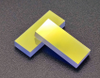
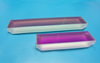
The Galvo motor selection begins with the component that is closest to your application, the mirror. Considerations such as wavelength, power, beam diameter and spot size will dictate the best mirror for your application. Low inertia is essential for beam-steering mirrors to attain the highest accelerations, while high stiffness is needed to achieve adequate servo bandwidth. The reality, however, is that a balance must be struck between the two. That means selecting the best alternative from a large array of mirror designs, or creating a custom mirror that matches your performance requirements.
Datasheet
Description
The Galvo motor selection begins with the component that is closest to your application, the mirror. Considerations such as wavelength, power, beam diameter and spot size will dictate the best mirror for your application. Low inertia is essential for beam-steering mirrors to attain the highest accelerations, while high stiffness is needed to achieve adequate servo bandwidth. The reality, however, is that a balance must be struck between the two. That means selecting the best alternative from a large array of mirror designs, or creating a custom mirror that matches your performance requirements.
Datasheet

Suppliers

Company
Product
Description
Supplier Links
Laser Scan Mirrors -  - Cambridge Technology, Inc.
Bedford, MA, USA
Laser Scan Mirrors
Laser Scan Mirrors
The Galvo motor selection begins with the component that is closest to your application, the mirror. Considerations such as wavelength, power, beam diameter and spot size will dictate the best mirror for your application. Low inertia is essential for beam-steering mirrors to attain the highest accelerations, while high stiffness is needed to achieve adequate servo bandwidth. The reality, however, is that a balance must be struck between the two. That means selecting the best alternative from a large array of mirror designs, or creating a custom mirror that matches your performance requirements.

The Galvo motor selection begins with the component that is closest to your application, the mirror.

Considerations such as wavelength, power, beam diameter and spot size will dictate the best mirror for your application. Low inertia is essential for beam-steering mirrors to attain the highest accelerations, while high stiffness is needed to achieve adequate servo bandwidth. The reality, however, is that a balance must be struck between the two. That means selecting the best alternative from a large array of mirror designs, or creating a custom mirror that matches your performance requirements.

Supplier's Site Datasheet

Technical Specifications

  Cambridge Technology, Inc.
Product Category Optical Mirrors
Product Name Laser Scan Mirrors
Mirror Types Flat Mirror
Unlock Full Specs
to access all available technical data

Similar Products

Optical Dielectric HR Mirrors -  - Changchun Yutai Optics Co., Ltd.
Changchun Yutai Optics Co., Ltd.
Specs
Mirror Types Flat Mirror; Spherical Mirror
Mirror Shape Round; Rectangular / Square; Elliptical
Mirror Materials Fused Silica; H-K9L or fused silica
View Details
Fold Mirror -  - Zygo Corporation
Zygo Corporation
Specs
Mirror Materials Fused Silica; Zerodur
View Details
Corner Cube Retro-Reflector - OT 853 - ORAFOL Fresnel Optics GmbH
ORAFOL Fresnel Optics GmbH
Specs
Mirror Types Reflector
Clear Aperture 226 mm (8.88 inch)
View Details
Ultrafast Flat Mirror, 25.4 mm Dia., 700-930 nm - 10Q00UF.25 - Newport MKS
Specs
Wavelength Range 700 to 930 nm (7000 to 9300 Å)
Diameter/Width 25.4 mm (1 inch)
Thickness 3 mm (0.1181 inch)
View Details