Description
Additional Properties
Hydrolytic Sensitivity 4: no reaction with water under neutral conditions Application Review of synthetic utility.1 Modifier for Pt-catalyst in 2-component RTVs.2 Core molecule for dendrimers.3 Excellent and inexpensive reagent for vinylations in cross-coupling reactions for the formation of styrenes and dienes.4,5,6 Extensive review on the use in silicon-based cross-coupling reactions.7 Reference 1. Handbook of Reagents for Organic Synthesis, Reagents for Silicon-Mediated Organic Synthesis, Fuchs, P. L. Ed., John Wiley and Sons, Ltd., 2011, p. 484-487. 2. Kim, C. et al. Bull. Kor. Chem. Soc. 1997, 18, 164. 3. Broadbridge, R. et al. J. Chem. Soc., Chem. Commun. 1998, 1449. 4. Denmark, S. E.; Butler, C. R. Org. Lett. 2006, 8, 63. 5. Denmark, S. E.; Wang, Z. J. Organomet. Chem. 2001, 624, 372. 6. Denmark, S. E.; Wehrli, D. Org. Lett. 2000, 2, 565. 7. Denmark, S. E. et al. Organic Reactions, Vol. 75, Denmark, S. E. ed., John Wiley and Sons, 233, 2011. Safety
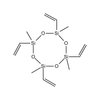
Packaging Under Nitrogen Alkenylsilane Cross-Coupling Agent The cross-coupling reaction is a highly useful methodology for the formation of carbon-carbon bonds. It involves two reagents, with one typically being a suitable organometallic reagent - the nucleophile - and the other a suitable organic substrate, normally an unsaturated halide, tosylate or similar - the electrophile. 1,3,5,7-Tetravinyl-1
,3,5,7-tetramethylcy
clotetrasiloxane; Methylvinylcyclosilo
xane; Tetramethyltetraviny
lcyclotetrasiloxane; Tetramethyltetraethe
nylcyclotetrasiloxan
e
Viscosity: 3.9 cSt
Excellent and inexpensive reagent for vinylations in cross-coupling reactions for the formation of styrenes and dienes
Undergoes ring-opening polymerization
Modifier for Pt-catalyst in 2-component RTVs
Core molecule for dendrimers
Extensive review of silicon based cross-coupling agents: Denmark, S. E. et al. "Organic Reactions, Volume 75" Denmark, S. E. ed., John Wiley and Sons, 233, 2011