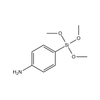
Description
Additional Properties
Hydrolytic Sensitivity 7: reacts slowly with moisture/water Application Coupler for silica-poly(phenylen
eterephthalamide) composite films.1 Together with phenyltrimethoxysila
ne, SIP6822.0, can be used to increase the dispersibility of mesoporous silica.2 Reference 1. Mark, J. et al. J. Mater. Chem. 1997, 7, 259. 2. Banet, P. et al. Langmuir 2008, 24, 9030. Safety
Packaging Under Nitrogen Monoamino Functional Trialkoxy Silane Silane coupling agents have the ability to form a durable bond between organic and inorganic materials to generate desired heterogeneous environments or to incorporate the bulk properties of different phases into a uniform composite structure. The general formula has two classes of functionality. The hydrolyzable group forms stable condensation products with siliceous surfaces and other oxides such as those of aluminum, zirconium, tin, titanium, and nickel. The organofunctional group alters the wetting or adhesion characteristics of the substrate, utilizes the substrate to catalyze chemical transformations at the heterogeneous interface, orders the interfacial region, or modifies its partition characteristics, and significantly effects the covalent bond between organic and inorganic materials. Arylsilane Cross-Coupling Agent The cross-coupling reaction is a highly useful methodology for the formation of carbon-carbon bonds. It involves two reagents, with one typically being a suitable organometallic reagent - the nucleophile - and the other a suitable organic substrate, normally an unsaturated halide, tosylate or similar - the electrophile. p-Aminophenyltrimeth
oxysilane; 4-(Trimethoxysilyl)a
niline; 4-(Trimethoxysilyl)b
enzenamine
Primary amine coupling agent for silica-poly(phenylen
eterephthalamide) composite films
Used with phenyltrimethoxysila
ne, SIP6822.0 , to increase the dispersibility of mesoporous silica
Contains other isomers
Coupler for silica-poly(phenylen
eterephthalamide) composite films
Couples without fluoride in aqueous medium
Used in microparticle surface modification
Determined by TGA a 25% weight loss of dried hydrolysates at 485 °C
Extensive review of silicon based cross-coupling agents: Denmark, S. E. et al. "Organic Reactions, Volume 75" Denmark, S. E. ed., John Wiley and Sons, 233, 2011