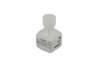
Claisse, Inc. Oxidizers and Non-Wetting Agents C-0710-00

Description
Fusion is an extremely effective method when preparing oxides, cement, carbonates, ceramic, slag, glass, silica, sulfides, bauxite, fluorides, polymers, catalysts, pure metals, ferroalloys, mining and geological samples for analysis by XRF, AA and ICP. Fusion does not consist of heating the sample to its melting temperature, but rather having the oxidized samples dissolved into a solvent, generally a lithium borate flux. Therefore, the temperature required for preparing all samples should be slightly higher than the melting temperature of the flux but not exceed 1050 °C. Lithium metaborate (LiBO2, m.p. 850°C) reacts with acidic oxides, e.g. SiO2, and lithium tetraborate (Li2B4O7, m.p. 920°C) reacts with basic oxides, e.g. CaO. In practice, a flux is composed of various proportions of these two salts. Recent research has shown that it is easier to make a glass disk when the appropriate flux composition is selected: this avoids crystallization, considerably reduces the incidence of glass sticking to the platinum mold and disks cracking and finally, produces homogenous and stable glass disks. For solutions, lithium metaborate is the best flux for preparing practically all types of samples as it crystallizes faster during cooling, therefore allowing the melt to dissolve easier in diluted acid.
Description
Fusion is an extremely effective method when preparing oxides, cement, carbonates, ceramic, slag, glass, silica, sulfides, bauxite, fluorides, polymers, catalysts, pure metals, ferroalloys, mining and geological samples for analysis by XRF, AA and ICP. Fusion does not consist of heating the sample to its melting temperature, but rather having the oxidized samples dissolved into a solvent, generally a lithium borate flux. Therefore, the temperature required for preparing all samples should be slightly higher than the melting temperature of the flux but not exceed 1050 °C. Lithium metaborate (LiBO2, m.p. 850°C) reacts with acidic oxides, e.g. SiO2, and lithium tetraborate (Li2B4O7, m.p. 920°C) reacts with basic oxides, e.g. CaO. In practice, a flux is composed of various proportions of these two salts. Recent research has shown that it is easier to make a glass disk when the appropriate flux composition is selected: this avoids crystallization, considerably reduces the incidence of glass sticking to the platinum mold and disks cracking and finally, produces homogenous and stable glass disks. For solutions, lithium metaborate is the best flux for preparing practically all types of samples as it crystallizes faster during cooling, therefore allowing the melt to dissolve easier in diluted acid.

Suppliers

Company
Product
Description
Supplier Links
Oxidizers and Non-Wetting Agents - C-0710-00 - Claisse, Inc.
St. Foy, Quebec, Canada
Oxidizers and Non-Wetting Agents
C-0710-00
Oxidizers and Non-Wetting Agents C-0710-00
Fusion is an extremely effective method when preparing oxides, cement, carbonates, ceramic, slag, glass, silica, sulfides, bauxite, fluorides, polymers, catalysts, pure metals, ferroalloys, mining and geological samples for analysis by XRF, AA and ICP. Fusion does not consist of heating the sample to its melting temperature, but rather having the oxidized samples dissolved into a solvent, generally a lithium borate flux. Therefore, the temperature required for preparing all samples should be slightly higher than the melting temperature of the flux but not exceed 1050 °C. Lithium metaborate (LiBO2, m.p. 850°C) reacts with acidic oxides, e.g. SiO2, and lithium tetraborate (Li2B4O7, m.p. 920°C) reacts with basic oxides, e.g. CaO. In practice, a flux is composed of various proportions of these two salts. Recent research has shown that it is easier to make a glass disk when the appropriate flux composition is selected: this avoids crystallization, considerably reduces the incidence of glass sticking to the platinum mold and disks cracking and finally, produces homogenous and stable glass disks. For solutions, lithium metaborate is the best flux for preparing practically all types of samples as it crystallizes faster during cooling, therefore allowing the melt to dissolve easier in diluted acid.

Fusion is an extremely effective method when preparing oxides, cement, carbonates, ceramic, slag, glass, silica, sulfides, bauxite, fluorides, polymers, catalysts, pure metals, ferroalloys, mining and geological samples for analysis by XRF, AA and ICP.

Fusion does not consist of heating the sample to its melting temperature, but rather having the oxidized samples dissolved into a solvent, generally a lithium borate flux. Therefore, the temperature required for preparing all samples should be slightly higher than the melting temperature of the flux but not exceed 1050 °C. Lithium metaborate (LiBO2, m.p. 850°C) reacts with acidic oxides, e.g. SiO2, and lithium tetraborate (Li2B4O7, m.p. 920°C) reacts with basic oxides, e.g. CaO. In practice, a flux is composed of various proportions of these two salts.

Recent research has shown that it is easier to make a glass disk when the appropriate flux composition is selected: this avoids crystallization, considerably reduces the incidence of glass sticking to the platinum mold and disks cracking and finally, produces homogenous and stable glass disks. For solutions, lithium metaborate is the best flux for preparing practically all types of samples as it crystallizes faster during cooling, therefore allowing the melt to dissolve easier in diluted acid.

Supplier's Site

Technical Specifications

  Claisse, Inc.
Product Category Inorganic Chemicals and Compounds
Product Number C-0710-00
Product Name Oxidizers and Non-Wetting Agents
Unlock Full Specs
to access all available technical data

Similar Products

pH Buffer 7.00 - 238896 - Hamilton Company
Hamilton Company
Specs
Type Other; Buffer
State of Matter Liquids
Volume 262 gallons (990 liters)
View Details
Potassium Sulfate FCC Granular - 2682 - Jost Chemical USA
Specs
Chemical Name Potassium Sulfate FCC Granular
Chemical Formula K2SO4
CAS Number 7778-80-5
View Details