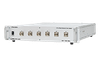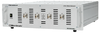

The ZTMN-0495AN-HP is a 4-port rack-mount mesh network emulator designed for simulating real-world mesh communication networks by independently controlling attenuation on each of six internal paths. It operates from 350 MHz to 6 GHz with 0 to 95 dB attenuation range in 0.25 dB steps, supporting up to 50 W input power per port. The unit is housed in a 3U height, 19-inch rack chassis featuring N-type female RF connectors on the front panel and weighs 8620 grams. Control is supported via USB HID and Ethernet using SSH, HTTP, and Telnet protocols. The device meets environmental rating ENV55.
Mini-Circuits’ ZTMN series mesh network emulators are multi-port test systems with independently variable attenuation on each internal path. This concept allows simulation of a “real-world” mesh communication network within the confined space of a test environment. Path loss can be varied independently between any pair of devices on the network without affecting any other combination of devices, allowing simulation of a complex range of test cases. ZTMN-0495AN-HP is a high power 4-port mesh covering 350 MHz to 6 GHz, with 50W input power rating per port and 0 to 95 dB attenuation range on each of the 6 internal paths. The model is housed in a compact, 3U height, 19-inch rack chassis with all RF connectors on the front panel. The ZTMN series also supports larger mesh network combinations, custom attenuation and frequency ranges available on request. The system can be controlled via USB or Ethernet (supporting SSH, HTTP & Telnet protocols), allowing local control directly from a PC, or remotely over a network. Full software support is provided, including our user-friendly GUI application for Windows and a full API with programming instructions for Windows and Linux environments.
| Mini-Circuits | |
|---|---|
| Product Category | Network Test Equipment |
| Product Number | ZTMN-0495AN-HP |
| Product Name | 4-Port Mesh Network Emulator, 350 - 6000 MHz, 50W, 0-95 dB, 3U, N-type |
| Network Protocol | supporting SSH, HTTP & Telnet protocols |