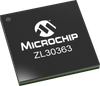
The ZL30142 SONET/SDH/GbE Stratum 3 System Synchronizer and SETS device is a highly integrated device that provides all of the functionality that is required for a central timing card in carrier grade network equipment. The basic functions of a central timing card include: • Input reference monitoring for both frequency accuracy and phase irregularities • Automatic input reference selection • Support of both external timing and line timing modes • Hitless reference switching • Wander and jitter filtering • Master/slave crossover for minimizing phase alignment between redundant timing cards • Independent derived output timing path for support of the SETS functionality
Click here for secure documentation Additional Features
Typical Applications
ITU-T G.8262 System Timing Cards which support 1 GbE interfaces
Telcordia GR-253 Carrier Grade SONET/SDH Stratum 3 System Timing Cards
Features & Benefits
Supports the requirements of ITU-T G.8262 for synchronous Ethernet Equipment slave Clocks (EEC option 1 and 2)
Supports the requirements of Telcordia GR-1244 Stratum 3 and GR-253, ITU-T G.812, G.813
Supports ITU-T G.823, G.824 and G.8261 for 2048 kbit/s and 1544 kbit/s interfaces
Meets the SONET/SDH jitter generation requirements up to OC-48/STM-16
Synchronizes to telecom reference clocks (2 kHz, N*8 kHz up to 77.76 MHz, 155.52 MHz) or to Ethernet reference clocks (25 MHz, 50 MHz, 62.5 MHz, 125 MHz)
Generates standard SONET/SDH clock rates (e.g., 19.44 MHz, 38.88 MHz, 77.76 MHz, 155.52 MHz, 622.08 MHz) or Ethernet clock rates (e.g., 25 MHz, 50 MHz, 125 MHz, 156.25 MHz, 312.5 MHz) for synchronizing Gigabit Ethernet PHYs
Programmable output synthesizer generates telecom clock frequencies from any multiple of 8 kHz up to 100 MHz
Generates several styles of telecom frame pulses with selectable pulse width, polarity and frequency
Internal state machine automatically controls mode of operation (free-run, locked, holdover)
Flexible input reference monitoring automatically disqualifies references based on frequency and phase irregularities
Provides automatic reference switching and holdover during loss of reference input
Supports master/slave configuration and dynamic input to output delay compensation for AdvancedTCA?
Configurable input to output delay and output to output phase alignment
The ZL30142 SONET/SDH/GbE Stratum 3 System Synchronizer and SETS device is a highly integrated device
that provides all of the functionality that is required for a central timing card in carrier grade network equipment. The
basic functions of a central timing card include:
• Input reference monitoring for both frequency accuracy and phase irregularities
• Automatic input reference selection
• Support of both external timing and line timing modes
• Hitless reference switching
• Wander and jitter filtering
• Master/slave crossover for minimizing phase alignment between redundant timing cards
• Independent derived output timing path for support of the SETS functionality
Click here for secure documentation Additional Features
- Typical Applications
- ITU-T G.8262 System Timing Cards which support 1 GbE interfaces
- Telcordia GR-253 Carrier Grade SONET/SDH Stratum 3 System Timing Cards
- Features & Benefits
- Supports the requirements of ITU-T G.8262 for synchronous Ethernet Equipment slave Clocks (EEC option 1 and 2)
- Supports the requirements of Telcordia GR-1244 Stratum 3 and GR-253, ITU-T G.812, G.813
- Supports ITU-T G.823, G.824 and G.8261 for 2048 kbit/s and 1544 kbit/s interfaces
- Meets the SONET/SDH jitter generation requirements up to OC-48/STM-16
- Synchronizes to telecom reference clocks (2 kHz, N*8 kHz up to 77.76 MHz, 155.52 MHz) or to Ethernet reference clocks (25 MHz, 50 MHz, 62.5 MHz, 125 MHz)
- Generates standard SONET/SDH clock rates (e.g., 19.44 MHz, 38.88 MHz, 77.76 MHz, 155.52 MHz, 622.08 MHz) or Ethernet clock rates (e.g., 25 MHz, 50 MHz, 125 MHz, 156.25 MHz, 312.5 MHz) for synchronizing Gigabit Ethernet PHYs
- Programmable output synthesizer generates telecom clock frequencies from any multiple of 8 kHz up to 100 MHz
- Generates several styles of telecom frame pulses with selectable pulse width, polarity and frequency
- Internal state machine automatically controls mode of operation (free-run, locked, holdover)
- Flexible input reference monitoring automatically disqualifies references based on frequency and phase irregularities
- Provides automatic reference switching and holdover during loss of reference input
- Supports master/slave configuration and dynamic input to output delay compensation for AdvancedTCA?
- Configurable input to output delay and output to output phase alignment