General Description
The USB2504 4-port hub controller is fully compliant with the USB 2.0 Specification and does not require firmware development. When connected to a USB high-speed host, the four downstream ports can operate at low-speed (1.5Mb/s), full-speed (12Mb/s), or high-speed (480Mb/s). As required by the USB 2.0 Specification, the USB2504 is fully backward compatible with legacy USB full-speed hosts.
A default configuration is available in the USB2504 following a reset. This configuration may be sufficient for some applications when it is desired to save the expense of an EEPROM. The controller may be configured from a microcontroller or an external EEPROM. When using the microcontroller interface, the USB2504 appears as a SMBus slave device. The EEPROM interface supports a 2-wire I2C device.
All required resistors on the USB ports are integrated into the USB2504. This includes all series termination resistors on D+ and D- pins and all required pull-down and pull-up resistors on D+ and D- pins. The over-current sense inputs for the downstream ports have internal pull-up resistors.
*The USBCheck online design review service is subject to Microchip's Program Terms and Conditions and requires a myMicrochip account.
For product comparison, please consider: USB2514B
Additional Features Note: The USB2504 is not recommended for new designs. The USB251x is the suggested replacement device for this product. General Features
Compliant with USB 2.0 Specification
Hub Controller IC with Four Downstream Ports
MultiTRAK&trade Technology Provides One Transaction Translator Per Port
Default Configuration with Pin Selectable Options
Flexible OEM Configuration Options
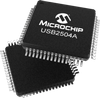
64-Pin TQFP RoHS compliant package Hardware Features
Integrated 1.8V regulator
Integrated Termination and Pull-Up/Pull-Down Resistors
Internal Short Circuit Protection of DP and DM Lines
On-Chip Oscillator Uses Low Cost 24MHz Crystal
Supports Ganged or Individual Over-Current Protection and Power Control
3.3V I/O with 5V tolerance
Pin-to-pin Compatible with USB20H04 OEM Selectable Features The 4-Port Hub supports several OEM selectable features:
Customize Vendor ID, Product ID, and Device ID
Select whether the hub is part of a compound device (When any downstream port is permanently hardwired to a USB peripheral device, the hub is part of a compound device)
Select the presence of a permanently hardwired USB peripheral device on a port by port basis
Configure the delay time for filtering the over-current sense inputs
Configure the delay time for turning on downstream port power
Configure the polarity of down stream port power control signals
Indicate the maximum current that the 4-port hub consumes from the USB upstream port
Indicate the maximum current required for the hub controller Pin Selectable Options for Default Configuration
Select Downstream Ports as Non-Removable Ports
Select Downstream Ports as Disabled Ports
Enable/Disable Downstream Port LED Indicators
Select Downstream Port Power Control and Over-Current Detection on a Ganged or Individual Basis
Select Downstream Port Power Control Polarity
General Description
The USB2504 4-port hub controller is fully compliant with the USB 2.0 Specification and does not require firmware development. When connected to a USB high-speed host, the four downstream ports can operate at low-speed (1.5Mb/s), full-speed (12Mb/s), or high-speed (480Mb/s). As required by the USB 2.0 Specification, the USB2504 is fully backward compatible with legacy USB full-speed hosts.
A default configuration is available in the USB2504 following a reset. This configuration may be sufficient for some applications when it is desired to save the expense of an EEPROM. The controller may be configured from a microcontroller or an external EEPROM. When using the microcontroller interface, the USB2504 appears as a SMBus slave device. The EEPROM interface supports a 2-wire I2C device.
All required resistors on the USB ports are integrated into the USB2504. This includes all series termination resistors on D+ and D- pins and all required pull-down and pull-up resistors on D+ and D- pins. The over-current sense inputs for the downstream ports have internal pull-up resistors.
*The USBCheck online design review service is subject to Microchip's Program Terms and Conditions and requires a myMicrochip account.
For product comparison, please consider: USB2514B
Additional Features
Note: The USB2504 is not recommended for new designs. The USB251x is the suggested replacement device for this product. General Features
- Compliant with USB 2.0 Specification
- Hub Controller IC with Four Downstream Ports
- MultiTRAK&trade Technology Provides One Transaction Translator Per Port
- Default Configuration with Pin Selectable Options
- Flexible OEM Configuration Options
- 64-Pin TQFP RoHS compliant package
Hardware Features
- Integrated 1.8V regulator
- Integrated Termination and Pull-Up/Pull-Down Resistors
- Internal Short Circuit Protection of DP and DM Lines
- On-Chip Oscillator Uses Low Cost 24MHz Crystal
- Supports Ganged or Individual Over-Current Protection and Power Control
- 3.3V I/O with 5V tolerance
- Pin-to-pin Compatible with USB20H04
OEM Selectable Features The 4-Port Hub supports several OEM selectable features:
- Customize Vendor ID, Product ID, and Device ID
- Select whether the hub is part of a compound device
(When any downstream port is permanently hardwired to a USB peripheral device, the hub is part of a compound device)
- Select the presence of a permanently hardwired USB peripheral device on a port by port basis
- Configure the delay time for filtering the over-current sense inputs
- Configure the delay time for turning on downstream port power
- Configure the polarity of down stream port power control signals
- Indicate the maximum current that the 4-port hub consumes from the USB upstream port
- Indicate the maximum current required for the hub controller
Pin Selectable Options for Default Configuration
- Select Downstream Ports as Non-Removable Ports
- Select Downstream Ports as Disabled Ports
- Enable/Disable Downstream Port LED Indicators
- Select Downstream Port Power Control and Over-Current Detection on a Ganged or Individual Basis
- Select Downstream Port Power Control Polarity