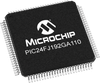
Ideal for low power (<100nA standby current) and connectivity applications that benefit from the availability of multiple serial ports (3xI2C, 3xSPI), 4xUARTS, and 23 independent timers. Large amounts of RAM (16kB) memory for buffering and large (up to 256kB) Enhanced Flash program memory make it ideal for embedded control and monitoring applications. PPS (Peripheral Pin Select) aids in configuring the most efficient pin configuration of available I/O, and CTMU provides touch sensing support for up to 64 individual buttons. Available in 64, 80, and 100 pin packages.
Additional Features
CPU
Up to 16 MIPS performance
16 x 16 Hardware Multiply, Single Cycle Execution
12-bit x 16-bit Hardware Divider
C Compiler Optimized Instruction Set
Low Power nanoWatt
Run, Idle and Sleep modes
Multiple, Switchable Clock Modes for Optimum Performance and Power Management
Run mode: 1 mA/MIPS, 2.0V Typical
Sleep mode Current Down to 100 nA Typical
Standby Current with 32 kHz Oscillator:2.5 uA,2.0V typical
Flash Program Memory
Self-Reprogrammable under Software Control
10,000 erase/write cycles
20 year data retention
EEprom emulation capable
System
Internal oscillator support - 31 kHz to 8 MHz, up to 32 MHz with 4X PLL
On-chip LDO Voltage Regulator
JTAG Boundary Scan and Flash Memory Program Support
Fail-Safe Clock Monitor – allows safe shutdown if clock fails
Watchdog Timer with separate RC oscillator
Analog Features
10-bit ADC, 16 channels, 500k samples per second
Three Analog comparators
Peripherals
CTMU supports Capacitive Touch applications
Perpheral Pin Select allows I/O remapping of many peripherals in real time
4xUART Modules with LIN and IrDA support, 4 Deep FIFO
3xSPI ™ Modules with 8 Deep FIFO
3xI2C™ Modules with Master and Slave Modes
Five 16-bit Timer Modules
Up to 9 Input Capture and 9 Output Compare/PWM with dedicated time base
Hardware RTCC, Real-Time Clock Calendar with Alarms
PMP, Parallel Master Port, with 16 Address Lines, and 8/16-bit Data
Ideal for low power (<100nA standby current) and connectivity applications that benefit from the availability of multiple serial ports (3xI2C, 3xSPI), 4xUARTS, and 23 independent timers. Large amounts of RAM (16kB) memory for buffering and large (up to 256kB) Enhanced Flash program memory make it ideal for embedded control and monitoring applications. PPS (Peripheral Pin Select) aids in configuring the most efficient pin configuration of available I/O, and CTMU provides touch sensing support for up to 64 individual buttons. Available in 64, 80, and 100 pin packages.
Additional Features
- CPU
- Up to 16 MIPS performance
- 16 x 16 Hardware Multiply, Single Cycle Execution
- 12-bit x 16-bit Hardware Divider
- C Compiler Optimized Instruction Set
- Low Power nanoWatt
- Run, Idle and Sleep modes
- Multiple, Switchable Clock Modes for Optimum Performance and Power Management
- Run mode: 1 mA/MIPS, 2.0V Typical
- Sleep mode Current Down to 100 nA Typical
- Standby Current with 32 kHz Oscillator:2.5 uA,2.0V typical
- Flash Program Memory
- Self-Reprogrammable under Software Control
- 10,000 erase/write cycles
- 20 year data retention
- EEprom emulation capable
- System
- Internal oscillator support - 31 kHz to 8 MHz, up to 32 MHz with 4X PLL
- On-chip LDO Voltage Regulator
- JTAG Boundary Scan and Flash Memory Program Support
- Fail-Safe Clock Monitor – allows safe shutdown if clock fails
- Watchdog Timer with separate RC oscillator
- Analog Features
- 10-bit ADC, 16 channels, 500k samples per second
- Three Analog comparators
- Peripherals
- CTMU supports Capacitive Touch applications
- Perpheral Pin Select allows I/O remapping of many peripherals in real time
- 4xUART Modules with LIN and IrDA support, 4 Deep FIFO
- 3xSPI ™ Modules with 8 Deep FIFO
- 3xI2C™ Modules with Master and Slave Modes
- Five 16-bit Timer Modules
- Up to 9 Input Capture and 9 Output Compare/PWM with dedicated time base
- Hardware RTCC, Real-Time Clock Calendar with Alarms
- PMP, Parallel Master Port, with 16 Address Lines, and 8/16-bit Data