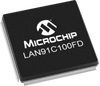

The LAN91C100FD is a Fast Ethernet controller designed for 10/100 Mbps applications, compliant with the IEEE 802.3 100BASE-T specification. It features a dual-speed CSMA/CD engine and supports multiple physical interfaces, including 100BASE-TX, 100BASE-T4, and 10BASE-T. The controller has a 32-bit wide data path and supports 32, 16, and 8-bit CPU accesses, making it versatile for various system architectures. With a total external memory of 128 Kbytes, the LAN91C100FD can handle up to 64 outstanding packets, ensuring efficient data throughput. It incorporates a unique memory management unit (MMU) architecture that allows for back-to-back frame transmission and reception, optimizing performance and reducing CPU overhead. The device also provides a flexible bus interface that accommodates both synchronous and asynchronous buses, including support for VESA local bus and EISA environments. Additionally, the LAN91C100FD includes a Media Independent Interface (MII) for network connectivity and offers full duplex capability, allowing independent transmit and receive paths. This controller is suitable for first-generation Fast Ethernet adapters and can utilize existing drivers from the LAN9000 family, making it a practical choice for engineers looking to implement Ethernet connectivity in their projects.
The LAN91C100FD is designed to facilitate the implementation of first generation Fast Ethernet adapters and connectivity products. For this first generation of products, flexibility dominates over integration. The LAN91C100FD is a digital device that implements the MAC portion of the CSMA/CD protocol at 10 and 100 Mbps, and couples it with a lean and fast data and control path system architecture to ensure the CPU to packet RAM data movement does not cause a bottleneck at 100 Mbps.
Total memory size is 128 Kbytes, equivalent to a total chip storage (transmit plus receive) of 64 outstanding packets. The LAN91C100FD is software compatible with the LAN9000 family of products and can use existing LAN9000 drivers (ODI, IPX, and NDIS) in 16 and 32 bit Intel X86 based environments.
Memory management is handled using a unique MMU (Memory Management Unit) architecture and a 32-bit wide data path. This I/O mapped architecture can sustain back-to-back frame transmission and reception for superior data throughput and optimal performance. It also dynamically allocates buffer memory in an efficient buffer utilization scheme, reducing software tasks and relieving the host CPU from performing these housekeeping functions. The total memory size is 128 Kbytes (external), equivalent to a total chip storage (transmit and receive) of 64 outstanding packets.
FEAST provides a flexible slave interface for easy connectivity with industry-standard buses. The Bus Interface Unit (BIU) can handle synchronous as well as asynchronous buses, with different signals being used for each one. FEAST's bus interface supports synchronous buses like the VESA local bus, as well as burst mode DMA for EISA environments. Asynchronous bus support for ISA is supported even though ISA cannot sustain 100 Mbps traffic. Fast Ethernet could be adopted for ISA-based nodes on the basis of the aggregate traffic benefits.
Two different interfaces are supported on the network side. The first is a conventional seven wire ENDEC interface that connects to the LAN83C694 for 10BASE-T and coax 10 Mbps Ethernet networks. The second interface follows the MII (Media Independent Interface) specification draft standard, consisting of 4 bit wide data transfers at the nibble rate. This interface is applicable to 10 Mbps or 100 Mbps networks. Three of the LAN91C100FD's pins are used to interface to the two-line MII serial management protocol. Four I/O ports (one input and three output pins) are provided for LAN83C694 configuration.
The LAN91C100FD is based on the LAN91C100 FEAST, functional revision G modified to add full duplex capability. Also added is a software-controlled option to allow collisions to discard receive packets. Previously, the LAN91C100 supported a "Diagnostic Full Duplex" mode. Under this mode the transmit packet is looped internally and received by the MAC. This mode was enabled using the FDUPLX bit in the TCR. In order to avoid confusion, the new, broader full duplex function of the LAN91C100FD is designated as Switched Full Duplex, and the TCR bit enabling it is designated as SWFDUP. When the LAN91C100FD is configured for SWFDUP, its transmit and receive paths will operate independently and some CSMA/CD functions will be disabled. When the controller is not configured for SWFDUP it will follow the CSMA/CD protocol.
*The LANCheck online design review service is subject to Microchip's Program Terms and Conditions and requires a myMicrochip account.
Please consider this device LAN9217, LAN9218
Additional Features
| Microchip Technology, Inc. | |
|---|---|
| Product Category | Network Cards and Network Controllers |
| Product Number | LAN91C100FD |
| Product Name | 10/100 Base-T/TX Ethernet Controller with 16/32 Bit Interface |
| Host Bus | 16-bit or 32-bit |