For New Designs, we highly recommend to consider Revision B for Prototypes and Production.
An ARM® Cortex®-M4 processor-based microcontroller (MCU), the SAM4E8E features a floating point unit and a high data bandwidth architecture and is targeted at industrial automation and building control applications.
The device embeds 512KB Flash and features multiple networking/connectiv
ity peripherals, including two 2.0A/B compatible CAN interfaces and an IEEE Std 1588-compatible 10/100Mbps Ethernet MAC.
Additional communication interfaces include a FS USB device, a HS SDCard/SDIO/MMC interface, USARTs, SPIs and multiple TWIs.
Analog features includes dual 1Msps, 16-bit ADCs of up to 24 channels with analog front end offering offset and gain error correction, and a 2-channel, 1Msps, 12-bit DAC.
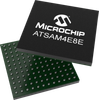
The SAM4E8E is available in 144-pin BGA and QFP package options.
Additional Features Microcontroller Features Core ARM Cortex-M4 with 2 Kbytes Cache running at up to 120 MHz Memory Protection Unit (MPU) DSP Instructions, Floating Point Unit (FPU), Thumb®-2 instruction set Memories 512 Kbytes Embedded Flash 128 Kbytes Embedded SRAM 16 Kbytes ROM with Embedded Boot Loader Routines (UART) and IAP Routines Static Memory Controller (SMC): SRAM, NOR, NAND Support NAND Flash Controller External Bus Interface: 8-bit Data, 4 Chip Selects, 24-bit Address System Embedded voltage regulator for single-supply operation Power-on-Reset (POR), Brown-out Detector (BOD) and Dual Watchdog for Safe Operation Quartz or ceramic resonator oscillators: 3 to 20 MHz with clock failure detection and 32.768 kHz for RTT or system clock RTC with Gregorian and Persian Calendar Mode, Waveform Generation in Backup mode RTC counter calibration circuitry compensates for 32.768 kHz crystal frequency inaccuracy High-precision 8/16/24 MHz factory-trimmed internal RC oscillator. In-application trimming access for frequency adjustment Slow clock internal RC oscillator as permanent low-power mode device clock One PLL up to 240 MHz for Device Clock and for USB Temperature Sensor Low-power tamper detection on two inputs, anti-tampering by immediate clear of general-purpose backup registers (GPBR) Up to 2 Peripheral DMA Controllers (PDC) with up to 33 Channels One 4-channel DMA Controller Low Power modes Sleep, Wait and Backup modes, down to 0.9 μA in Backup mode with RTC, RTT, and GPBR Package 144-ball LFBGA, 10x10 mm, pitch 0.8 mm 144-lead LQFP, 20x20 mm, pitch 0.5 mm Temperature operating range
Revision A - Industrial (-40° C to +85° C), Revision B - (-40° C to +105° C) Peripheral Features Two USARTs with USART1 (ISO7816, IrDA®, RS-485, SPI, Manchester and Modem Modes) USB 2.0 Device: Full Speed (12 Mbits), 2668 byte FIFO, up to 8 Endpoints. On-chip Transceiver Two 2-wire UARTs Two 2-wire Interfaces (TWI) High-speed Multimedia Card Interface (SDIO/SD Card/MMC) One Master/Slave Serial Peripheral Interface (SPI) with Chip Select Signals Three 3-channel 32-bit Timer/Counter blocks with Capture, Waveform, Compare and PWM Mode. Quadrature Decoder Logic and 2-bit Gray Up/Down Counter for Stepper Motor. 32-bit low-power Real-time Timer (RTT) and low-power Real-time Clock (RTC) with calendar and alarm features 256-bit General Purpose Backup Registers (GPBR) One Ethernet MAC (GMAC) 10/100 Mbps in MII mode only with dedicated DMA and Support for IEEE1588, Wake-on-LAN Two CAN Controllers with eight Mailboxes 4-channel 16-bit PWM with Complementary Output, Fault Input, 12-bit Dead Time Generator Counter for Motor Control. Real-time Event Management I/O Up to 117 I/O Lines with External Interrupt Capability (Edge or Level Sensitivity), Debouncing, Glitch Filtering Bidirectional Pad, Analog I/O, Programmable Pull-up/Pull-down Five 32-bit Parallel Input/Output Controllers, Peripheral DMA Assisted Parallel Capture Mode Cryptography AES 256-bit Key Algorithm compliant with FIPS Publication 197 Analog Features AFE (Analog Front End): 2x16-bit ADC, up to 24-channels, Differential Input Mode, Programmable Gain Stage, Auto Calibration and Automatic Offset Correction One 2-channel 12-bit 1 Msps DAC One Analog Comparator with Flexible Input Selection, Selectable Input Hysteresis Debugger Development Support Serial Wire/JTAG Debug Port(SWJ-DP) Debug access to all memories and registers in the system, including Cortex-M4 register bank when the core is running, halted, or held in reset. Serial Wire Debug Port (SW-DP) and Serial Wire JTAG Debug Port (SWJ-DP) debug access. Flash Patch and Breakpoint (FPB) unit for implementing breakpoints and code patches. Data Watchpoint and Trace (DWT) unit for implementing watchpoints, data tracing, and system profiling. Instrumentation Trace Macrocell (ITM) for support of printf style debugging. IEEE1149.1 JTAG Boundary-scan on all digital pins. Integrated Software Libraries and Tools ASF-Atmel software Framework – SAM software development framework Integrated in the Atmel Studio IDE with a graphical user interface or available as standalone for GCC, IAR compilers. DMA support, Interrupt handlers Driver support USB, TCP/IP, Wi-Fi and Bluetooth, Numerous USB classes, DHCP and Wi-Fi encryption Stacks RTOS integration, FreeRTOS is a core component
For New Designs, we highly recommend to consider Revision B for Prototypes and Production.
An ARM® Cortex®-M4 processor-based microcontroller (MCU), the SAM4E8E features a floating point unit and a high data bandwidth architecture and is targeted at industrial automation and building control applications.
The device embeds 512KB Flash and features multiple networking/connectivity peripherals, including two 2.0A/B compatible CAN interfaces and an IEEE Std 1588-compatible 10/100Mbps Ethernet MAC.
Additional communication interfaces include a FS USB device, a HS SDCard/SDIO/MMC interface, USARTs, SPIs and multiple TWIs.
Analog features includes dual 1Msps, 16-bit ADCs of up to 24 channels with analog front end offering offset and gain error correction, and a 2-channel, 1Msps, 12-bit DAC.
The SAM4E8E is available in 144-pin BGA and QFP package options.
Additional Features
Microcontroller Features Core
- ARM Cortex-M4 with 2 Kbytes Cache running at up to 120 MHz
- Memory Protection Unit (MPU)
- DSP Instructions, Floating Point Unit (FPU), Thumb®-2 instruction set
Memories
- 512 Kbytes Embedded Flash
- 128 Kbytes Embedded SRAM
- 16 Kbytes ROM with Embedded Boot Loader Routines (UART) and IAP Routines
- Static Memory Controller (SMC): SRAM, NOR, NAND Support
- NAND Flash Controller
- External Bus Interface: 8-bit Data, 4 Chip Selects, 24-bit Address
System
- Embedded voltage regulator for single-supply operation
- Power-on-Reset (POR), Brown-out Detector (BOD) and Dual Watchdog for Safe Operation
- Quartz or ceramic resonator oscillators: 3 to 20 MHz with clock failure detection and 32.768 kHz for RTT or system clock
- RTC with Gregorian and Persian Calendar Mode, Waveform Generation in Backup mode
- RTC counter calibration circuitry compensates for 32.768 kHz crystal frequency inaccuracy
- High-precision 8/16/24 MHz factory-trimmed internal RC oscillator. In-application trimming access for frequency adjustment
- Slow clock internal RC oscillator as permanent low-power mode device clock
- One PLL up to 240 MHz for Device Clock and for USB
- Temperature Sensor
- Low-power tamper detection on two inputs, anti-tampering by immediate clear of general-purpose backup registers (GPBR)
- Up to 2 Peripheral DMA Controllers (PDC) with up to 33 Channels
- One 4-channel DMA Controller
Low Power modes
- Sleep, Wait and Backup modes, down to 0.9 μA in Backup mode with RTC, RTT, and GPBR
Package
- 144-ball LFBGA, 10x10 mm, pitch 0.8 mm
- 144-lead LQFP, 20x20 mm, pitch 0.5 mm
Temperature operating range
- Revision A - Industrial (-40° C to +85° C), Revision B - (-40° C to +105° C)
Peripheral Features
- Two USARTs with USART1 (ISO7816, IrDA®, RS-485, SPI, Manchester and Modem Modes)
- USB 2.0 Device: Full Speed (12 Mbits), 2668 byte FIFO, up to 8 Endpoints. On-chip Transceiver
- Two 2-wire UARTs
- Two 2-wire Interfaces (TWI)
- High-speed Multimedia Card Interface (SDIO/SD Card/MMC)
- One Master/Slave Serial Peripheral Interface (SPI) with Chip Select Signals
- Three 3-channel 32-bit Timer/Counter blocks with Capture, Waveform, Compare and PWM Mode. Quadrature Decoder Logic and 2-bit Gray Up/Down Counter for Stepper Motor.
- 32-bit low-power Real-time Timer (RTT) and low-power Real-time Clock (RTC) with calendar and alarm features
- 256-bit General Purpose Backup Registers (GPBR)
- One Ethernet MAC (GMAC) 10/100 Mbps in MII mode only with dedicated DMA and Support for IEEE1588, Wake-on-LAN
- Two CAN Controllers with eight Mailboxes
- 4-channel 16-bit PWM with Complementary Output, Fault Input, 12-bit Dead Time Generator Counter for Motor Control.
- Real-time Event Management
I/O
- Up to 117 I/O Lines with External Interrupt Capability (Edge or Level Sensitivity), Debouncing, Glitch Filtering
- Bidirectional Pad, Analog I/O, Programmable Pull-up/Pull-down
- Five 32-bit Parallel Input/Output Controllers, Peripheral DMA Assisted Parallel Capture Mode
Cryptography
- AES 256-bit Key Algorithm compliant with FIPS Publication 197
Analog Features
- AFE (Analog Front End): 2x16-bit ADC, up to 24-channels, Differential Input Mode, Programmable Gain Stage, Auto Calibration and Automatic Offset Correction
- One 2-channel 12-bit 1 Msps DAC
- One Analog Comparator with Flexible Input Selection, Selectable Input Hysteresis
Debugger Development Support
- Serial Wire/JTAG Debug Port(SWJ-DP)
- Debug access to all memories and registers in the system, including Cortex-M4 register bank when the core is running, halted, or held in reset.
- Serial Wire Debug Port (SW-DP) and Serial Wire JTAG Debug Port (SWJ-DP) debug access.
- Flash Patch and Breakpoint (FPB) unit for implementing breakpoints and code patches.
- Data Watchpoint and Trace (DWT) unit for implementing watchpoints, data tracing, and system profiling.
- Instrumentation Trace Macrocell (ITM) for support of printf style debugging.
- IEEE1149.1 JTAG Boundary-scan on all digital pins.
Integrated Software Libraries and Tools
- ASF-Atmel software Framework – SAM software development framework
- Integrated in the Atmel Studio IDE with a graphical user interface or available as standalone for GCC, IAR compilers.
- DMA support, Interrupt handlers Driver support
- USB, TCP/IP, Wi-Fi and Bluetooth, Numerous USB classes, DHCP and Wi-Fi encryption Stacks
- RTOS integration, FreeRTOS is a core component