ApplicationRange -
Applications:
Li+, Na+, K+, Mg2+, Ca2+, Sr2+, Ba2+, NH4+
Samples with low concentrations
Good Na+/NH4+ separation
Low detection limits
Transition metals
Excellent peak form
Matrix with high pH
Organic Modifier -
Eluent: 0 - 100% acetone and acetonitrile (no alcohol) Sample: 0 - 100% acetone, acetonitrile, and alcohols
pH range -
Eluent: 0 - 12 Sample: 0 - 14
Regeneration -
Note: Ensure that the maximum pressure is never exceeded during regeneration. If the pressure becomes too high, reduce the flow rate. Regeneration: Disconnect the column outlet from the downstream functional units such as suppressor or detector. Instead, collect the flow of liquid in a beaker. Rinse the column with ultrapure water before and after regeneration. Depending on the type of contamination, proceed in accordance with one of the following instructions: Organic contamination: Regenerate the column in the opposite direction to the flow at 1 mL/min with the following solutions in succession: 1 h with ultrapure water 1 h with acetonitrile-water mixture (40:60) 1 h with ultrapure water Inorganic contamination: Regenerate the column in the opposite direction to the flow at a flow rate of 1 mL/min over 1 h with 50 mmol/L nitric acid .
StandardEluent -
Nitric acid eluent (standard eluent) Nitric acid (c = 1 mol/L): 5.0 mmol/L; 10 mL/2 L Rubidium (from rubidium nitrate): 50 µg/L Rb+; 172.5 µg/2 L (RbNO3)
Storage -
In standard eluent at ambient temperature.
Capacity -
58 µmol (K+)
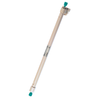
Housing material - PEEK Carrier material - Polystyrene-divinylb
enzene copolymer with carboxyl groups Particle size - 5 µm Standard flow - 1.0 mL/min Maximum pressure - 25 MPa Maximum flow - 2.0 mL/min Column dimensions - 250 x 4.0 mm Temperature range - 10–60 °C Standard temperature - 40 °C
ApplicationRange -
Applications:
- Li+, Na+, K+, Mg2+, Ca2+, Sr2+, Ba2+, NH4+
- Samples with low concentrations
- Good Na+/NH4+ separation
- Low detection limits
- Transition metals
- Excellent peak form
- Matrix with high pH
Organic Modifier -
Eluent: 0 - 100% acetone and acetonitrile (no alcohol)
Sample: 0 - 100% acetone, acetonitrile, and alcohols
pH range -
Eluent: 0 - 12
Sample: 0 - 14
Regeneration -
Note:
Ensure that the maximum pressure is never exceeded during regeneration.
If the pressure becomes too high, reduce the flow rate.
Regeneration:
Disconnect the column outlet from the downstream functional units such as suppressor or detector. Instead, collect the flow of liquid in a beaker.
Rinse the column with ultrapure water before and after regeneration.
Depending on the type of contamination, proceed in accordance with one of the following instructions:
Organic contamination:
Regenerate the column in the opposite direction to the flow at 1 mL/min with the following solutions in succession:
1 h with ultrapure water
1 h with acetonitrile-water mixture (40:60)
1 h with ultrapure water
Inorganic contamination:
Regenerate the column in the opposite direction to the flow at a flow rate of 1 mL/min over 1 h with 50 mmol/L nitric acid
.
StandardEluent -
Nitric acid eluent (standard eluent)
Nitric acid (c = 1 mol/L): 5.0 mmol/L; 10 mL/2 L
Rubidium (from rubidium nitrate): 50 µg/L Rb+; 172.5 µg/2 L (RbNO3)
Storage -
In standard eluent at ambient temperature.
Capacity -
58 µmol (K+)
Housing material - PEEK
Carrier material - Polystyrene-divinylbenzene copolymer with carboxyl groups
Particle size - 5 µm
Standard flow - 1.0 mL/min
Maximum pressure - 25 MPa
Maximum flow - 2.0 mL/min
Column dimensions - 250 x 4.0 mm
Temperature range - 10–60 °C
Standard temperature - 40 °C