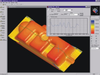
I-deas Test features three core modules. These modules lay the foundation for all the I-deas Test measurement data aquisition, test data analysis and test-CAE integration functionality. These core modules include: Base Test, Test Geometry, Time Data Processing
1. Base Test Module The Base Test Module provides the framework and user interface for interactive, and batch software operation. Base Test is the starter kit and prerequisite for all other NX I-deas Test modules. Base Test provides an intuitive user interface, and delivers highly productive XY and XYZ graphing operations, extensive math operations and advanced test data management capabilities.
2. Test Geometry Module The Test Geometry Module adds the tools required to create test models and enable interaction with other geometry-based data from CAD, CAE and other test sources. Presenting data measured at many locations on the structure using a geometry-based display provides a very efficient way of understanding and communicating test results.
The extensive geometry creation and display capabilities of the I-deas system are leveraged to provide convenient ways to view test data. Special features include easy-to-use methods for constructing geometry.
Geometry can be constructed using features such as:
Creation of test measurement points (nodes)
Global and local coordinate systems in Cartesian, cylindrical, or spherical systems are supported. Local coordinate systems can be used to account for off-axis measurements
Tracelines providing wireframe displays
Elements that may be defined for shaded image displays and animations
Groups of measurement points on different regions of the geometry can be defined to automate data processing/display
3. Time Data Processing Module The Time Data Processing Module adds a specialized framework for performing rapid interactive or batch processing, editing and management of large time histories. A special low-overhead family of 2D graphing routines streamlines the tasks of interactively identifying, cutting, pasting and editing sections of long recordings. The Time History task lets you manage and process time history records stored on disk. Time history records can be multichannel and unlimited in size, with either even or uneven time point spacing.
Many add-on modules are available to address specific test data acquisition, analysis, correlation, modal analysis, normal mode tuning, multipoint sine, customer jury evaluations, sound quality and many other test needs.
I-deas Test features three core modules. These modules lay the foundation for all the I-deas Test measurement data aquisition, test data analysis and test-CAE integration functionality. These core modules include: Base Test, Test Geometry, Time Data Processing
1. Base Test Module
The Base Test Module provides the framework and user interface for interactive, and batch software operation. Base Test is the starter kit and prerequisite for all other NX I-deas Test modules. Base Test provides an intuitive user interface, and delivers highly productive XY and XYZ graphing operations, extensive math operations and advanced test data management capabilities.
2. Test Geometry Module
The Test Geometry Module adds the tools required to create test models and enable interaction with other geometry-based data from CAD, CAE and other test sources. Presenting data measured at many locations on the structure using a geometry-based display provides a very efficient way of understanding and communicating test results.
The extensive geometry creation and display capabilities of the I-deas system are leveraged to provide convenient ways to view test data. Special features include easy-to-use methods for constructing geometry.
Geometry can be constructed using features such as:
- Creation of test measurement points (nodes)
- Global and local coordinate systems in Cartesian, cylindrical, or spherical systems are supported. Local coordinate systems can be used to account for off-axis measurements
- Tracelines providing wireframe displays
- Elements that may be defined for shaded image displays and animations
- Groups of measurement points on different regions of the geometry can be defined to automate data processing/display
3. Time Data Processing Module
The Time Data Processing Module adds a specialized framework for performing rapid interactive or batch processing, editing and management of large time histories. A special low-overhead family of 2D graphing routines streamlines the tasks of interactively identifying, cutting, pasting and editing sections of long recordings. The Time History task lets you manage and process time history records stored on disk. Time history records can be multichannel and unlimited in size, with either even or uneven time point spacing.
Many add-on modules are available to address specific test data acquisition, analysis, correlation, modal analysis, normal mode tuning, multipoint sine, customer jury evaluations, sound quality and many other test needs.