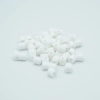
Matexcel Small Particle Size Nanoporous Carbon Powder MCP-006

Description
Compared with traditional catalyst-supported activated carbon, the pore structure of small particle size nanoporous carbon powder is regular and orderly and the size is controllable, which can bring the following three advantages: 1. Compared with the diameter of the holes, the connecting holes between the holes and the holes are smaller, and the catalyst is confined in the holes after being loaded, which is not easy to agglomerate, and the life of the catalyst is significantly improved. 2. Compared with activated carbon, the new nanoporous carbon material has larger pores and can support more catalysts without being blocked by catalyst nanoparticles, and the pore size and connecting pore size can be adjusted according to the reactants and products. Precise size design of the required pore structure facilitates the entry and exit of reactants and products, and significantly improves the catalytic efficiency. 3. A large number of hydroxyl groups are modified on the inner wall of the pore, which is conducive to the uniform loading of the catalyst, and also provides a stronger bonding effect with the metal nanoparticles, so that the metal nanoparticles cannot move. Another advantage of using it as a drug catalyst is that there are very few precious metals remaining in the drug, and the treatment of precious metal residues in the later stage is relatively easy. Application scenarios: drug catalysts, hydrogen fuel cell catalysts. Product overview: Composition: The basic composition is carbon 91-95%, oxygen 4-8%, hydrogen 1%, with good electrical conductivity (2-10 S/cm) and excellent chemical stability. Hydrogen and oxygen exist on the surface of the pores in the form of hydroxyl groups, and the density is about 10-5mol/m2. If not required, they can also be removed at high temperature. Structure: The interior is a three-dimensional through-hole nano-channel structure, each hole is connected to 12 surrounding holes, the pore structure is orderly, the pore size distribution is narrow, and can be precisely adjusted in the range of 10-1000 nanometers. Specifications: Particle Size:1um Diameter: 15nm; 30nm; 50nm; 100nm
Datasheet
Description
Compared with traditional catalyst-supported activated carbon, the pore structure of small particle size nanoporous carbon powder is regular and orderly and the size is controllable, which can bring the following three advantages: 1. Compared with the diameter of the holes, the connecting holes between the holes and the holes are smaller, and the catalyst is confined in the holes after being loaded, which is not easy to agglomerate, and the life of the catalyst is significantly improved. 2. Compared with activated carbon, the new nanoporous carbon material has larger pores and can support more catalysts without being blocked by catalyst nanoparticles, and the pore size and connecting pore size can be adjusted according to the reactants and products. Precise size design of the required pore structure facilitates the entry and exit of reactants and products, and significantly improves the catalytic efficiency. 3. A large number of hydroxyl groups are modified on the inner wall of the pore, which is conducive to the uniform loading of the catalyst, and also provides a stronger bonding effect with the metal nanoparticles, so that the metal nanoparticles cannot move. Another advantage of using it as a drug catalyst is that there are very few precious metals remaining in the drug, and the treatment of precious metal residues in the later stage is relatively easy. Application scenarios: drug catalysts, hydrogen fuel cell catalysts. Product overview: Composition: The basic composition is carbon 91-95%, oxygen 4-8%, hydrogen 1%, with good electrical conductivity (2-10 S/cm) and excellent chemical stability. Hydrogen and oxygen exist on the surface of the pores in the form of hydroxyl groups, and the density is about 10-5mol/m2. If not required, they can also be removed at high temperature. Structure: The interior is a three-dimensional through-hole nano-channel structure, each hole is connected to 12 surrounding holes, the pore structure is orderly, the pore size distribution is narrow, and can be precisely adjusted in the range of 10-1000 nanometers. Specifications: Particle Size:1um Diameter: 15nm; 30nm; 50nm; 100nm
Datasheet

Suppliers

Company
Product
Description
Supplier Links
Small Particle Size Nanoporous Carbon Powder - MCP-006 - Matexcel
Shirley, NY, United States
Small Particle Size Nanoporous Carbon Powder
MCP-006
Small Particle Size Nanoporous Carbon Powder MCP-006
Compared with traditional catalyst-supported activated carbon, the pore structure of small particle size nanoporous carbon powder is regular and orderly and the size is controllable, which can bring the following three advantages: 1. Compared with the diameter of the holes, the connecting holes between the holes and the holes are smaller, and the catalyst is confined in the holes after being loaded, which is not easy to agglomerate, and the life of the catalyst is significantly improved. 2. Compared with activated carbon, the new nanoporous carbon material has larger pores and can support more catalysts without being blocked by catalyst nanoparticles, and the pore size and connecting pore size can be adjusted according to the reactants and products. Precise size design of the required pore structure facilitates the entry and exit of reactants and products, and significantly improves the catalytic efficiency. 3. A large number of hydroxyl groups are modified on the inner wall of the pore, which is conducive to the uniform loading of the catalyst, and also provides a stronger bonding effect with the metal nanoparticles, so that the metal nanoparticles cannot move. Another advantage of using it as a drug catalyst is that there are very few precious metals remaining in the drug, and the treatment of precious metal residues in the later stage is relatively easy. Application scenarios: drug catalysts, hydrogen fuel cell catalysts. Product overview: Composition: The basic composition is carbon 91-95%, oxygen 4-8%, hydrogen 1%, with good electrical conductivity (2-10 S/cm) and excellent chemical stability. Hydrogen and oxygen exist on the surface of the pores in the form of hydroxyl groups, and the density is about 10-5mol/m2. If not required, they can also be removed at high temperature. Structure: The interior is a three-dimensional through-hole nano-channel structure, each hole is connected to 12 surrounding holes, the pore structure is orderly, the pore size distribution is narrow, and can be precisely adjusted in the range of 10-1000 nanometers. Specifications: Particle Size:1um Diameter: 15nm; 30nm; 50nm; 100nm

Compared with traditional catalyst-supported activated carbon, the pore structure of small particle size nanoporous carbon powder is regular and orderly and the size is controllable, which can bring the following three advantages:
1. Compared with the diameter of the holes, the connecting holes between the holes and the holes are smaller, and the catalyst is confined in the holes after being loaded, which is not easy to agglomerate, and the life of the catalyst is significantly improved.
2. Compared with activated carbon, the new nanoporous carbon material has larger pores and can support more catalysts without being blocked by catalyst nanoparticles, and the pore size and connecting pore size can be adjusted according to the reactants and products. Precise size design of the required pore structure facilitates the entry and exit of reactants and products, and significantly improves the catalytic efficiency.
3. A large number of hydroxyl groups are modified on the inner wall of the pore, which is conducive to the uniform loading of the catalyst, and also provides a stronger bonding effect with the metal nanoparticles, so that the metal nanoparticles cannot move.
Another advantage of using it as a drug catalyst is that there are very few precious metals remaining in the drug, and the treatment of precious metal residues in the later stage is relatively easy.
Application scenarios: drug catalysts, hydrogen fuel cell catalysts.

Product overview:

Composition: The basic composition is carbon 91-95%, oxygen 4-8%, hydrogen 1%, with good electrical conductivity (2-10 S/cm) and excellent chemical stability. Hydrogen and oxygen exist on the surface of the pores in the form of hydroxyl groups, and the density is about 10-5mol/m2. If not required, they can also be removed at high temperature.
Structure: The interior is a three-dimensional through-hole nano-channel structure, each hole is connected to 12 surrounding holes, the pore structure is orderly, the pore size distribution is narrow, and can be precisely adjusted in the range of 10-1000 nanometers.
Specifications:
Particle Size:1um
Diameter: 15nm; 30nm; 50nm; 100nm

Supplier's Site Datasheet

Technical Specifications

  Matexcel
Product Category Industrial Ceramic Materials
Product Number MCP-006
Product Name Small Particle Size Nanoporous Carbon Powder
Material Type Carbon
Unlock Full Specs
to access all available technical data

Similar Products

TO-220 Ceramic Insulator Cooling Pads -  - Xiamen Innovacera Advanced Materials Co., Ltd.
Xiamen Innovacera Advanced Materials Co., Ltd.
Specs
Material Type Alumina; Aluminum Nitride; SpecialtyMaterial
Applications Electronics or semiconductors; IGBT thermal management,power module cooling,High-temperature power electronics,Electric vehicle (EV) traction inverters
Performance Features Heat dissipation,electrical insulation,mechanical stability
View Details
Ceramic Flange -  - 3X Ceramic Parts Company Limited
3X Ceramic Parts Company Limited
Specs
Material Type Zirconia; SpecialtyMaterial
Density 6 g/cc (50.07 lbs/gal)
Compressive Strength 290074 psi (2.00E6 KPa)
View Details
Ceramic Beads - 5364090 - RS Components, Ltd.
RS Components, Ltd.
Specs
Material Type Ceramic
View Details
Aluminum Silicon Carbide Structural Parts -  - Fountyl Technologies Pte. Ltd.
Fountyl Technologies Pte. Ltd.
Specs
Material Type Carbide Material; Silicon Carbide
Shape / Form Custom Shape
Applications Structural
View Details