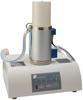
Linseis Inc. Quenching Dilatometer L78/RITA

Description
The Quenching/Deformatio n Dilatometer L78 RITA is especially suitable for the determination of TTT, CHT and CCT diagrams. The special induction furnace enables heating and cooling speeds in excess of 2500°C/s. The system complies with ASTM A1033. General Information: This practice is based upon the principle that, during heating and cooling of steels, dimensional changes occur as a result of both thermal expansions associated with temperature change and phase transformation. In this practice, sensitive high-speed quenching dilatometer equipment is used to detect and measure the changes in dimension that occur as functions of both time and temperature during defined thermal cycles. The resulting data are converted to discrete values of strain for specific values of time and temperature during the thermal cycle. Strain as a function of time or temperature, or both, can then be used to determine the beginning and completion of one or more phase transformations. Main advantaged of the L78 RITA Quenching Dilatometer system: The instrument can perform measurements under vacuum, inert, oxidized, reduced atmospheres from 150 (low temperature option) up to 1000°C and room temperature up to 1600°C in one run. The unique heating and cooling arrangement enable very fast controlled heat up and cool down speeds of up to 2500°C/s. With the optional susceptor non metallic samples can me analyzed. This special Quenching dilatometer is especially esigned for the determination of continuous cooling / heat up CHT, CCT and isotherm TTT- diagrams. All critical parameters such as heat up and cool down speed, gas control and safety features are software controlled. The professional 32-bit software Linseis TA-WIN operates exclusively under the Microsoft© operation system. All routine (creation of CHT/CCT/TTT diagrams) and demanding applications are solved by the unique Software package which comes with the instrument. Certainly export functions in ASCII-format as well as graphic output is possible. During heating, steel phase transformation of the crystallographic transformation from ferrite, pearlite, bainite, martensite or combinations of these constituents to austenite take place. During cooling, the crystallographic transformations from austenite to ferrite, pearlite, bainite, or martensite or a combination thereof occur. The LINSEIS L78 Quenching Dilatometer
Description
The Quenching/Deformatio n Dilatometer L78 RITA is especially suitable for the determination of TTT, CHT and CCT diagrams. The special induction furnace enables heating and cooling speeds in excess of 2500°C/s. The system complies with ASTM A1033. General Information: This practice is based upon the principle that, during heating and cooling of steels, dimensional changes occur as a result of both thermal expansions associated with temperature change and phase transformation. In this practice, sensitive high-speed quenching dilatometer equipment is used to detect and measure the changes in dimension that occur as functions of both time and temperature during defined thermal cycles. The resulting data are converted to discrete values of strain for specific values of time and temperature during the thermal cycle. Strain as a function of time or temperature, or both, can then be used to determine the beginning and completion of one or more phase transformations. Main advantaged of the L78 RITA Quenching Dilatometer system: The instrument can perform measurements under vacuum, inert, oxidized, reduced atmospheres from 150 (low temperature option) up to 1000°C and room temperature up to 1600°C in one run. The unique heating and cooling arrangement enable very fast controlled heat up and cool down speeds of up to 2500°C/s. With the optional susceptor non metallic samples can me analyzed. This special Quenching dilatometer is especially esigned for the determination of continuous cooling / heat up CHT, CCT and isotherm TTT- diagrams. All critical parameters such as heat up and cool down speed, gas control and safety features are software controlled. The professional 32-bit software Linseis TA-WIN operates exclusively under the Microsoft© operation system. All routine (creation of CHT/CCT/TTT diagrams) and demanding applications are solved by the unique Software package which comes with the instrument. Certainly export functions in ASCII-format as well as graphic output is possible. During heating, steel phase transformation of the crystallographic transformation from ferrite, pearlite, bainite, martensite or combinations of these constituents to austenite take place. During cooling, the crystallographic transformations from austenite to ferrite, pearlite, bainite, or martensite or a combination thereof occur. The LINSEIS L78 Quenching Dilatometer

Suppliers

Company
Product
Description
Supplier Links
Quenching Dilatometer - L78/RITA - Linseis Inc.
Robbinsville, NJ, USA
Quenching Dilatometer
L78/RITA
Quenching Dilatometer L78/RITA
The Quenching/Deformatio n Dilatometer L78 RITA is especially suitable for the determination of TTT, CHT and CCT diagrams. The special induction furnace enables heating and cooling speeds in excess of 2500°C/s. The system complies with ASTM A1033. General Information: This practice is based upon the principle that, during heating and cooling of steels, dimensional changes occur as a result of both thermal expansions associated with temperature change and phase transformation. In this practice, sensitive high-speed quenching dilatometer equipment is used to detect and measure the changes in dimension that occur as functions of both time and temperature during defined thermal cycles. The resulting data are converted to discrete values of strain for specific values of time and temperature during the thermal cycle. Strain as a function of time or temperature, or both, can then be used to determine the beginning and completion of one or more phase transformations. Main advantaged of the L78 RITA Quenching Dilatometer system: The instrument can perform measurements under vacuum, inert, oxidized, reduced atmospheres from 150 (low temperature option) up to 1000°C and room temperature up to 1600°C in one run. The unique heating and cooling arrangement enable very fast controlled heat up and cool down speeds of up to 2500°C/s. With the optional susceptor non metallic samples can me analyzed. This special Quenching dilatometer is especially esigned for the determination of continuous cooling / heat up CHT, CCT and isotherm TTT- diagrams. All critical parameters such as heat up and cool down speed, gas control and safety features are software controlled. The professional 32-bit software Linseis TA-WIN operates exclusively under the Microsoft© operation system. All routine (creation of CHT/CCT/TTT diagrams) and demanding applications are solved by the unique Software package which comes with the instrument. Certainly export functions in ASCII-format as well as graphic output is possible. During heating, steel phase transformation of the crystallographic transformation from ferrite, pearlite, bainite, martensite or combinations of these constituents to austenite take place. During cooling, the crystallographic transformations from austenite to ferrite, pearlite, bainite, or martensite or a combination thereof occur. The LINSEIS L78 Quenching Dilatometer

The Quenching/Deformation Dilatometer L78 RITA is especially suitable for the determination of TTT, CHT and CCT diagrams. The special induction furnace enables heating and cooling speeds in excess of 2500°C/s. The system complies with ASTM A1033.

General Information:

This practice is based upon the principle that, during heating and cooling of steels, dimensional changes occur as a result of both thermal expansions associated with temperature change and phase transformation. In this practice, sensitive high-speed quenching dilatometer equipment is used to detect and measure the changes in dimension that occur as functions of both time and temperature during defined thermal cycles. The resulting data are converted to discrete values of strain for specific values of time and temperature during the thermal cycle. Strain as a function of time or temperature, or both, can then be used to determine the beginning and completion of one or more phase transformations.

Main advantaged of the L78 RITA Quenching Dilatometer system:

  • The instrument can perform measurements under vacuum, inert, oxidized, reduced atmospheres from 150 (low temperature option) up to 1000°C and room temperature up to 1600°C in one run.
  • The unique heating and cooling arrangement enable very fast controlled heat up and cool down speeds of up to 2500°C/s.
  • With the optional susceptor non metallic samples can me analyzed.
  • This special Quenching dilatometer is especially esigned for the determination of continuous cooling / heat up CHT, CCT and isotherm TTT- diagrams.

All critical parameters such as heat up and cool down speed, gas control and safety features are software controlled. The professional 32-bit software Linseis TA-WIN operates exclusively under the Microsoft© operation system. All routine (creation of CHT/CCT/TTT diagrams) and demanding applications are solved by the unique Software package which comes with the instrument. Certainly export functions in ASCII-format as well as graphic output is possible.

During heating, steel phase transformation of the crystallographic transformation from ferrite, pearlite, bainite, martensite or combinations of these constituents to austenite take place. During cooling, the crystallographic transformations from austenite to ferrite, pearlite, bainite, or martensite or a combination thereof occur. The LINSEIS L78 Quenching Dilatometer

Supplier's Site

Technical Specifications

  Linseis Inc.
Product Category Calorimeters and Thermal Analyzers
Product Number L78/RITA
Product Name Quenching Dilatometer
Thermal Analyzer Type Dilatometer
Properties Measured Rapid Induction Thermal Analysis
Thermal Analyzer Performance Specs Non Contact Measurement, Theoretically an Indefinite Resolution
Features Cooling; Programmable Heating; Temperature Control
Unlock Full Specs
to access all available technical data

Similar Products

COSA 9610™ Wobbe Index, BTU, & CARI Calorimeter -  - COSA Xentaur Corporation
Specs
Calorimeter Type Combustion
Features Cooling (optional feature)
Certifications Ex, FM
View Details
Isoperibol Calorimeter - AC500 - LECO Corporation
Specs
Calorimeter Type Combustion; Isoperibol Calorimeter
Display None
Remote Interface Computer Interface; Application Software Included.
View Details
Thermo-optical Oscillating Refraction Characterization - TORC 5000 - Anton Paar
Specs
Temperature Range 4 to 125 C (39 to 257 F)
Accuracy 2.00E-5 (%)
Remote Interface Computer Interface
View Details
Fascinating Flexibility in Thermal Analysis - Simultaneous TGA-DSC: STA 449 F3 Jupiter® -  - NETZSCH-Gerätebau GmbH
Specs
Thermal Analyzer Type Simultaneous TGA-DSC/DTA
Features Cooling; Temperature Control
Display Video
View Details