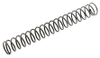
Lee Spring Company Helical Compression Spring LC 043EF 06M

Description
COMPRESSION SPRINGS are open-coil helical springs wound or constructed to oppose compression along the axis of wind. Helical Compression Springs are the most common metal spring configuration. Generally, these coil springs are either placed over a rod or fitted inside a hole. When you put a load on a compression coil spring, making it shorter, it pushes back against the load and tries to get back to its original length. Compression springs offer resistance to linear compressing forces (push), and are in fact one of the most efficient energy storage devices available. Configurations: The most common compression spring, the straight metal coil spring, has the same diameter for the entire length. Other configuration options for compression coil springs include hourglass (concave), conical and barrel (convex) types. The straight coil spring configuration is the standard coil type for Stock Compression Springs. Ends: All Lee Spring Stock Compression Stock Springs, except BANTAM Mini Springs, Instrumentation Series Compression Stock Spring and Lite Pressure™ Compression Stock Spring Series, feature squared and ground ends. Ground ends provide flat planes and stability. Squareness influences how the axis force produced by the spring can be transferred to adjacent parts. Although open ends may be suitable in some applications, closed ends afford a greater degree of squareness. Squared and ground end compression stock springs are particularly useful in applications in which 1) high-duty springs are specified, 2) unusually close tolerances on load or rate are needed, 3) solid height must be minimized, 4) accurate seating and uniform bearing pressures are required and 5) a tendency towards buckling must be reduced. Applications: Compression Metal Springs are found in a wide variety of applications ranging from automotive engines and large stamping presses to major appliances and lawn mowers to medical devices, cell phones, electronics and sensitive instrumentation devices. Cone shape metal springs are generally used in applications requiring low solid height and increased resistance to surging.
Description
COMPRESSION SPRINGS are open-coil helical springs wound or constructed to oppose compression along the axis of wind. Helical Compression Springs are the most common metal spring configuration. Generally, these coil springs are either placed over a rod or fitted inside a hole. When you put a load on a compression coil spring, making it shorter, it pushes back against the load and tries to get back to its original length. Compression springs offer resistance to linear compressing forces (push), and are in fact one of the most efficient energy storage devices available. Configurations: The most common compression spring, the straight metal coil spring, has the same diameter for the entire length. Other configuration options for compression coil springs include hourglass (concave), conical and barrel (convex) types. The straight coil spring configuration is the standard coil type for Stock Compression Springs. Ends: All Lee Spring Stock Compression Stock Springs, except BANTAM Mini Springs, Instrumentation Series Compression Stock Spring and Lite Pressure™ Compression Stock Spring Series, feature squared and ground ends. Ground ends provide flat planes and stability. Squareness influences how the axis force produced by the spring can be transferred to adjacent parts. Although open ends may be suitable in some applications, closed ends afford a greater degree of squareness. Squared and ground end compression stock springs are particularly useful in applications in which 1) high-duty springs are specified, 2) unusually close tolerances on load or rate are needed, 3) solid height must be minimized, 4) accurate seating and uniform bearing pressures are required and 5) a tendency towards buckling must be reduced. Applications: Compression Metal Springs are found in a wide variety of applications ranging from automotive engines and large stamping presses to major appliances and lawn mowers to medical devices, cell phones, electronics and sensitive instrumentation devices. Cone shape metal springs are generally used in applications requiring low solid height and increased resistance to surging.

Suppliers

Company
Product
Description
Supplier Links
Helical Compression Spring - LC 043EF 06M - Lee Spring Company
Brooklyn, NY, USA
Helical Compression Spring
LC 043EF 06M
Helical Compression Spring LC 043EF 06M
COMPRESSION SPRINGS are open-coil helical springs wound or constructed to oppose compression along the axis of wind. Helical Compression Springs are the most common metal spring configuration. Generally, these coil springs are either placed over a rod or fitted inside a hole. When you put a load on a compression coil spring, making it shorter, it pushes back against the load and tries to get back to its original length. Compression springs offer resistance to linear compressing forces (push), and are in fact one of the most efficient energy storage devices available. Configurations: The most common compression spring, the straight metal coil spring, has the same diameter for the entire length. Other configuration options for compression coil springs include hourglass (concave), conical and barrel (convex) types. The straight coil spring configuration is the standard coil type for Stock Compression Springs. Ends: All Lee Spring Stock Compression Stock Springs, except BANTAM Mini Springs, Instrumentation Series Compression Stock Spring and Lite Pressure™ Compression Stock Spring Series, feature squared and ground ends. Ground ends provide flat planes and stability. Squareness influences how the axis force produced by the spring can be transferred to adjacent parts. Although open ends may be suitable in some applications, closed ends afford a greater degree of squareness. Squared and ground end compression stock springs are particularly useful in applications in which 1) high-duty springs are specified, 2) unusually close tolerances on load or rate are needed, 3) solid height must be minimized, 4) accurate seating and uniform bearing pressures are required and 5) a tendency towards buckling must be reduced. Applications: Compression Metal Springs are found in a wide variety of applications ranging from automotive engines and large stamping presses to major appliances and lawn mowers to medical devices, cell phones, electronics and sensitive instrumentation devices. Cone shape metal springs are generally used in applications requiring low solid height and increased resistance to surging.

COMPRESSION SPRINGS are open-coil helical springs wound or constructed to oppose compression along the axis of wind. Helical Compression Springs are the most common metal spring configuration. Generally, these coil springs are either placed over a rod or fitted inside a hole. When you put a load on a compression coil spring, making it shorter, it pushes back against the load and tries to get back to its original length. Compression springs offer resistance to linear compressing forces (push), and are in fact one of the most efficient energy storage devices available.
Configurations: The most common compression spring, the straight metal coil spring, has the same diameter for the entire length. Other configuration options for compression coil springs include hourglass (concave), conical and barrel (convex) types. The straight coil spring configuration is the standard coil type for Stock Compression Springs.
Ends: All Lee Spring Stock Compression Stock Springs, except BANTAM Mini Springs, Instrumentation Series Compression Stock Spring and Lite Pressure™ Compression Stock Spring Series, feature squared and ground ends. Ground ends provide flat planes and stability. Squareness influences how the axis force produced by the spring can be transferred to adjacent parts. Although open ends may be suitable in some applications, closed ends afford a greater degree of squareness. Squared and ground end compression stock springs are particularly useful in applications in which 1) high-duty springs are specified, 2) unusually close tolerances on load or rate are needed, 3) solid height must be minimized, 4) accurate seating and uniform bearing pressures are required and 5) a tendency towards buckling must be reduced.
Applications: Compression Metal Springs are found in a wide variety of applications ranging from automotive engines and large stamping presses to major appliances and lawn mowers to medical devices, cell phones, electronics and sensitive instrumentation devices. Cone shape metal springs are generally used in applications requiring low solid height and increased resistance to surging.

Supplier's Site

Technical Specifications

  Lee Spring Company
Product Category Compression Springs
Product Number LC 043EF 06M
Product Name Helical Compression Spring
Material Alloy Steel (Music Wire)
Coil Shape Cross-section Compression
Spring Pitch Constant Pitch
Base Unit System English Design
Outer Diameter 0.3900 inch (9.91 mm)
Unlock Full Specs
to access all available technical data

Similar Products

Single-Layer Wave Ring - LR-0700-N - Zhejiang Lisheng Spring Co., Ltd.
Zhejiang Lisheng Spring Co., Ltd.
Specs
Material Stainless Steel
Inner Diameter 7 inch (178 mm)
View Details
Compression Springs - 821295 - RS Components, Ltd.
Specs
Material Stainless Steel
End Configuration Closed (squared) ends
Outer Diameter 0.1417 inch (3.6 mm)
View Details
Wave Springs - MWM-6 B - Rotor Clip Company, Inc.
Rotor Clip Company, Inc.
Specs
Material Stainless Steel; High Carbon Steel; Copper Base Alloy
Coil Shape Straight
Outer Diameter 0.1575 inch (4 mm)
View Details
Custom Suspension Springs -  - Coiling Technologies, Inc.
Coiling Technologies, Inc.
Specs
Coil Shape Suspension
Outer Diameter 23.5 inch (597 mm)
Wire diameter 0.1250 to 2.5 inch (3.17 to 63.5 mm)
View Details