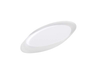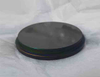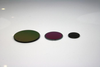
Knight Optical (UK) Ltd Silicon Window Float-Zone Grade 15mmdia x 1mmthk WSI1501

Description
Silicon (Si) is one of the hardest minerals and optical materials available for use in the NIR (1µm) to about 6µm. Optical quality Silicon is usually doped (5 to 40 ohm cm) to prevent absorption bands within the transmission waveband. Silicon has a lower refractive index than germanium and has a lower density that makes for less weighty optical designs. Silicon is ideal for use as windows in the 3 to 5µm (MWIR) waveband and as substrate for optical filters. This waveband (3 to 5µm) is important for the detection of sources radiating at a black body temperature of 700K, such as the muzzle flash from guns, such as sniper rifles and mortar pieces. Every component is individually tested by our highly skilled technicians in our state of the art metrology lab to ensure all components meet our high quality standards. Its transmission is about 50% within the 1 to 6µm and above 50µm, which will mean that anti-reflection coatings are required to improve the transmission ... The MWIR optical components manufactured from silicon, or other suitable material, can be used to build a unit that can detect the muzzle flash from, for example, a sniper rifle. The detection of snipers is of great importance in, for example, Afghanistan, as many military lives are being lost to snipers. The gun flash from a sniper rifle has a distinct spectral distribution from the hot gases that are emitted. These gasses are, for example, CO and H2 together with CO2, N2 and H2O that produce distinct emissions in the 3 to 5µm band. Silicon has a high thermal capacity that makes it ideal for laser mirrors. The MWIR optical components manufactured from silicon, for example, need to be tested to ensure that they meet the design specification. MWIR interferometers are used to determine the surface quality in terms of the number of fringes the surface is from the required. Interferometers can measure the difference relative to flat or spherical surfaces. Additional converging or diverging optics are required to ensure that the interrogation beam is retro-reflected back along the incident path for convex and concave surfaces. As the MWIR interferometer is used to determine the accuracy of surfaces, then its components must be manufactured to a higher specification than that needed for the surface. These reference surfaces must be traceable to a national standard, such as NPL in the UK. Some typical applications where Silicon is used are MWIR Gun Flash Detection, Imaging systems, and MWIR Interferometers. Below are listed our Stock Silicon Windows. These are offered uncoated and with Antireflective coating @3-5µm. Read more
Datasheet
Description
Silicon (Si) is one of the hardest minerals and optical materials available for use in the NIR (1µm) to about 6µm. Optical quality Silicon is usually doped (5 to 40 ohm cm) to prevent absorption bands within the transmission waveband. Silicon has a lower refractive index than germanium and has a lower density that makes for less weighty optical designs. Silicon is ideal for use as windows in the 3 to 5µm (MWIR) waveband and as substrate for optical filters. This waveband (3 to 5µm) is important for the detection of sources radiating at a black body temperature of 700K, such as the muzzle flash from guns, such as sniper rifles and mortar pieces. Every component is individually tested by our highly skilled technicians in our state of the art metrology lab to ensure all components meet our high quality standards. Its transmission is about 50% within the 1 to 6µm and above 50µm, which will mean that anti-reflection coatings are required to improve the transmission ... The MWIR optical components manufactured from silicon, or other suitable material, can be used to build a unit that can detect the muzzle flash from, for example, a sniper rifle. The detection of snipers is of great importance in, for example, Afghanistan, as many military lives are being lost to snipers. The gun flash from a sniper rifle has a distinct spectral distribution from the hot gases that are emitted. These gasses are, for example, CO and H2 together with CO2, N2 and H2O that produce distinct emissions in the 3 to 5µm band. Silicon has a high thermal capacity that makes it ideal for laser mirrors. The MWIR optical components manufactured from silicon, for example, need to be tested to ensure that they meet the design specification. MWIR interferometers are used to determine the surface quality in terms of the number of fringes the surface is from the required. Interferometers can measure the difference relative to flat or spherical surfaces. Additional converging or diverging optics are required to ensure that the interrogation beam is retro-reflected back along the incident path for convex and concave surfaces. As the MWIR interferometer is used to determine the accuracy of surfaces, then its components must be manufactured to a higher specification than that needed for the surface. These reference surfaces must be traceable to a national standard, such as NPL in the UK. Some typical applications where Silicon is used are MWIR Gun Flash Detection, Imaging systems, and MWIR Interferometers. Below are listed our Stock Silicon Windows. These are offered uncoated and with Antireflective coating @3-5µm. Read more
Datasheet

Suppliers

Company
Product
Description
Supplier Links
Silicon Window Float-Zone Grade 15mmdia x 1mmthk - WSI1501 - Knight Optical (UK) Ltd
Harrietsham, United Kingdom
Silicon Window Float-Zone Grade 15mmdia x 1mmthk
WSI1501
Silicon Window Float-Zone Grade 15mmdia x 1mmthk WSI1501
Silicon (Si) is one of the hardest minerals and optical materials available for use in the NIR (1µm) to about 6µm. Optical quality Silicon is usually doped (5 to 40 ohm cm) to prevent absorption bands within the transmission waveband. Silicon has a lower refractive index than germanium and has a lower density that makes for less weighty optical designs. Silicon is ideal for use as windows in the 3 to 5µm (MWIR) waveband and as substrate for optical filters. This waveband (3 to 5µm) is important for the detection of sources radiating at a black body temperature of 700K, such as the muzzle flash from guns, such as sniper rifles and mortar pieces. Every component is individually tested by our highly skilled technicians in our state of the art metrology lab to ensure all components meet our high quality standards. Its transmission is about 50% within the 1 to 6µm and above 50µm, which will mean that anti-reflection coatings are required to improve the transmission ... The MWIR optical components manufactured from silicon, or other suitable material, can be used to build a unit that can detect the muzzle flash from, for example, a sniper rifle. The detection of snipers is of great importance in, for example, Afghanistan, as many military lives are being lost to snipers. The gun flash from a sniper rifle has a distinct spectral distribution from the hot gases that are emitted. These gasses are, for example, CO and H2 together with CO2, N2 and H2O that produce distinct emissions in the 3 to 5µm band. Silicon has a high thermal capacity that makes it ideal for laser mirrors. The MWIR optical components manufactured from silicon, for example, need to be tested to ensure that they meet the design specification. MWIR interferometers are used to determine the surface quality in terms of the number of fringes the surface is from the required. Interferometers can measure the difference relative to flat or spherical surfaces. Additional converging or diverging optics are required to ensure that the interrogation beam is retro-reflected back along the incident path for convex and concave surfaces. As the MWIR interferometer is used to determine the accuracy of surfaces, then its components must be manufactured to a higher specification than that needed for the surface. These reference surfaces must be traceable to a national standard, such as NPL in the UK. Some typical applications where Silicon is used are MWIR Gun Flash Detection, Imaging systems, and MWIR Interferometers. Below are listed our Stock Silicon Windows. These are offered uncoated and with Antireflective coating @3-5µm. Read more

Silicon (Si) is one of the hardest minerals and optical materials available for use in the NIR (1µm) to about 6µm. Optical quality Silicon is usually doped (5 to 40 ohm cm) to prevent absorption bands within the transmission waveband. Silicon has a lower refractive index than germanium and has a lower density that makes for less weighty optical designs.
Silicon is ideal for use as windows in the 3 to 5µm (MWIR) waveband and as substrate for optical filters. This waveband (3 to 5µm) is important for the detection of sources radiating at a black body temperature of 700K, such as the muzzle flash from guns, such as sniper rifles and mortar pieces. Every component is individually tested by our highly skilled technicians in our state of the art metrology lab to ensure all components meet our high quality standards. Its transmission is about 50% within the 1 to 6µm and above 50µm, which will mean that anti-reflection coatings are required to improve the transmission ...
The MWIR optical components manufactured from silicon, or other suitable material, can be used to build a unit that can detect the muzzle flash from, for example, a sniper rifle. The detection of snipers is of great importance in, for example, Afghanistan, as many military lives are being lost to snipers. The gun flash from a sniper rifle has a distinct spectral distribution from the hot gases that are emitted. These gasses are, for example, CO and H2 together with CO2, N2 and H2O that produce distinct emissions in the 3 to 5µm band.
Silicon has a high thermal capacity that makes it ideal for laser mirrors.
The MWIR optical components manufactured from silicon, for example, need to be tested to ensure that they meet the design specification. MWIR interferometers are used to determine the surface quality in terms of the number of fringes the surface is from the required. Interferometers can measure the difference relative to flat or spherical surfaces. Additional converging or diverging optics are required to ensure that the interrogation beam is retro-reflected back along the incident path for convex and concave surfaces. As the MWIR interferometer is used to determine the accuracy of surfaces, then its components must be manufactured to a higher specification than that needed for the surface. These reference surfaces must be traceable to a national standard, such as NPL in the UK. Some typical applications where Silicon is used are MWIR Gun Flash Detection, Imaging systems, and MWIR Interferometers.
Below are listed our Stock Silicon Windows. These are offered uncoated and with Antireflective coating @3-5µm.
Read more

Supplier's Site Datasheet

Technical Specifications

  Knight Optical (UK) Ltd
Product Category Optical Windows
Product Number WSI1501
Product Name Silicon Window Float-Zone Grade 15mmdia x 1mmthk
Window Material Silicon
Unlock Full Specs
to access all available technical data

Similar Products

AR Laser Windows -  - Gurley Precision Instruments
Gurley Precision Instruments
Specs
Wavelength Range 266 to 1064 nm (2660 to 10640 Å)
Window Material UV Grade Fused Silica
Windows Features Anti-Reflection Coating
View Details
Fused Silica Windows with Hole -  - Changchun Yutai Optics Co., Ltd.
Changchun Yutai Optics Co., Ltd.
Specs
Parallelism or Wedge Angle 180 arcmin
Surface Quality 60-40 Scratch / Dig
Surface Flatness λ/10
View Details
Parallel Optical Window, UV Fused Silica, 10.0 mm, λ/10, 425-675 nm - FSW11AR.14 - Newport MKS
Specs
Window Material UV Grade Fused Silica; UV Grade Fused Silica
Windows Features Anti-Reflection Coating
Coating Material 425-675 nm
View Details
Zinc Selenide (ZnSe) Windows -  - Zygo Corporation
Specs
Window Material Zinc Selenide
View Details