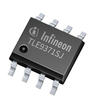
Infineon Technologies AG Transceivers - Automotive Transceivers - CAN Transceivers - TLE9371SJ TLE9371SJ

Description
CAN Signal Improvement transceivers actively improve the signal integrity in a network, reducing signal ringing effects and help to operate in larger topologies at bit rates significantly faster than before. The CAN FD SIC parts can replace existing CAN (FD) transceivers, making the adoption of this technology straight-forward and without significant changes in the application. Even more, they are backward compatible to existing CAN transceiver solutions. Summary of Features Highly accurate transmitter allowing precise control of CANH and CANL signals, active drive of recessive edge and active signal improvement Ringing in CAN networks significantly reduced, star-based typologies with higher data rates possible Increases maximum achievable CAN speed to 8MB/s Increased EMC performance Guaranteed CAN FD protocol operations under all conditions incl. error handling and arbitration scenarios Fully interoperable with CAN XL protocol Benefits Connection of more nodes with more functions possible Entry for more complex applications e.g. autonomous driving with security requirements, new comfort features in-body applications Less cable with decreased weight & costs; more positive CO2 balance, no cable variants for optional nodes, decreased No. of connectors Potential Applications Gateway modules: engine management, transmission control, automated driving, electric power steering Body control modules (BCM) Family Overview For family overview please click here. Applications ADAS & autonomous driving Automotive head unit Automotive instrument cluster Body electronics and power distribution Domain controller for ADAS and autonomous driving
Request a Quote Datasheet
Description
CAN Signal Improvement transceivers actively improve the signal integrity in a network, reducing signal ringing effects and help to operate in larger topologies at bit rates significantly faster than before. The CAN FD SIC parts can replace existing CAN (FD) transceivers, making the adoption of this technology straight-forward and without significant changes in the application. Even more, they are backward compatible to existing CAN transceiver solutions. Summary of Features Highly accurate transmitter allowing precise control of CANH and CANL signals, active drive of recessive edge and active signal improvement Ringing in CAN networks significantly reduced, star-based typologies with higher data rates possible Increases maximum achievable CAN speed to 8MB/s Increased EMC performance Guaranteed CAN FD protocol operations under all conditions incl. error handling and arbitration scenarios Fully interoperable with CAN XL protocol Benefits Connection of more nodes with more functions possible Entry for more complex applications e.g. autonomous driving with security requirements, new comfort features in-body applications Less cable with decreased weight & costs; more positive CO2 balance, no cable variants for optional nodes, decreased No. of connectors Potential Applications Gateway modules: engine management, transmission control, automated driving, electric power steering Body control modules (BCM) Family Overview For family overview please click here. Applications ADAS & autonomous driving Automotive head unit Automotive instrument cluster Body electronics and power distribution Domain controller for ADAS and autonomous driving
Request a Quote Datasheet

Suppliers

Company
Product
Description
Supplier Links
Transceivers - Automotive Transceivers - CAN Transceivers - TLE9371SJ - TLE9371SJ - Infineon Technologies AG
Neubiberg, Germany
Transceivers - Automotive Transceivers - CAN Transceivers - TLE9371SJ
TLE9371SJ
Transceivers - Automotive Transceivers - CAN Transceivers - TLE9371SJ TLE9371SJ
CAN Signal Improvement transceivers actively improve the signal integrity in a network, reducing signal ringing effects and help to operate in larger topologies at bit rates significantly faster than before. The CAN FD SIC parts can replace existing CAN (FD) transceivers, making the adoption of this technology straight-forward and without significant changes in the application. Even more, they are backward compatible to existing CAN transceiver solutions. Summary of Features Highly accurate transmitter allowing precise control of CANH and CANL signals, active drive of recessive edge and active signal improvement Ringing in CAN networks significantly reduced, star-based typologies with higher data rates possible Increases maximum achievable CAN speed to 8MB/s Increased EMC performance Guaranteed CAN FD protocol operations under all conditions incl. error handling and arbitration scenarios Fully interoperable with CAN XL protocol Benefits Connection of more nodes with more functions possible Entry for more complex applications e.g. autonomous driving with security requirements, new comfort features in-body applications Less cable with decreased weight & costs; more positive CO2 balance, no cable variants for optional nodes, decreased No. of connectors Potential Applications Gateway modules: engine management, transmission control, automated driving, electric power steering Body control modules (BCM) Family Overview For family overview please click here. Applications ADAS & autonomous driving Automotive head unit Automotive instrument cluster Body electronics and power distribution Domain controller for ADAS and autonomous driving
CAN Signal Improvement transceivers actively improve the signal integrity in a network, reducing signal ringing effects and help to operate in larger topologies at bit rates significantly faster than before. The CAN FD SIC parts can replace existing CAN (FD) transceivers, making the adoption of this technology straight-forward and without significant changes in the application. Even more, they are backward compatible to existing CAN transceiver solutions.


Summary of Features

  • Highly accurate transmitter allowing precise control of CANH and CANL signals, active drive of recessive edge and active signal improvement
  • Ringing in CAN networks significantly reduced, star-based typologies with higher data rates possible
  • Increases maximum achievable CAN speed to 8MB/s
  • Increased EMC performance
  • Guaranteed CAN FD protocol operations under all conditions incl. error handling and arbitration scenarios
  • Fully interoperable with CAN XL protocol

Benefits

  • Connection of more nodes with more functions possible
  • Entry for more complex applications e.g. autonomous driving with security requirements, new comfort features in-body applications
  • Less cable with decreased weight & costs; more positive CO2 balance, no cable variants for optional nodes, decreased No. of connectors

Potential Applications

  • Gateway modules: engine management, transmission control, automated driving, electric power steering
  • Body control modules (BCM)

Family Overview


For family overview please click here.


Applications

  • ADAS & autonomous driving
  • Automotive head unit
  • Automotive instrument cluster
  • Body electronics and power distribution
  • Domain controller for ADAS and autonomous driving

Supplier's Site Datasheet

Technical Specifications

  Infineon Technologies AG
Product Category IC Interfaces
Product Number TLE9371SJ
Product Name Transceivers - Automotive Transceivers - CAN Transceivers - TLE9371SJ
Technology CAN
Device Type Transceiver
Features RoHS
Unlock Full Specs
to access all available technical data

Similar Products

Interface - Interface - Controllers - AN983B-BG - 199069-AN983B-BG - Win Source Electronics
Specs
Supply Voltage Other; 3 V ~ 3.6 V
Operating Temperature 0 to 70 C (32 to 158 F)
Package Type QFP; PG-PQFP-128
View Details
2 suppliers
Power Switch ICs - 1787478 - RS Components, Ltd.
Infineon Technologies AG
Specs
Features RoHS
Supply Voltage Other; 45 v
Package Type Sot-223
View Details
 - BTS54040LBBXUMA1 - Rochester Electronics
Infineon Technologies AG
Specs
Device Type Sensor Interface
Features RoHS
Package Type TDFN; PowerTDFN24
View Details
Controllers - CY7C63823-PXC-ND - DigiKey
Infineon Technologies AG
Specs
Technology USB; SPI
Device Type Line / Bus Controller
Supply Voltage Other; 4V ~ 5.5V
View Details
3 suppliers