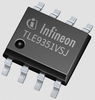
The TLE9351VSJ is a high speed CAN transceiver, used in HS CAN systems for automotive applications as well as for industrial applications. It is designed to fulfill the requirements of ISO 11898-2:2016 physical layer specification as well as SAE J1939 and SAE J2284. The TLE9351VSJ is available in a RoHS compliant, halogen free PG-DSO-8 package. As an interface between the physical bus layer and the HS CAN protocol controller, the TLE9351VSJ is designed to protect the microcontroller against interferences generated inside the network. A very high ESD robustness and the optimized RF immunity allows the use in automotive applications without additional protection devices, such as suppressor diodes or common mode chokes. Based on the high symmetry of the CANH and CANL output signals, the TLE9351VSJ provides a very low level of electromagnetic emission (EME) within a wide frequency range. The TLE9351VSJ fulfills even stringent EMC test limits without an additional external circuit, such as a common mode choke. The optimized transmitter symmetry combined with the optimized delay symmetry of the receiver enables the TLE9351VSJ to support CAN FD data frames. The device supports data transmission rates up to 5 MBit/s, depending on the size of the network and the inherent parasitic effects. Dedicated low-power modes, such as stand-by mode, provide very low quiescent current during power-up of the device. In stand-by mode the typical quiescent current on VIO is less than 10 µA while the device can still wake up by a bus signal on the HS CAN bus. Fail-safe features, such as overtemperature protection, output current limitation or the TxD time-out feature are designed to protect the TLE9351VSJ and the external circuitry from irreparable damage.
Summary of Features
Fully compliant to ISO 11898-2:2016 and SAE J2284-4/-5
Loop delay symmetry for CAN FD data frames up to 5 MBit/s
Certified according to VeLIO (Vehicle LAN Interoperability and Optimization) test requirements
Very low electromagnetic emission (EME) allows the use without additional common mode choke
VIO input for voltage adaption to the microcontroller interface (3.3 V or 5 V)
Bus wake-up pattern (WUP) function with optimized filter time for worldwide OEM usage
Stand-by mode with minimized quiescent current
Transmitter supply VCC can be disabled in stand-by mode to further minimize quiescent current
Excellent ESD robustness
TxD time-out function
Very low CAN bus leakage current in power-down state
Overtemperature protection
Protected against automotive transients according to ISO 7637 and SAE J2962-2
Green Product (RoHS compliant)
Potential Applications
Gateway modules
Body control modules (BCM)
Applications
Automotive secondary power distribution unit
Belt starter generator 48 V – inverter ISG
EV traction inverter
Light electric vehicles (LEV)
Family Overview
For family overview please click here.
Designers who used this product also designed with
IPB80N06S2L-11 | Automotive MOSFET
2EDF7275F | Gate driver ICs
BSS138W | Small signal/small power MOSFET
TLF35584QVVS1 | OPTIREG™ PMIC
BSC065N06LS5 | N-Channel Power MOSFET
TLE5012B E1000 | Angle sensors
TLF35584QKVS1 | OPTIREG™ PMIC
IPB048N15N5 | N-Channel Power MOSFET
1EDN7126U | Gate driver ICs
FP30R06W1E3 | IGBT modules
OPTIGA TRUST M SLS32AIA | OPTIGA™ Trust
TLE8080EM | Engine management IC
TLD5098EL | LITIX™ Power
SAK-TC366DP-64F300S AA | AURIX™ Family – TC36xDP
TLE9461-3ES | OPTIREG™ Lite SBC
BTS5030-2EKA | PROFET™ + 12V | automotive smart high-side switch
OPTIGA TRUST M EXPRESS | OPTIGA™ Trust
IPB80N06S2L-11 | Automotive MOSFET
2EDF7275F | Gate driver ICs
BSS138W | Small signal/small power MOSFET
TLF35584QVVS1 | OPTIREG™ PMIC
BSC065N06LS5 | N-Channel Power MOSFET
TLE5012B E1000 | Angle sensors
TLF35584QKVS1 | OPTIREG™ PMIC
IPB048N15N5 | N-Channel Power MOSFET
1 2 3 4 5
The TLE9351VSJ is a high speed CAN transceiver, used in HS CAN systems for automotive applications as well as for industrial applications. It is designed to fulfill the requirements of ISO 11898-2:2016 physical layer specification as well as SAE J1939 and SAE J2284.
The TLE9351VSJ is available in a RoHS compliant, halogen free PG-DSO-8 package.
As an interface between the physical bus layer and the HS CAN protocol controller, the TLE9351VSJ is designed to protect the microcontroller against interferences generated inside the network. A very high ESD robustness and the optimized RF immunity allows the use in automotive applications without additional protection devices, such as suppressor diodes or common mode chokes.
Based on the high symmetry of the CANH and CANL output signals, the TLE9351VSJ provides a very low level of electromagnetic emission (EME) within a wide frequency range. The TLE9351VSJ fulfills even stringent EMC test limits without an additional external circuit, such as a common mode choke.
The optimized transmitter symmetry combined with the optimized delay symmetry of the receiver enables the TLE9351VSJ to support CAN FD data frames. The device supports data transmission rates up to 5 MBit/s, depending on the size of the network and the inherent parasitic effects.
Dedicated low-power modes, such as stand-by mode, provide very low quiescent current during power-up of the device. In stand-by mode the typical quiescent current on VIO is less than 10 µA while the device can still wake up by a bus signal on the HS CAN bus.
Fail-safe features, such as overtemperature protection, output current limitation or the TxD time-out feature are designed to protect the TLE9351VSJ and the external circuitry from irreparable damage.
Summary of Features
- Fully compliant to ISO 11898-2:2016 and SAE J2284-4/-5
- Loop delay symmetry for CAN FD data frames up to 5 MBit/s
- Certified according to VeLIO (Vehicle LAN Interoperability and Optimization) test requirements
- Very low electromagnetic emission (EME) allows the use without additional common mode choke
- VIO input for voltage adaption to the microcontroller interface (3.3 V or 5 V)
- Bus wake-up pattern (WUP) function with optimized filter time for worldwide OEM usage
- Stand-by mode with minimized quiescent current
- Transmitter supply VCC can be disabled in stand-by mode to further minimize quiescent current
- Excellent ESD robustness
- TxD time-out function
- Very low CAN bus leakage current in power-down state
- Overtemperature protection
- Protected against automotive transients according to ISO 7637 and SAE J2962-2
- Green Product (RoHS compliant)
Potential Applications
- Gateway modules
- Body control modules (BCM)
Applications
- Automotive secondary power distribution unit
- Belt starter generator 48 V – inverter ISG
- EV traction inverter
- Light electric vehicles (LEV)
Family Overview
For family overview please click here.
Designers who used this product also designed with
- IPB80N06S2L-11 |
Automotive MOSFET
- 2EDF7275F |
Gate driver ICs
- BSS138W |
Small signal/small power MOSFET
- TLF35584QVVS1 |
OPTIREG™ PMIC
- BSC065N06LS5 |
N-Channel Power MOSFET
- TLE5012B E1000 |
Angle sensors
- TLF35584QKVS1 |
OPTIREG™ PMIC
- IPB048N15N5 |
N-Channel Power MOSFET
- 1EDN7126U |
Gate driver ICs
- FP30R06W1E3 |
IGBT modules
- OPTIGA TRUST M SLS32AIA |
OPTIGA™ Trust
- TLE8080EM |
Engine management IC
- TLD5098EL |
LITIX™ Power
- SAK-TC366DP-64F300S AA |
AURIX™ Family – TC36xDP
- TLE9461-3ES |
OPTIREG™ Lite SBC
- BTS5030-2EKA |
PROFET™ + 12V | automotive smart high-side switch
- OPTIGA TRUST M EXPRESS |
OPTIGA™ Trust
- IPB80N06S2L-11 |
Automotive MOSFET
- 2EDF7275F |
Gate driver ICs
- BSS138W |
Small signal/small power MOSFET
- TLF35584QVVS1 |
OPTIREG™ PMIC
- BSC065N06LS5 |
N-Channel Power MOSFET
- TLE5012B E1000 |
Angle sensors
- TLF35584QKVS1 |
OPTIREG™ PMIC
- IPB048N15N5 |
N-Channel Power MOSFET
1
2
3
4
5