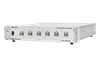
The HDLCTerr module performs multi-channel HDLC emulation and analysis. It permits frame error testing and transmission of memory generated sequences of fixed or variable length HDLC frames, GL *.HDL Trace file frames, and various bandwidth streams.
In an OC-3/OC-12 channelized HDLCTerr module, 1040 T1s or 1701 E1s can be identified and processed in transmit and receive mode.
The HDLCHpio module performs file–based HDLC record and playback actions. It permits receive / transmit of HDLC streams of various bandwidth (hyper channel, timeslot, and multiple sub-channel streams per timeslot).
In an OC-3 channelized HDLCHpio module, 2016 T1s or 1953 E1s can be identified and processed in transmit and receive mode. In an OC-12 channelized HdlcHpio application, 2640 T1s or 2325 E1s can be identified and processed in transmit and receive mode.
File based High Throughput HDLC Record/Playback (HdlcHpio)
The module performs file–based HDLC record and playback actions. It takes advantage of Multi-core CPU and offers high throughput & permits receive / transmit of HDLC streams of various bandwidth over multiple Links and Channels (hyper channel, timeslot, and multiple sub-channel streams per timeslot). It also provides users the option to speed up /slow down the transmission.
It permits
Receiving and transmitting HDLC streams of various bandwidths from single or multiple GL HDL trace files
Receiving and transmitting hyperchannel (N x 64 kbps) streams, timeslot streams (64 kbps) and subchannel streams (n x 8 kbps).
Transmitting and receiving multiple subchannels within a single timeslot.
GL's *.HDL trace files contain port, timeslot and timing information. During playback, this information can be used to replay frames on the same timeslots preserving the timing information
Key Features
Port, timeslot, subchannel translation Port/timeslot numbers can be translated (groomed) before playback. For example, if the frames were captured on port 1 timeslot 23, port 2, timeslot 23, ... port 8 timeslot 23 they can be ordered to play on port 1 timeslot 1, port 1 timeslot 2, ..., port 1 timeslot 8.
Time preservation, speeding up and slowing down during playback Playback can either preserve the inter-frame timing of the originally captured *.hdl trace file frames or playback frames faster / slower than the originally captured frames. In addition the original timing can also be modified by specifying number of flags to insert between frames.
Advanced performance support for multiprocessor computers The module is designed to take full advantage of the multiprocessor PCs. By default, it is using all the processors available to the Windows OS using an adaptive thread pools. However, the task can be directed to use fewer processors, to achieve optimal performance coexisting with other processor intensive applications or WCS tasks running on the computer.
Flexible transmit options Frames from *.hdl trace files can be transmitted either once (till the end of the trace file is reached), continuously in a round robin fashion (the first frame is transmitted again when the end of the trace file is reached), or up to the limited frame count. Each stream can have different characteristics.
Flexible receive options Received streams can be placed in the same or multiple *.HDL trace files. Files can be circular to limit disk space. In circular files, new frames will eventually replace earlier frames.
Extensive documentation The module comes with the detailed documentation and examples that help to reduce the learning curve. Simple yet flexible and versatile syntax makes it easier for users to use the software.
Real-time counters The module allows users to monitor (query) the following attributes when the task is in progress
Total HDLC tx / rx stream count
Running tx / rx stream count
Under run count
Malformed frame count
CRC (FCS) error count
The HDLCTerr module performs multi-channel HDLC emulation and analysis. It permits frame error testing and transmission of memory generated sequences of fixed or variable length HDLC frames, GL *.HDL Trace file frames, and various bandwidth streams.
In an OC-3/OC-12 channelized HDLCTerr module, 1040 T1s or 1701 E1s can be identified and processed in transmit and receive mode.
The HDLCHpio module performs file–based HDLC record and playback actions. It permits receive / transmit of HDLC streams of various bandwidth (hyper channel, timeslot, and multiple sub-channel streams per timeslot).
In an OC-3 channelized HDLCHpio module, 2016 T1s or 1953 E1s can be identified and processed in transmit and receive mode. In an OC-12 channelized HdlcHpio application, 2640 T1s or 2325 E1s can be identified and processed in transmit and receive mode.
File based High Throughput HDLC Record/Playback (HdlcHpio)
The module performs file–based HDLC record and playback actions. It takes advantage of Multi-core CPU and offers high throughput & permits receive / transmit of HDLC streams of various bandwidth over multiple Links and Channels (hyper channel, timeslot, and multiple sub-channel streams per timeslot). It also provides users the option to speed up /slow down the transmission.
It permits
- Receiving and transmitting HDLC streams of various bandwidths from single or multiple GL HDL trace files
- Receiving and transmitting hyperchannel (N x 64 kbps) streams, timeslot streams (64 kbps) and subchannel streams
(n x 8 kbps).
- Transmitting and receiving multiple subchannels within a single timeslot.
GL's *.HDL trace files contain port, timeslot and timing information. During playback, this information can be used to replay frames on the same timeslots preserving the timing information
Key Features
- Port, timeslot, subchannel translation Port/timeslot numbers can be translated (groomed) before playback. For example, if the frames were captured on port 1 timeslot 23, port 2, timeslot 23, ... port 8 timeslot 23 they can be ordered to play on port 1 timeslot 1, port 1 timeslot 2, ..., port 1 timeslot 8.
- Time preservation, speeding up and slowing down during playback Playback can either preserve the inter-frame timing of the originally captured *.hdl trace file frames or playback frames faster / slower than the originally captured frames. In addition the original timing can also be modified by specifying number of flags to insert between frames.
- Advanced performance support for multiprocessor computers The module is designed to take full advantage of the multiprocessor PCs. By default, it is using all the processors available to the Windows OS using an adaptive thread pools. However, the task can be directed to use fewer processors, to achieve optimal performance coexisting with other processor intensive applications or WCS tasks running on the computer.
- Flexible transmit options Frames from *.hdl trace files can be transmitted either once (till the end of the trace file is reached), continuously in a round robin fashion (the first frame is transmitted again when the end of the trace file is reached), or up to the limited frame count. Each stream can have different characteristics.
- Flexible receive options Received streams can be placed in the same or multiple *.HDL trace files. Files can be circular to limit disk space. In circular files, new frames will eventually replace earlier frames.
- Extensive documentation The module comes with the detailed documentation and examples that help to reduce the learning curve. Simple yet flexible and versatile syntax makes it easier for users to use the software.
- Real-time counters The module allows users to monitor (query) the following attributes when the task is in progress
- Total HDLC tx / rx stream count
- Running tx / rx stream count
- Under run count
- Malformed frame count
- CRC (FCS) error count