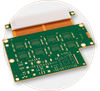
A multi layer flex circuit combine several single-sided or double-sided circuits with complex interconnections, shielding and/or surface mounted technologies in a multi layer design. The multi layers may or may not be continuously laminated together throughout the production process. If your design needs require maximum flexibility, continuous lamination may not be appropriate. Multi layer circuits are an effective solution when confronted with design challenges such as: unavoidable crossovers, specific impedance requirements, elimination of crosstalk, additional shielding and high component density.
Flexible Circuit is proud to be able to say that “We Go Where Others Will Not” when it comes to helping you with design solutions utilizing multi layer flex circuits.
As a connective device, the primary benefits of flexible circuits compared to traditional cabling and rigid boards include:
Reduced wiring errors
Elimination of mechanical connectors
Unparalleled design flexibility
Higher circuit density
More robust operating temperature range
Stronger signal quality
Improved reliability and impedance control
Size and weight reduction
There are many benefits to Flexible Printed Circuits including:
Assembly Error Reduction – With accurate designs and automated production, flex circuits eliminate human errors once involved in hand-built wire harnesses. With the exception of production-induced errors, circuits are ONLY routed to those points called for by the accurate design plan.
Decreased Assembly Time and Costs – Flex circuits require less manual labor during assembly and reduce production errors. Flex circuits have an intrinsic ability to integrate form, fit and function. Flex circuits eliminate the high cost of routing, wrapping and soldering wires. Complete interconnection systems are installed or replaced, rather than individual hard PC boards. As a result, wiring errors are eliminated and hence manufacturing costs are reduced. Whether it is a low volume production with a complex circuit or high volume production with a simple circuit, assembly time and costs are decreased.
Design Freedom – Unlike rigid boards, flex circuits are not restricted to two dimensions. Because they are as flexible as wires or ribbon cables, flex circuit design options are endless. At Flexible Circuit, we pride ourselves on taking on the most complex of design challenges. Flex circuits can be designed to meet highly complex and unimaginable configurations while being able to operate in the most hostile environments. Flex circuit designs could entail any of the following:
Highly complex configurations
Withstand hostile operating environments
Single- Double- combinations
Complex interconnections
Shielding
Rigid/flex capabilities
Surface mounted devices
A multi layer flex circuit combine several single-sided or double-sided circuits with complex interconnections, shielding and/or surface mounted technologies in a multi layer design. The multi layers may or may not be continuously laminated together throughout the production process. If your design needs require maximum flexibility, continuous lamination may not be appropriate. Multi layer circuits are an effective solution when confronted with design challenges such as: unavoidable crossovers, specific impedance requirements, elimination of crosstalk, additional shielding and high component density.
Flexible Circuit is proud to be able to say that “We Go Where Others Will Not” when it comes to helping you with design solutions utilizing multi layer flex circuits.
As a connective device, the primary benefits of flexible circuits compared to traditional cabling and rigid boards include:
- Reduced wiring errors
- Elimination of mechanical connectors
- Unparalleled design flexibility
- Higher circuit density
- More robust operating temperature range
- Stronger signal quality
- Improved reliability and impedance control
- Size and weight reduction
There are many benefits to Flexible Printed Circuits including:
Assembly Error Reduction – With accurate designs and automated production, flex circuits eliminate human errors once involved in hand-built wire harnesses. With the exception of production-induced errors, circuits are ONLY routed to those points called for by the accurate design plan.
Decreased Assembly Time and Costs – Flex circuits require less manual labor during assembly and reduce production errors. Flex circuits have an intrinsic ability to integrate form, fit and function. Flex circuits eliminate the high cost of routing, wrapping and soldering wires. Complete interconnection systems are installed or replaced, rather than individual hard PC boards. As a result, wiring errors are eliminated and hence manufacturing costs are reduced. Whether it is a low volume production with a complex circuit or high volume production with a simple circuit, assembly time and costs are decreased.
Design Freedom – Unlike rigid boards, flex circuits are not restricted to two dimensions. Because they are as flexible as wires or ribbon cables, flex circuit design options are endless. At Flexible Circuit, we pride ourselves on taking on the most complex of design challenges. Flex circuits can be designed to meet highly complex and unimaginable configurations while being able to operate in the most hostile environments. Flex circuit designs could entail any of the following:
- Highly complex configurations
- Withstand hostile operating environments
- Single- Double- combinations
- Complex interconnections
- Shielding
- Rigid/flex capabilities
- Surface mounted devices