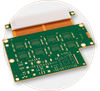
Flexible Circuit Technologies, Inc. Flat Flexible Circuits

Description
Flat flex circuits are light weight, low profile, small outline cables designed to satisfy high density cabling applications. Their distinguishing factors include repeated dynamic flexing and the ability to fold into nearly any shape, evenly distributing stress especially when compared to traditional cabling. Flat flex circuits can be designed to hold any number of electrical components or simply as a connector between two circuits. Common industry applications include, but are not limited to: consumer electronics, telecommunications, medical, automotive, industrial and commercial. As a unique flex circuit, the primary benefits of flat flex circuits include: High Flex Life Superior Heat Dissipation Light Weight Low Profile Durability Point-to-point Wire Replacement Foldable Multiple Termination Options High Flex Life – Flat flex circuits are designed to flex and move throughout their life cycle. By virtue of their design, they will out-flex, or out-live, conventional wiring. Superior Heat Dissipation – Due to the larger surface-to-volume ratio and compact design of flat flex circuits compared to traditional round wire, a shorter thermal path is allowed. Light Weight – Compared to traditional round cables, flat flex circuits are extremely thin, making them considerably lighter. Low Profile – Especially when compared to traditional cable, flat flex circuits’ thin design can help resolve some of the most complex design challenges. Durability – Particularly, in designs that have moving parts, the flat flex circuit can move and flex up to 5 million times without a failure. Point-to-Point Wire Replacement – Depending on the number of point-to-point connections in a circuit design, flat flex circuits are an easy solution when connecting various components within an application. Foldable – Flat flexible circuit cabling can folded many times over, enabling easier routing, particularly where space is limited. Multiple Termination Options – Flat flex circuits can be attached through a hot bar soldering process, through hole soldering or a variety of different connectors. In summary, if you have flexible design needs, Flexible Circuit Technologies can help.
Request a Quote
Description
Flat flex circuits are light weight, low profile, small outline cables designed to satisfy high density cabling applications. Their distinguishing factors include repeated dynamic flexing and the ability to fold into nearly any shape, evenly distributing stress especially when compared to traditional cabling. Flat flex circuits can be designed to hold any number of electrical components or simply as a connector between two circuits. Common industry applications include, but are not limited to: consumer electronics, telecommunications, medical, automotive, industrial and commercial. As a unique flex circuit, the primary benefits of flat flex circuits include: High Flex Life Superior Heat Dissipation Light Weight Low Profile Durability Point-to-point Wire Replacement Foldable Multiple Termination Options High Flex Life – Flat flex circuits are designed to flex and move throughout their life cycle. By virtue of their design, they will out-flex, or out-live, conventional wiring. Superior Heat Dissipation – Due to the larger surface-to-volume ratio and compact design of flat flex circuits compared to traditional round wire, a shorter thermal path is allowed. Light Weight – Compared to traditional round cables, flat flex circuits are extremely thin, making them considerably lighter. Low Profile – Especially when compared to traditional cable, flat flex circuits’ thin design can help resolve some of the most complex design challenges. Durability – Particularly, in designs that have moving parts, the flat flex circuit can move and flex up to 5 million times without a failure. Point-to-Point Wire Replacement – Depending on the number of point-to-point connections in a circuit design, flat flex circuits are an easy solution when connecting various components within an application. Foldable – Flat flexible circuit cabling can folded many times over, enabling easier routing, particularly where space is limited. Multiple Termination Options – Flat flex circuits can be attached through a hot bar soldering process, through hole soldering or a variety of different connectors. In summary, if you have flexible design needs, Flexible Circuit Technologies can help.
Request a Quote

Suppliers

Company
Product
Description
Supplier Links
Flat Flexible Circuits -  - Flexible Circuit Technologies, Inc.
Plymouth, MN, United States
Flat Flexible Circuits
Flat flex circuits are light weight, low profile, small outline cables designed to satisfy high density cabling applications. Their distinguishing factors include repeated dynamic flexing and the ability to fold into nearly any shape, evenly distributing stress especially when compared to traditional cabling. Flat flex circuits can be designed to hold any number of electrical components or simply as a connector between two circuits. Common industry applications include, but are not limited to: consumer electronics, telecommunications, medical, automotive, industrial and commercial. As a unique flex circuit, the primary benefits of flat flex circuits include: High Flex Life Superior Heat Dissipation Light Weight Low Profile Durability Point-to-point Wire Replacement Foldable Multiple Termination Options High Flex Life – Flat flex circuits are designed to flex and move throughout their life cycle. By virtue of their design, they will out-flex, or out-live, conventional wiring. Superior Heat Dissipation – Due to the larger surface-to-volume ratio and compact design of flat flex circuits compared to traditional round wire, a shorter thermal path is allowed. Light Weight – Compared to traditional round cables, flat flex circuits are extremely thin, making them considerably lighter. Low Profile – Especially when compared to traditional cable, flat flex circuits’ thin design can help resolve some of the most complex design challenges. Durability – Particularly, in designs that have moving parts, the flat flex circuit can move and flex up to 5 million times without a failure. Point-to-Point Wire Replacement – Depending on the number of point-to-point connections in a circuit design, flat flex circuits are an easy solution when connecting various components within an application. Foldable – Flat flexible circuit cabling can folded many times over, enabling easier routing, particularly where space is limited. Multiple Termination Options – Flat flex circuits can be attached through a hot bar soldering process, through hole soldering or a variety of different connectors. In summary, if you have flexible design needs, Flexible Circuit Technologies can help.

Flat flex circuits are light weight, low profile, small outline cables designed to satisfy high density cabling applications. Their distinguishing factors include repeated dynamic flexing and the ability to fold into nearly any shape, evenly distributing stress especially when compared to traditional cabling.

Flat flex circuits can be designed to hold any number of electrical components or simply as a connector between two circuits. Common industry applications include, but are not limited to: consumer electronics, telecommunications, medical, automotive, industrial and commercial.

As a unique flex circuit, the primary benefits of flat flex circuits include:

  • High Flex Life
  • Superior Heat Dissipation
  • Light Weight
  • Low Profile
  • Durability
  • Point-to-point Wire Replacement
  • Foldable
  • Multiple Termination Options

High Flex Life – Flat flex circuits are designed to flex and move throughout their life cycle. By virtue of their design, they will out-flex, or out-live, conventional wiring.

Superior Heat Dissipation – Due to the larger surface-to-volume ratio and compact design of flat flex circuits compared to traditional round wire, a shorter thermal path is allowed.

Light Weight – Compared to traditional round cables, flat flex circuits are extremely thin, making them considerably lighter.

Low Profile – Especially when compared to traditional cable, flat flex circuits’ thin design can help resolve some of the most complex design challenges.

Durability – Particularly, in designs that have moving parts, the flat flex circuit can move and flex up to 5 million times without a failure.

Point-to-Point Wire Replacement – Depending on the number of point-to-point connections in a circuit design, flat flex circuits are an easy solution when connecting various components within an application.

Foldable – Flat flexible circuit cabling can folded many times over, enabling easier routing, particularly where space is limited.

Multiple Termination Options – Flat flex circuits can be attached through a hot bar soldering process, through hole soldering or a variety of different connectors.

In summary, if you have flexible design needs, Flexible Circuit Technologies can help.

Supplier's Site

Technical Specifications

  Flexible Circuit Technologies, Inc.
Product Category Flexible Circuits
Product Name Flat Flexible Circuits
Applications Automotive Equipment; Commercial Equipment; Industrial Equipment; Medical Equipment; Telecommunication Equipment; Other; Consumer
Unlock Full Specs
to access all available technical data

Similar Products

Multi Layer Flexible Circuit -  - Flexible Circuit Technologies, Inc.
Flexible Circuit Technologies, Inc.
Specs
Applications Automotive Equipment; Commercial Equipment; Industrial Equipment; Medical Equipment; Telecommunication Equipment; Other; Consumer
Mounting Press Fit (optional feature); Surface Mount (optional feature); Through-Hole (optional feature)
Features Multi Layer; Shielding (optional feature)
View Details
Four-layer Rigid Flexible Circuits -  - Flexible Circuit Technologies, Inc.
Flexible Circuit Technologies, Inc.
Specs
Applications Automotive Equipment; Commercial Equipment; Industrial Equipment; Medical Equipment; Telecommunication Equipment; Other; Consumer
Mounting Press Fit (optional feature); Surface Mount (optional feature); Through-Hole (optional feature)
Features Multi Layer; Rigid Flex; Shielding (optional feature)
View Details
Six-layer Rigid Flexible Circuits -  - Flexible Circuit Technologies, Inc.
Flexible Circuit Technologies, Inc.
Specs
Applications Automotive Equipment; Commercial Equipment; Industrial Equipment; Medical Equipment; Telecommunication Equipment; Other; Consumer
Mounting Press Fit (optional feature); Surface Mount (optional feature); Through-Hole (optional feature)
Features Multi Layer; Rigid Flex; Shielding (optional feature)
View Details
Eight-layer Rigid Flexible Circuits -  - Flexible Circuit Technologies, Inc.
Flexible Circuit Technologies, Inc.
Specs
Applications Automotive Equipment; Commercial Equipment; Industrial Equipment; Medical Equipment; Telecommunication Equipment; Other; Consumer
Mounting Press Fit (optional feature); Surface Mount (optional feature); Through-Hole (optional feature)
Features Multi Layer; Rigid Flex; Shielding (optional feature)
View Details