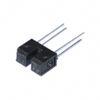
Wavelength-sensitive photodiodes utilize the effect of the wavelength-specific absorption depth of radiation in silicon. For this purpose, two p-n junctions are aligned vertically in the silicon crystal, thus enabling separate signal detection within vertically adjacent ranges. Such a configuration is particularly useful for the wavelength detection of monochromatic input signals. The calculation then merely requires the formation of a quotient between two photocurrents. The calculation of a color temperature from a non-monochromatic input signal requires two such detectors and an additional optical filter.
Features:
Two vertically aligned p-n junctions
Measuring range: 450-950 nm
Particularly suitable for monochromatic light
Wavelength-sensitive photodiodes utilize the effect of the wavelength-specific absorption depth of radiation in silicon. For this purpose, two p-n junctions are aligned vertically in the silicon crystal, thus enabling separate signal detection within vertically adjacent ranges. Such a configuration is particularly useful for the wavelength detection of monochromatic input signals. The calculation then merely requires the formation of a quotient between two photocurrents. The calculation of a color temperature from a non-monochromatic input signal requires two such detectors and an additional optical filter.
Features:
- Two vertically aligned p-n junctions
- Measuring range: 450-950 nm
- Particularly suitable for monochromatic light