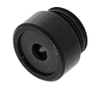
Plano-convex axicons have one conical and one plano surface. Axicons can be defined by their apex angle.
Conical lenses are used to transform the light into a ring or to create an approximation of non-diffractive Bessel beam from collimated Gaussian beam in the near field.
A combination of axicons and spherical lenses can be used to convert a parallel laser beam into a thick-walled hollow "pipe" of light or to produce an annular focus.
Precision and standard grade axicons
Made of BK7 or UVFS
Range of cone apex angles: 140o to 179o
Coated axicons or axicons made from other optical materials can be supplied
Plano-convex axicons have one conical and one plano surface. Axicons can be defined by their apex angle.
Conical lenses are used to transform the light into a ring or to create an approximation of non-diffractive Bessel beam from collimated Gaussian beam in the near field.
A combination of axicons and spherical lenses can be used to convert a parallel laser beam into a thick-walled hollow "pipe" of light or to produce an annular focus.
- Precision and standard grade axicons
- Made of BK7 or UVFS
- Range of cone apex angles: 140o to 179o
- Coated axicons or axicons made from other optical materials can be supplied