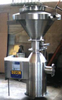
Ducon Environmental Systems  Venturi Scrubber

Description
To remove sub-micron particles from flue gas Ducon's Venturi scrubber uses a wet process utilizing high pressure drop. Our venturi scrubber features a wetted wall inlet that eliminates wet-dry build-up. Distributing the scrubbing liquid over a inlet perimeter of the venturi (Weir) eliminates the use of spray nozzles any potential for plugging. Downstream of the venturi an efficient entrainment separation is accomplished using either a mist eliminator or a cyclonic separator The 3 sections of a Ducon Venturi scrubber are converging, throat, and diverging sections. Inlet gas stream enters the scrubber at the converging section. As the gas cycles down to the throat it increases speed causing liquid from the walls to tear into tiny droplets. These tiny liquid droplets entrain particles. Downstream particle removal happens in the diverging section as the gas is forced to slow down. A Venturi Scrubber can be engineered to collect both particulate and gas pollutants. That being said, the most efficient use of a Venturi Scrubber is to remove particles. Packed towers, FGD, and other scrubber technology are more efficient at removing gas pollutants.
Request a Quote
Description
To remove sub-micron particles from flue gas Ducon's Venturi scrubber uses a wet process utilizing high pressure drop. Our venturi scrubber features a wetted wall inlet that eliminates wet-dry build-up. Distributing the scrubbing liquid over a inlet perimeter of the venturi (Weir) eliminates the use of spray nozzles any potential for plugging. Downstream of the venturi an efficient entrainment separation is accomplished using either a mist eliminator or a cyclonic separator The 3 sections of a Ducon Venturi scrubber are converging, throat, and diverging sections. Inlet gas stream enters the scrubber at the converging section. As the gas cycles down to the throat it increases speed causing liquid from the walls to tear into tiny droplets. These tiny liquid droplets entrain particles. Downstream particle removal happens in the diverging section as the gas is forced to slow down. A Venturi Scrubber can be engineered to collect both particulate and gas pollutants. That being said, the most efficient use of a Venturi Scrubber is to remove particles. Packed towers, FGD, and other scrubber technology are more efficient at removing gas pollutants.
Request a Quote

Suppliers

Company
Product
Description
Supplier Links
Venturi Scrubber -  - Ducon Environmental Systems 
Farmingdale, NY, United States
Venturi Scrubber
Venturi Scrubber
To remove sub-micron particles from flue gas Ducon's Venturi scrubber uses a wet process utilizing high pressure drop. Our venturi scrubber features a wetted wall inlet that eliminates wet-dry build-up. Distributing the scrubbing liquid over a inlet perimeter of the venturi (Weir) eliminates the use of spray nozzles any potential for plugging. Downstream of the venturi an efficient entrainment separation is accomplished using either a mist eliminator or a cyclonic separator The 3 sections of a Ducon Venturi scrubber are converging, throat, and diverging sections. Inlet gas stream enters the scrubber at the converging section. As the gas cycles down to the throat it increases speed causing liquid from the walls to tear into tiny droplets. These tiny liquid droplets entrain particles. Downstream particle removal happens in the diverging section as the gas is forced to slow down. A Venturi Scrubber can be engineered to collect both particulate and gas pollutants. That being said, the most efficient use of a Venturi Scrubber is to remove particles. Packed towers, FGD, and other scrubber technology are more efficient at removing gas pollutants.

To remove sub-micron particles from flue gas Ducon's Venturi scrubber uses a wet process utilizing high pressure drop. Our venturi scrubber features a wetted wall inlet that eliminates wet-dry build-up. Distributing the scrubbing liquid over a inlet perimeter of the venturi (Weir) eliminates the use of spray nozzles any potential for plugging. Downstream of the venturi an efficient entrainment separation is accomplished using either a mist eliminator or a cyclonic separator The 3 sections of a Ducon Venturi scrubber are converging, throat, and diverging sections. Inlet gas stream enters the scrubber at the converging section. As the gas cycles down to the throat it increases speed causing liquid from the walls to tear into tiny droplets. These tiny liquid droplets entrain particles. Downstream particle removal happens in the diverging section as the gas is forced to slow down. A Venturi Scrubber can be engineered to collect both particulate and gas pollutants. That being said, the most efficient use of a Venturi Scrubber is to remove particles. Packed towers, FGD, and other scrubber technology are more efficient at removing gas pollutants.

Supplier's Site

Technical Specifications

  Ducon Environmental Systems 
Product Category Scrubbers
Product Name Venturi Scrubber
Process Type Wet Type
Unlock Full Specs
to access all available technical data

Similar Products

LIMESTONE FGD -  - Ducon Environmental Systems 
Ducon Environmental Systems 
Specs
Process Type Wet Type
Filter Type Wet Scrubber
Efficiency 9.9 to 99.9 %
View Details
SEAWATER FGD -  - Ducon Environmental Systems 
Ducon Environmental Systems 
Specs
Pollutants Scrubbed Other Pollents; SO2
Process Type Wet Type
View Details
Chemical Absorption Scrubber -  - Ducon Environmental Systems 
Ducon Environmental Systems 
Specs
Pollutants Scrubbed NOx; Other Pollents; SO2, HCl, H2S, NOx, NH3, CO2, TRS, Organics, odors, fumes and other toxic components
Process Type Wet Type
Filter Type Spray Scrubber (optional feature)
View Details
Dry FGD (Dry Sorbent Injection) -  - Ducon Environmental Systems 
Ducon Environmental Systems 
Specs
Pollutants Scrubbed Other Pollents; Sulfur dioxide, hydrogen chloride, and other toxic components
Process Type Dry Type
View Details
