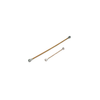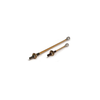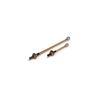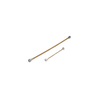
Stock Drive Products & Sterling Instrument - SDP/SI 0.13" Dia. flexible steel cable without casing and with plated steel ends A 7C12-05422A

Description
Couplings Types Couplings can be divided into two categories: flexible and rigid. Both types are used to connect two rotating shafts driven by a motor and transmit torque and angular velocity; however, flexible couplings and shafts are designed to accommodate angular misalignment, angular offset, axial movement, and a variety of load conditions. A flexible coupling is pliable due to the twisting and compression of a durable, adaptable material, like neoprene, rubber, or silicone. Flexibility can also be achieved with thin metal disks, corrugated aluminum bellows (bellows couplings), or even a stainless-steel ball (miniature ball couplings). Some materials can provide vibration reduction, as in our precision flexible antivibration couplings. Rigid couplings are limited by comparison; rigid couplings are used when shafts are already positioned in precise lateral and angular alignment. Their rigid design inhibits shaft misalignment. They can generally transmit more power than flexible couplings due to their rigidity. Even the most complicated application challenges can be solved by our skilled engineers, they will identify the best coupling solution for your application. SDP/SI provides a comprehensive range of rigid and flexible couplings. Many of our precision couplings, including the Miniature Bellows Coupling and the Neo-Flex Coupling, have our patented Fairloc® Hub design, which solves phasing, timing, positioning, and frequent removal problems. For more about the easily adjustable Fairloc® hub design click here. Precision Magnetic Disk Couplings Precision Flexible Bellows Couplings Precision Miniature Ball Couplings Precision Flexible Antivibration Couplings 1 2 3 4
Request a Quote
Datasheet
Datasheet Summary
Powered by GS/AI

A 7C12-05422A is a flexible steel cable shaft with a 0.130-inch diameter and plated steel end fittings, designed for torque transmission in remote control applications. It has a length of 5 inches, features a No. 2 end fitting on one end and a No. 3 end fitting on the other, and is rated for a maximum torsional torque of 13.0 lbf·in. in manual operation and 3.8 lbf·in. under dynamic conditions at a 20-inch radius of curvature. The shaft is engineered for high flexibility, with a torsional deflection of 19.5 degrees per foot under manual load at that radius. This part belongs to a series where variations in diameter, length, and end fittings are available, and the A variant indicates enhanced flexibility compared to standard .130-inch shafts.

Suppliers

Company
Product
Description
Supplier Links
0.13
Hicksville, NY, United States
0.13" Dia. flexible steel cable without casing and with plated steel ends
A 7C12-05422A
0.13" Dia. flexible steel cable without casing and with plated steel ends A 7C12-05422A
Couplings Types Couplings can be divided into two categories: flexible and rigid. Both types are used to connect two rotating shafts driven by a motor and transmit torque and angular velocity; however, flexible couplings and shafts are designed to accommodate angular misalignment, angular offset, axial movement, and a variety of load conditions. A flexible coupling is pliable due to the twisting and compression of a durable, adaptable material, like neoprene, rubber, or silicone. Flexibility can also be achieved with thin metal disks, corrugated aluminum bellows (bellows couplings), or even a stainless-steel ball (miniature ball couplings). Some materials can provide vibration reduction, as in our precision flexible antivibration couplings. Rigid couplings are limited by comparison; rigid couplings are used when shafts are already positioned in precise lateral and angular alignment. Their rigid design inhibits shaft misalignment. They can generally transmit more power than flexible couplings due to their rigidity. Even the most complicated application challenges can be solved by our skilled engineers, they will identify the best coupling solution for your application. SDP/SI provides a comprehensive range of rigid and flexible couplings. Many of our precision couplings, including the Miniature Bellows Coupling and the Neo-Flex Coupling, have our patented Fairloc® Hub design, which solves phasing, timing, positioning, and frequent removal problems. For more about the easily adjustable Fairloc® hub design click here. Precision Magnetic Disk Couplings Precision Flexible Bellows Couplings Precision Miniature Ball Couplings Precision Flexible Antivibration Couplings 1 2 3 4

Couplings Types

Couplings can be divided into two categories: flexible and rigid. Both types are used to connect two rotating shafts driven by a motor and transmit torque and angular velocity; however, flexible couplings and shafts are designed to accommodate angular misalignment, angular offset, axial movement, and a variety of load conditions. A flexible coupling is pliable due to the twisting and compression of a durable, adaptable material, like neoprene, rubber, or silicone.


Flexibility can also be achieved with thin metal disks, corrugated aluminum bellows (bellows couplings), or even a stainless-steel ball (miniature ball couplings). Some materials can provide vibration reduction, as in our precision flexible antivibration couplings.

Rigid couplings are limited by comparison; rigid couplings are used when shafts are already positioned in precise lateral and angular alignment. Their rigid design inhibits shaft misalignment. They can generally transmit more power than flexible couplings due to their rigidity.

Even the most complicated application challenges can be solved by our skilled engineers, they will identify the best coupling solution for your application. SDP/SI provides a comprehensive range of rigid and flexible couplings. Many of our precision couplings, including the Miniature Bellows Coupling and the Neo-Flex Coupling, have our patented Fairloc® Hub design, which solves phasing, timing, positioning, and frequent removal problems. For more about the easily adjustable Fairloc® hub design click here.


Precision Magnetic Disk Couplings


Precision Flexible Bellows Couplings


Precision Miniature Ball Couplings


Precision Flexible Antivibration Couplings


  • 1
  • 2
  • 3
  • 4
Supplier's Site Datasheet

Technical Specifications

  Stock Drive Products & Sterling Instrument - SDP/SI
Product Category Flexible Shafts
Product Number A 7C12-05422A
Product Name 0.13" Dia. flexible steel cable without casing and with plated steel ends
Torque Capacity 1.12 In-lbs (1.29 kg-cm)
Unlock Full Specs
to access all available technical data

Similar Products

3.3 Dia. Steel Flexible Cable - A 7C13M3307611A - Stock Drive Products & Sterling Instrument - SDP/SI
Stock Drive Products & Sterling Instrument - SDP/SI
Specs
Torque Capacity 0.5310 In-lbs (0.6122 kg-cm)
Length 0.2493 ft (0.7600 dm)
View Details
0.15 Dia. Steel Flexible Cable - A 7C13-05522 - Stock Drive Products & Sterling Instrument - SDP/SI
Stock Drive Products & Sterling Instrument - SDP/SI
Specs
Torque Capacity 20.9 In-lbs (24.1 kg-cm)
Length 0.0032 ft (0.0096 dm)
View Details
3.8 Dia. Steel Flexible Cable - A 7C12M3830533 - Stock Drive Products & Sterling Instrument - SDP/SI
Stock Drive Products & Sterling Instrument - SDP/SI
Specs
Torque Capacity 7.7 In-lbs (8.88 kg-cm)
Diameter 0.5000 inch (12.7 mm)
Length 1 ft (3.05 dm)
View Details
3.8 Dia. Steel Flexible Cable - S55SS7MFSH38150 - Stock Drive Products & Sterling Instrument - SDP/SI
Stock Drive Products & Sterling Instrument - SDP/SI
Specs
Torque Capacity 1.86 In-lbs (2.14 kg-cm)
Diameter 0.5000 inch (12.7 mm)
Length 0.4921 ft (1.5 dm)
View Details