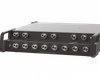
Data Connect Enterprise, Inc.48 24-Port VDSL2 30A DSLAM 2-SFP5224V-DSGFP
Description
Features
VDSL Interface
24 Full duplex VDSL links via RJ-21 (Telco-50) connector
24 corresponding POTS lines via RJ-21 (Telco-50) connector
Built-in POTS splitter for each VDSL port
Link to 5201V-BM, 5204V-BM, 5204V-MR, 5204V-NRD
Auto-speed function for VDSL2 link (by distance and cable quality)
Ethernet Interface
2 10/100/1000Mbps TP and SFP shard combo interfaces
Auto-MDI / MDI-X detection on Gigabit RJ45 port
VDSL2 Features
Cost-effective VDSL2 link and central management solution
Compliant with VDSL2 standard – ITU-T G.993.2 – ITU-T G.994.1 – ITU-T G.997.1
ITU-T G.993.2, 8a / 8b / 8c / 8d / 12a / 12b / 17a / 30a
Configurable Line Template and Alarm Template
Configurable UPBO / DPBO / US0 Allow / Virtual Noise PSD
Configurable Bits warp / G.hs carrier set / RFI Band
Manual / RaInit / Dynamic Rate Adaption
DMT (Discrete Multi-Tone) line coding VDSL
Up to 100/100Mbps symmetric data rate
Selectable target data rate and target SNR margin
Built-in surge protection to against surge damage from high energy spike
Voice and data communication can be shared on the existing telephone wire simultaneously
Supports Downstream / Upstream rate control on each port
Layer 2 Features
High performance of Store-and Forward architecture, runt / CRC filtering eliminate erroneous packets to optimize the network bandwidth
Broadcast / Multicast / Unicast storm control
Supports VLAN – IEEE 802.1Q Tag-Based VLAN – Port-Base VLAN – Q-in-Q tunneling (VLAN Stacking) – GVRP for dynamic VLAN management – Private VLAN Edge (PVE / Protected port)
Link Aggregation – IEEE 802.3ad LACP (Link Aggregation Control Protocol) – Cisco ether-channel (Static Trunk)
Spanning Tree Protocol – STP, IEEE 802.1D (Class Spanning Tree Protocol) -MSTP, IEEE 802.1s (Multiple Spanning Tree Protocol, Spanning Tree by VLAN)
Port Mirroring to monitor the incoming or outgoing traffic on a particular port
PPPoE packet pass-through
VPN pass-through
Quality of Service
4 Priority queues on all switch ports
Traffic classifications – IEEE 802.1p CoS – IP TOS /DSCP to 802.1p priority mapping – Port-Based priority
Strict priority and Weighted Round Robin (WRR) CoS policies
Voice QoS by application source / destination protocol no.
Multicast
Support IGMP Snooping v1 and v2
IGMP snooping v2 fast leave
Querier mode support
Security
IEEE 802.1x Port-Based network access control protocol
RADIUS users access authentication
L3 / L4 Access Control List (ACL)
MAC Filtering and source IP-MAC / Port-Binding
Port Security for source MAC address entries
Management
Switch Management Interface – Telnet Command Line Interface – Web switch management – SNMP v1, v2c, v3 switch management – SSL switch management
DHCP client for IP address assignment
DHCP Option 82 and DHCP Relay
SNTP (Simple Network Time Protocol)
Built-in Trivial File Transfer Protocol (TFTP) client
Firmware upgrade via TFTP or HTTP
Configuration upload / download via TFTP or HTTP
Four RMON groups 1, 2, 3, 9 (history, statistics, alarms, and events)
SNMP trap for interface Link Up and Link Down notification
Logging to remote syslog server
Link Layer Discovery Protocol (LLDP) for easy network management
Supports Ping function
Reset button for system management
1 RS-232 male DB9 console interface for Switch basic management and setup
User Privilege Control – admin, operator, viewer
Redundant Power System
100 ~ 240V AC / 48V DC Dual power redundant (Optional)
Active- active redundant power failure protection
Backup of catastrophic power failure on one supply
Data Connect Enterprise, Inc.
Done
Description
Features
VDSL Interface
24 Full duplex VDSL links via RJ-21 (Telco-50) connector
24 corresponding POTS lines via RJ-21 (Telco-50) connector
Built-in POTS splitter for each VDSL port
Link to 5201V-BM, 5204V-BM, 5204V-MR, 5204V-NRD
Auto-speed function for VDSL2 link (by distance and cable quality)
Ethernet Interface
2 10/100/1000Mbps TP and SFP shard combo interfaces
Auto-MDI / MDI-X detection on Gigabit RJ45 port
VDSL2 Features
Cost-effective VDSL2 link and central management solution
Compliant with VDSL2 standard – ITU-T G.993.2 – ITU-T G.994.1 – ITU-T G.997.1
ITU-T G.993.2, 8a / 8b / 8c / 8d / 12a / 12b / 17a / 30a
Configurable Line Template and Alarm Template
Configurable UPBO / DPBO / US0 Allow / Virtual Noise PSD
Configurable Bits warp / G.hs carrier set / RFI Band
Manual / RaInit / Dynamic Rate Adaption
DMT (Discrete Multi-Tone) line coding VDSL
Up to 100/100Mbps symmetric data rate
Selectable target data rate and target SNR margin
Built-in surge protection to against surge damage from high energy spike
Voice and data communication can be shared on the existing telephone wire simultaneously
Supports Downstream / Upstream rate control on each port
Layer 2 Features
High performance of Store-and Forward architecture, runt / CRC filtering eliminate erroneous packets to optimize the network bandwidth
Broadcast / Multicast / Unicast storm control
Supports VLAN – IEEE 802.1Q Tag-Based VLAN – Port-Base VLAN – Q-in-Q tunneling (VLAN Stacking) – GVRP for dynamic VLAN management – Private VLAN Edge (PVE / Protected port)
Link Aggregation – IEEE 802.3ad LACP (Link Aggregation Control Protocol) – Cisco ether-channel (Static Trunk)
Spanning Tree Protocol – STP, IEEE 802.1D (Class Spanning Tree Protocol) -MSTP, IEEE 802.1s (Multiple Spanning Tree Protocol, Spanning Tree by VLAN)
Port Mirroring to monitor the incoming or outgoing traffic on a particular port
PPPoE packet pass-through
VPN pass-through
Quality of Service
4 Priority queues on all switch ports
Traffic classifications – IEEE 802.1p CoS – IP TOS /DSCP to 802.1p priority mapping – Port-Based priority
Strict priority and Weighted Round Robin (WRR) CoS policies
Voice QoS by application source / destination protocol no.
Multicast
Support IGMP Snooping v1 and v2
IGMP snooping v2 fast leave
Querier mode support
Security
IEEE 802.1x Port-Based network access control protocol
RADIUS users access authentication
L3 / L4 Access Control List (ACL)
MAC Filtering and source IP-MAC / Port-Binding
Port Security for source MAC address entries
Management
Switch Management Interface – Telnet Command Line Interface – Web switch management – SNMP v1, v2c, v3 switch management – SSL switch management
DHCP client for IP address assignment
DHCP Option 82 and DHCP Relay
SNTP (Simple Network Time Protocol)
Built-in Trivial File Transfer Protocol (TFTP) client
Firmware upgrade via TFTP or HTTP
Configuration upload / download via TFTP or HTTP
Four RMON groups 1, 2, 3, 9 (history, statistics, alarms, and events)
SNMP trap for interface Link Up and Link Down notification
Logging to remote syslog server
Link Layer Discovery Protocol (LLDP) for easy network management
Supports Ping function
Reset button for system management
1 RS-232 male DB9 console interface for Switch basic management and setup
User Privilege Control – admin, operator, viewer
Redundant Power System
100 ~ 240V AC / 48V DC Dual power redundant (Optional)
Active- active redundant power failure protection
Backup of catastrophic power failure on one supply
Features
VDSL Interface
24 Full duplex VDSL links via RJ-21 (Telco-50) connector
24 corresponding POTS lines via RJ-21 (Telco-50) connector
Built-in POTS splitter for each VDSL port
Link to 5201V-BM, 5204V-BM, 5204V-MR, 5204V-NRD
Auto-speed function for VDSL2 link (by distance and cable quality)
Ethernet Interface
2 10/100/1000Mbps TP and SFP shard combo interfaces
Auto-MDI / MDI-X detection on Gigabit RJ45 port
VDSL2 Features
Cost-effective VDSL2 link and central management solution
Compliant with VDSL2 standard – ITU-T G.993.2 – ITU-T G.994.1 – ITU-T G.997.1
ITU-T G.993.2, 8a / 8b / 8c / 8d / 12a / 12b / 17a / 30a
Configurable Line Template and Alarm Template
Configurable UPBO / DPBO / US0 Allow / Virtual Noise PSD
Configurable Bits warp / G.hs carrier set / RFI Band
Manual / RaInit / Dynamic Rate Adaption
DMT (Discrete Multi-Tone) line coding VDSL
Up to 100/100Mbps symmetric data rate
Selectable target data rate and target SNR margin
Built-in surge protection to against surge damage from high energy spike
Voice and data communication can be shared on the existing telephone wire simultaneously
Supports Downstream / Upstream rate control on each port
Layer 2 Features
High performance of Store-and Forward architecture, runt / CRC filtering eliminate erroneous packets to optimize the network bandwidth
Broadcast / Multicast / Unicast storm control
Supports VLAN – IEEE 802.1Q Tag-Based VLAN – Port-Base VLAN – Q-in-Q tunneling (VLAN Stacking) – GVRP for dynamic VLAN management – Private VLAN Edge (PVE / Protected port)
Link Aggregation – IEEE 802.3ad LACP (Link Aggregation Control Protocol) – Cisco ether-channel (Static Trunk)
Spanning Tree Protocol – STP, IEEE 802.1D (Class Spanning Tree Protocol) -MSTP, IEEE 802.1s (Multiple Spanning Tree Protocol, Spanning Tree by VLAN)
Port Mirroring to monitor the incoming or outgoing traffic on a particular port
PPPoE packet pass-through
VPN pass-through
Quality of Service
4 Priority queues on all switch ports
Traffic classifications – IEEE 802.1p CoS – IP TOS /DSCP to 802.1p priority mapping – Port-Based priority
Strict priority and Weighted Round Robin (WRR) CoS policies
Voice QoS by application source / destination protocol no.
Multicast
Support IGMP Snooping v1 and v2
IGMP snooping v2 fast leave
Querier mode support
Security
IEEE 802.1x Port-Based network access control protocol
RADIUS users access authentication
L3 / L4 Access Control List (ACL)
MAC Filtering and source IP-MAC / Port-Binding
Port Security for source MAC address entries
Management
Switch Management Interface – Telnet Command Line Interface – Web switch management – SNMP v1, v2c, v3 switch management – SSL switch management
DHCP client for IP address assignment
DHCP Option 82 and DHCP Relay
SNTP (Simple Network Time Protocol)
Built-in Trivial File Transfer Protocol (TFTP) client
Firmware upgrade via TFTP or HTTP
Configuration upload / download via TFTP or HTTP
Four RMON groups 1, 2, 3, 9 (history, statistics, alarms, and events)
SNMP trap for interface Link Up and Link Down notification
Logging to remote syslog server
Link Layer Discovery Protocol (LLDP) for easy network management
Supports Ping function
Reset button for system management
1 RS-232 male DB9 console interface for Switch basic management and setup
User Privilege Control – admin, operator, viewer
Redundant Power System
100 ~ 240V AC / 48V DC Dual power redundant (Optional)
Active- active redundant power failure protection
Backup of catastrophic power failure on one supply
Features
VDSL Interface
24 Full duplex VDSL links via RJ-21 (Telco-50) connector
24 corresponding POTS lines via RJ-21 (Telco-50) connector
Built-in POTS splitter for each VDSL port
Link to 5201V-BM, 5204V-BM, 5204V-MR, 5204V-NRD
Auto-speed function for VDSL2 link (by distance and cable quality)
Ethernet Interface
2 10/100/1000Mbps TP and SFP shard combo interfaces
Auto-MDI / MDI-X detection on Gigabit RJ45 port
VDSL2 Features
Cost-effective VDSL2 link and central management solution
Compliant with VDSL2 standard – ITU-T G.993.2 – ITU-T G.994.1 – ITU-T G.997.1