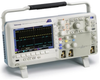
Tektronix, Inc. Digital Oscilloscope DPO2012

Description
The DPO2012 is a 100 MHz, 2 channel digital oscilloscope from Tektronix. Measure voltage or current signals over time in an electronic circuit or component to display amplitude, frequency and rise times, etc. Applications include troubleshooting, production test, and design. Additional Features: Bandwidth: 100 MHz 2 Channels 1 GS/s Sample Rate on All Channels 1 Megapoint Record Length on All Channels 5,000 wfm/s Maximum Waveform Capture Rate Suite of advanced triggers Serial Bus Trigger and Decode I2C, SPI, CAN, LIN, and RS-232/422/485/UART serial triggering, decode, and analysis options Ease of Use Features Wave Inspector® Controls Provide Easy Navigation and Automated Search of Waveform Data FilterVu™ Variable Low-pass Filter Allows for Removal of Unwanted Signal Noise while still Capturing High-frequency Events 29 Automated Measurements, and FFT Analysis for Simplified Waveform Analysis TekVPI® Probe Interface Supports Active, Differential, and Current Probes for Automatic Scaling and Units 7 in. (180 mm) Widescreen TFT-LCD Color Display USB 2.0 Host Port on the Front Panel for Quick and Easy Data Storage USB 2.0 Device Port on Rear Panel for Easy Connection to a PC or Direct Printing to a PictBridge®-compatib le Printer Plug 'n' Play PC connectivity and analysis software solutions TekVPI Probe Interface supports active, differential, and current probes for automatic scaling and units The Tektronix DPO2012 digital phosphor oscilloscope (DPOs) delivers the performance and tools you need to visualize your signals and find answers quickly. The DPO2000 Series are the first oscilloscopes to provide 1 M points of usable record length on all channels, serial trigger and decode analysis options, a variable low-pass filter that also allows you to see signal details to the oscilloscope’s full bandwidth and all in a compact form factor. Wave Inspector Navigation and Search Record length, one of the key specifications of an oscilloscope, is the number of samples it can digitize and store in a single acquisition. The longer the record length, the longer the time window you can capture with high timing resolution (high sample rate). The first digital oscilloscopes could capture and store only 500 points, which made it very difficult to acquire all relevant information around the event being investigated. Over the years, oscilloscope vendors have provided longer and longer record lengths to meet market demands for long capture windows with high resolution. These mega-point record lengths often represent thousands of screens worth of signal activity. While standard record lengths have increased greatly over the years and can now satisfy the vast majority of applications in the marketplace, tools for effectively and efficiently viewing, navigating, and analyzing long record length acquisitions have been sorely neglected until now. The Tektronix MSO/DPO2000 Series redefines expectations for working with long record lengths with the following innovative Wave Inspector controls: Zoom/Pan A dedicated, two-tier front-panel control provides intuitive control of both zooming and panning. The inner control adjusts the zoom factor (or zoom scale); turning it clockwise activates zoom and goes to progressively higher zoom factors, while turning it counterclockwise results in lower zoom factors and eventually turning zoom off. The outer control pans the zoom box across the waveform to quickly get to the portion of the waveform you are interested in. The outer control also utilizes force-feedback to determine how fast to pan on the waveform. The farther you turn the outer control, the faster the zoom box moves. Pan direction is changed by simply turning the control the other way. No longer do you need to navigate through multiple menus to adjust your zoom view. Play/Pause A dedicated play/pause button on the front panel scrolls the waveform across the display automatically while you look for anomalies or an event of interest. Playback speed and direction are controlled using the intuitive pan control. Once again, turning the control further makes the waveform scroll faster and changing direction is as simple as turning the control the other way. User Marks See something interesting on your waveform? Press the Set Mark button on the front panel to leave one or more “bookmarks” on the waveform. Navigating between marks is as simple as pressing the Previous (←) and Next (→) buttons on the front panel Search Marks Don’t want to take the time to inspect the entire acquisition manually to find the event you’re looking for? The MSO/DPO2000 Series features a robust automatic waveform search feature that allows you to search through your long acquisition based on user-defined criteria. All occurrences of the event are highlighted with search marks and are easily navigated to, using the front-panel Previous (←) and Next (→) buttons. Search types include edge, pulse width, runt, logic, setup and hold, rise/fall time and parallel, I2C, SPI, RS-232/422/485/ UART, CAN, and LIN packet content. Serial Triggering and Analysis One of the most common applications requiring long record length is serial data analysis in embedded system design. Embedded systems are virtually everywhere. They can contain many different types of devices including microprocessors, microcontrollers, DSPs, RAM, EEPROMs, FPGAs, ADCs, DACs, and I/O. These various devices have traditionally communicated with each other and the outside world using wide parallel buses. Today, however, more and more embedded systems are replacing these wide parallel buses with serial buses due to lower board space requirements, fewer pins, lower power, embedded clocks, differential signaling for better noise immunity and most importantly, lower cost. In addition, there’s a large supply of off-the-shelf building block components from reputable manufacturers, enabling rapid design development. While serial buses have a large number of benefits, they also present significant challenges that their predecessors (parallel buses) did not face. They make debugging bus and system problems more difficult, it’s harder to isolate events of interest and it’s more difficult to interpret what is displayed on the oscilloscope screen. The MSO2000 and DPO2000 Series address these challenges and represent the ultimate tool for engineers working with serial buses such as I2C, SPI, RS-232/422/ 485/UART, CAN, and LIN. Bus Display Provides a higher level, combined view of the individual signals (clock, data, chip enable, etc.) that make up your bus, making it easy to identify where packets begin and end and identifying sub-packet components such as address, data, identifier, CRC, etc. Serial Triggering Trigger on packet content such as start of packet, specific addresses, specific data content, unique identifiers, etc., on popular serial interfaces - I2C, SPI, RS-232/422/485/UART, CAN, and LIN. Bus Decoding Tired of having to visually inspect the waveform to count clocks and determine if each bit is a 1 or a 0, and then combine bits into bytes and determine the hex value? Let the oscilloscope do it for you! Once you’ve set up a bus, the oscilloscope will decode each packet on the bus and display the value in either hex, binary, decimal (LIN only), or ASCII (RS-232/422/485/UART only) in the bus waveform. Event Table In addition to seeing decoded packet data on the bus waveform itself, you can view all captured packets in a tabular view much like you would see on a logic analyzer. Packets are time-stamped and listed consecutively with columns for each component (Address, Data, etc.). The event table can also be exported for use offline. Search Serial triggering is very useful for isolating an event of interest, but once you’ve captured it and need to analyze the surrounding data, what do you do? In the past, you had to manually scroll through the waveform, counting and converting bits and looking for what caused the event. With the MSO2000 and DPO2000 Series, you can have the oscilloscope automatically search through the acquired data for user-defined criteria including serial packet content. Each occurrence is marked for easy reference. Rapid navigation between marks is as simple as pressing the Previous (←) and Next (→) buttons on the front panel. PC Connectivity and USB Data Storage The MSO2000 and DPO2000 Series provides flexibility in data transfer with standard USB host and device ports which enable removable data storage, seamless PC connectivity, and direct printing. Also available are optional GPIB, LAN, and Video-Out adaptors. Easily capture, save and analyze measurement results with OpenChoice® Desktop PC Communications software. Simply pull screen images and waveform data into the stand-alone desktop application or directly in Microsoft Word and Excel. To complement OpenChoice, National Instruments LabVIEW SignalExpressTM Tektronix Edition software provides you with extended capabilities, including advanced analysis, remote oscilloscope control and live waveform analysis. Alternatively, if you prefer not to use the PC, you can simply print your image directly to any PictBridge® compatible printer using the USB device port. TekVPI® Probing The TekVPI probe interface sets the standard for ease of use in probing. TekVPI probes feature status indicators and controls, as well as a probe menu button right on the input compensation box itself. This button brings up a probe menu on the oscilloscope display with all relevant settings and controls for the probe. The TekVPI interface utilizes a new probe power management architecture enabling direct attachment of current probes (Requires TekVPI External Power Supply - Tektronix Part number: 119-7465-xx). Finally, TekVPI probes can be controlled remotely by using USB, GPIB, or Ethernet, enabling more versatile solutions in ATE environments.
Datasheet
Description
The DPO2012 is a 100 MHz, 2 channel digital oscilloscope from Tektronix. Measure voltage or current signals over time in an electronic circuit or component to display amplitude, frequency and rise times, etc. Applications include troubleshooting, production test, and design. Additional Features: Bandwidth: 100 MHz 2 Channels 1 GS/s Sample Rate on All Channels 1 Megapoint Record Length on All Channels 5,000 wfm/s Maximum Waveform Capture Rate Suite of advanced triggers Serial Bus Trigger and Decode I2C, SPI, CAN, LIN, and RS-232/422/485/UART serial triggering, decode, and analysis options Ease of Use Features Wave Inspector® Controls Provide Easy Navigation and Automated Search of Waveform Data FilterVu™ Variable Low-pass Filter Allows for Removal of Unwanted Signal Noise while still Capturing High-frequency Events 29 Automated Measurements, and FFT Analysis for Simplified Waveform Analysis TekVPI® Probe Interface Supports Active, Differential, and Current Probes for Automatic Scaling and Units 7 in. (180 mm) Widescreen TFT-LCD Color Display USB 2.0 Host Port on the Front Panel for Quick and Easy Data Storage USB 2.0 Device Port on Rear Panel for Easy Connection to a PC or Direct Printing to a PictBridge®-compatib le Printer Plug 'n' Play PC connectivity and analysis software solutions TekVPI Probe Interface supports active, differential, and current probes for automatic scaling and units The Tektronix DPO2012 digital phosphor oscilloscope (DPOs) delivers the performance and tools you need to visualize your signals and find answers quickly. The DPO2000 Series are the first oscilloscopes to provide 1 M points of usable record length on all channels, serial trigger and decode analysis options, a variable low-pass filter that also allows you to see signal details to the oscilloscope’s full bandwidth and all in a compact form factor. Wave Inspector Navigation and Search Record length, one of the key specifications of an oscilloscope, is the number of samples it can digitize and store in a single acquisition. The longer the record length, the longer the time window you can capture with high timing resolution (high sample rate). The first digital oscilloscopes could capture and store only 500 points, which made it very difficult to acquire all relevant information around the event being investigated. Over the years, oscilloscope vendors have provided longer and longer record lengths to meet market demands for long capture windows with high resolution. These mega-point record lengths often represent thousands of screens worth of signal activity. While standard record lengths have increased greatly over the years and can now satisfy the vast majority of applications in the marketplace, tools for effectively and efficiently viewing, navigating, and analyzing long record length acquisitions have been sorely neglected until now. The Tektronix MSO/DPO2000 Series redefines expectations for working with long record lengths with the following innovative Wave Inspector controls: Zoom/Pan A dedicated, two-tier front-panel control provides intuitive control of both zooming and panning. The inner control adjusts the zoom factor (or zoom scale); turning it clockwise activates zoom and goes to progressively higher zoom factors, while turning it counterclockwise results in lower zoom factors and eventually turning zoom off. The outer control pans the zoom box across the waveform to quickly get to the portion of the waveform you are interested in. The outer control also utilizes force-feedback to determine how fast to pan on the waveform. The farther you turn the outer control, the faster the zoom box moves. Pan direction is changed by simply turning the control the other way. No longer do you need to navigate through multiple menus to adjust your zoom view. Play/Pause A dedicated play/pause button on the front panel scrolls the waveform across the display automatically while you look for anomalies or an event of interest. Playback speed and direction are controlled using the intuitive pan control. Once again, turning the control further makes the waveform scroll faster and changing direction is as simple as turning the control the other way. User Marks See something interesting on your waveform? Press the Set Mark button on the front panel to leave one or more “bookmarks” on the waveform. Navigating between marks is as simple as pressing the Previous (←) and Next (→) buttons on the front panel Search Marks Don’t want to take the time to inspect the entire acquisition manually to find the event you’re looking for? The MSO/DPO2000 Series features a robust automatic waveform search feature that allows you to search through your long acquisition based on user-defined criteria. All occurrences of the event are highlighted with search marks and are easily navigated to, using the front-panel Previous (←) and Next (→) buttons. Search types include edge, pulse width, runt, logic, setup and hold, rise/fall time and parallel, I2C, SPI, RS-232/422/485/ UART, CAN, and LIN packet content. Serial Triggering and Analysis One of the most common applications requiring long record length is serial data analysis in embedded system design. Embedded systems are virtually everywhere. They can contain many different types of devices including microprocessors, microcontrollers, DSPs, RAM, EEPROMs, FPGAs, ADCs, DACs, and I/O. These various devices have traditionally communicated with each other and the outside world using wide parallel buses. Today, however, more and more embedded systems are replacing these wide parallel buses with serial buses due to lower board space requirements, fewer pins, lower power, embedded clocks, differential signaling for better noise immunity and most importantly, lower cost. In addition, there’s a large supply of off-the-shelf building block components from reputable manufacturers, enabling rapid design development. While serial buses have a large number of benefits, they also present significant challenges that their predecessors (parallel buses) did not face. They make debugging bus and system problems more difficult, it’s harder to isolate events of interest and it’s more difficult to interpret what is displayed on the oscilloscope screen. The MSO2000 and DPO2000 Series address these challenges and represent the ultimate tool for engineers working with serial buses such as I2C, SPI, RS-232/422/ 485/UART, CAN, and LIN. Bus Display Provides a higher level, combined view of the individual signals (clock, data, chip enable, etc.) that make up your bus, making it easy to identify where packets begin and end and identifying sub-packet components such as address, data, identifier, CRC, etc. Serial Triggering Trigger on packet content such as start of packet, specific addresses, specific data content, unique identifiers, etc., on popular serial interfaces - I2C, SPI, RS-232/422/485/UART, CAN, and LIN. Bus Decoding Tired of having to visually inspect the waveform to count clocks and determine if each bit is a 1 or a 0, and then combine bits into bytes and determine the hex value? Let the oscilloscope do it for you! Once you’ve set up a bus, the oscilloscope will decode each packet on the bus and display the value in either hex, binary, decimal (LIN only), or ASCII (RS-232/422/485/UART only) in the bus waveform. Event Table In addition to seeing decoded packet data on the bus waveform itself, you can view all captured packets in a tabular view much like you would see on a logic analyzer. Packets are time-stamped and listed consecutively with columns for each component (Address, Data, etc.). The event table can also be exported for use offline. Search Serial triggering is very useful for isolating an event of interest, but once you’ve captured it and need to analyze the surrounding data, what do you do? In the past, you had to manually scroll through the waveform, counting and converting bits and looking for what caused the event. With the MSO2000 and DPO2000 Series, you can have the oscilloscope automatically search through the acquired data for user-defined criteria including serial packet content. Each occurrence is marked for easy reference. Rapid navigation between marks is as simple as pressing the Previous (←) and Next (→) buttons on the front panel. PC Connectivity and USB Data Storage The MSO2000 and DPO2000 Series provides flexibility in data transfer with standard USB host and device ports which enable removable data storage, seamless PC connectivity, and direct printing. Also available are optional GPIB, LAN, and Video-Out adaptors. Easily capture, save and analyze measurement results with OpenChoice® Desktop PC Communications software. Simply pull screen images and waveform data into the stand-alone desktop application or directly in Microsoft Word and Excel. To complement OpenChoice, National Instruments LabVIEW SignalExpressTM Tektronix Edition software provides you with extended capabilities, including advanced analysis, remote oscilloscope control and live waveform analysis. Alternatively, if you prefer not to use the PC, you can simply print your image directly to any PictBridge® compatible printer using the USB device port. TekVPI® Probing The TekVPI probe interface sets the standard for ease of use in probing. TekVPI probes feature status indicators and controls, as well as a probe menu button right on the input compensation box itself. This button brings up a probe menu on the oscilloscope display with all relevant settings and controls for the probe. The TekVPI interface utilizes a new probe power management architecture enabling direct attachment of current probes (Requires TekVPI External Power Supply - Tektronix Part number: 119-7465-xx). Finally, TekVPI probes can be controlled remotely by using USB, GPIB, or Ethernet, enabling more versatile solutions in ATE environments.
Datasheet

Suppliers

Company
Product
Description
Supplier Links
Digital Oscilloscope - DPO2012 - ValueTronics International, Inc.
Elgin, IL, USA
Digital Oscilloscope
DPO2012
Digital Oscilloscope DPO2012
The DPO2012 is a 100 MHz, 2 channel digital oscilloscope from Tektronix. Measure voltage or current signals over time in an electronic circuit or component to display amplitude, frequency and rise times, etc. Applications include troubleshooting, production test, and design. Additional Features: Bandwidth: 100 MHz 2 Channels 1 GS/s Sample Rate on All Channels 1 Megapoint Record Length on All Channels 5,000 wfm/s Maximum Waveform Capture Rate Suite of advanced triggers Serial Bus Trigger and Decode I2C, SPI, CAN, LIN, and RS-232/422/485/UART serial triggering, decode, and analysis options Ease of Use Features Wave Inspector® Controls Provide Easy Navigation and Automated Search of Waveform Data FilterVu™ Variable Low-pass Filter Allows for Removal of Unwanted Signal Noise while still Capturing High-frequency Events 29 Automated Measurements, and FFT Analysis for Simplified Waveform Analysis TekVPI® Probe Interface Supports Active, Differential, and Current Probes for Automatic Scaling and Units 7 in. (180 mm) Widescreen TFT-LCD Color Display USB 2.0 Host Port on the Front Panel for Quick and Easy Data Storage USB 2.0 Device Port on Rear Panel for Easy Connection to a PC or Direct Printing to a PictBridge®-compatib le Printer Plug 'n' Play PC connectivity and analysis software solutions TekVPI Probe Interface supports active, differential, and current probes for automatic scaling and units The Tektronix DPO2012 digital phosphor oscilloscope (DPOs) delivers the performance and tools you need to visualize your signals and find answers quickly. The DPO2000 Series are the first oscilloscopes to provide 1 M points of usable record length on all channels, serial trigger and decode analysis options, a variable low-pass filter that also allows you to see signal details to the oscilloscope’s full bandwidth and all in a compact form factor. Wave Inspector Navigation and Search Record length, one of the key specifications of an oscilloscope, is the number of samples it can digitize and store in a single acquisition. The longer the record length, the longer the time window you can capture with high timing resolution (high sample rate). The first digital oscilloscopes could capture and store only 500 points, which made it very difficult to acquire all relevant information around the event being investigated. Over the years, oscilloscope vendors have provided longer and longer record lengths to meet market demands for long capture windows with high resolution. These mega-point record lengths often represent thousands of screens worth of signal activity. While standard record lengths have increased greatly over the years and can now satisfy the vast majority of applications in the marketplace, tools for effectively and efficiently viewing, navigating, and analyzing long record length acquisitions have been sorely neglected until now. The Tektronix MSO/DPO2000 Series redefines expectations for working with long record lengths with the following innovative Wave Inspector controls: Zoom/Pan A dedicated, two-tier front-panel control provides intuitive control of both zooming and panning. The inner control adjusts the zoom factor (or zoom scale); turning it clockwise activates zoom and goes to progressively higher zoom factors, while turning it counterclockwise results in lower zoom factors and eventually turning zoom off. The outer control pans the zoom box across the waveform to quickly get to the portion of the waveform you are interested in. The outer control also utilizes force-feedback to determine how fast to pan on the waveform. The farther you turn the outer control, the faster the zoom box moves. Pan direction is changed by simply turning the control the other way. No longer do you need to navigate through multiple menus to adjust your zoom view. Play/Pause A dedicated play/pause button on the front panel scrolls the waveform across the display automatically while you look for anomalies or an event of interest. Playback speed and direction are controlled using the intuitive pan control. Once again, turning the control further makes the waveform scroll faster and changing direction is as simple as turning the control the other way. User Marks See something interesting on your waveform? Press the Set Mark button on the front panel to leave one or more “bookmarks” on the waveform. Navigating between marks is as simple as pressing the Previous (←) and Next (→) buttons on the front panel Search Marks Don’t want to take the time to inspect the entire acquisition manually to find the event you’re looking for? The MSO/DPO2000 Series features a robust automatic waveform search feature that allows you to search through your long acquisition based on user-defined criteria. All occurrences of the event are highlighted with search marks and are easily navigated to, using the front-panel Previous (←) and Next (→) buttons. Search types include edge, pulse width, runt, logic, setup and hold, rise/fall time and parallel, I2C, SPI, RS-232/422/485/ UART, CAN, and LIN packet content. Serial Triggering and Analysis One of the most common applications requiring long record length is serial data analysis in embedded system design. Embedded systems are virtually everywhere. They can contain many different types of devices including microprocessors, microcontrollers, DSPs, RAM, EEPROMs, FPGAs, ADCs, DACs, and I/O. These various devices have traditionally communicated with each other and the outside world using wide parallel buses. Today, however, more and more embedded systems are replacing these wide parallel buses with serial buses due to lower board space requirements, fewer pins, lower power, embedded clocks, differential signaling for better noise immunity and most importantly, lower cost. In addition, there’s a large supply of off-the-shelf building block components from reputable manufacturers, enabling rapid design development. While serial buses have a large number of benefits, they also present significant challenges that their predecessors (parallel buses) did not face. They make debugging bus and system problems more difficult, it’s harder to isolate events of interest and it’s more difficult to interpret what is displayed on the oscilloscope screen. The MSO2000 and DPO2000 Series address these challenges and represent the ultimate tool for engineers working with serial buses such as I2C, SPI, RS-232/422/ 485/UART, CAN, and LIN. Bus Display Provides a higher level, combined view of the individual signals (clock, data, chip enable, etc.) that make up your bus, making it easy to identify where packets begin and end and identifying sub-packet components such as address, data, identifier, CRC, etc. Serial Triggering Trigger on packet content such as start of packet, specific addresses, specific data content, unique identifiers, etc., on popular serial interfaces - I2C, SPI, RS-232/422/485/UART, CAN, and LIN. Bus Decoding Tired of having to visually inspect the waveform to count clocks and determine if each bit is a 1 or a 0, and then combine bits into bytes and determine the hex value? Let the oscilloscope do it for you! Once you’ve set up a bus, the oscilloscope will decode each packet on the bus and display the value in either hex, binary, decimal (LIN only), or ASCII (RS-232/422/485/UART only) in the bus waveform. Event Table In addition to seeing decoded packet data on the bus waveform itself, you can view all captured packets in a tabular view much like you would see on a logic analyzer. Packets are time-stamped and listed consecutively with columns for each component (Address, Data, etc.). The event table can also be exported for use offline. Search Serial triggering is very useful for isolating an event of interest, but once you’ve captured it and need to analyze the surrounding data, what do you do? In the past, you had to manually scroll through the waveform, counting and converting bits and looking for what caused the event. With the MSO2000 and DPO2000 Series, you can have the oscilloscope automatically search through the acquired data for user-defined criteria including serial packet content. Each occurrence is marked for easy reference. Rapid navigation between marks is as simple as pressing the Previous (←) and Next (→) buttons on the front panel. PC Connectivity and USB Data Storage The MSO2000 and DPO2000 Series provides flexibility in data transfer with standard USB host and device ports which enable removable data storage, seamless PC connectivity, and direct printing. Also available are optional GPIB, LAN, and Video-Out adaptors. Easily capture, save and analyze measurement results with OpenChoice® Desktop PC Communications software. Simply pull screen images and waveform data into the stand-alone desktop application or directly in Microsoft Word and Excel. To complement OpenChoice, National Instruments LabVIEW SignalExpressTM Tektronix Edition software provides you with extended capabilities, including advanced analysis, remote oscilloscope control and live waveform analysis. Alternatively, if you prefer not to use the PC, you can simply print your image directly to any PictBridge® compatible printer using the USB device port. TekVPI® Probing The TekVPI probe interface sets the standard for ease of use in probing. TekVPI probes feature status indicators and controls, as well as a probe menu button right on the input compensation box itself. This button brings up a probe menu on the oscilloscope display with all relevant settings and controls for the probe. The TekVPI interface utilizes a new probe power management architecture enabling direct attachment of current probes (Requires TekVPI External Power Supply - Tektronix Part number: 119-7465-xx). Finally, TekVPI probes can be controlled remotely by using USB, GPIB, or Ethernet, enabling more versatile solutions in ATE environments.

The DPO2012 is a 100 MHz, 2 channel digital oscilloscope from Tektronix. Measure voltage or current signals over time in an electronic circuit or component to display amplitude, frequency and rise times, etc. Applications include troubleshooting, production test, and design.

Additional Features:

  • Bandwidth: 100 MHz
  • 2 Channels
  • 1 GS/s Sample Rate on All Channels
  • 1 Megapoint Record Length on All Channels
  • 5,000 wfm/s Maximum Waveform Capture Rate
  • Suite of advanced triggers

Serial Bus Trigger and Decode

  • I2C, SPI, CAN, LIN, and RS-232/422/485/UART serial triggering, decode, and analysis options

Ease of Use Features

  • Wave Inspector® Controls Provide Easy Navigation and Automated Search of Waveform Data
  • FilterVu™ Variable Low-pass Filter Allows for Removal of Unwanted Signal Noise while still Capturing High-frequency Events
  • 29 Automated Measurements, and FFT Analysis for Simplified Waveform Analysis
  • TekVPI® Probe Interface Supports Active, Differential, and Current Probes for Automatic Scaling and Units
  • 7 in. (180 mm) Widescreen TFT-LCD Color Display
  • USB 2.0 Host Port on the Front Panel for Quick and Easy Data Storage
  • USB 2.0 Device Port on Rear Panel for Easy Connection to a PC or Direct Printing to a PictBridge®-compatible Printer
  • Plug 'n' Play PC connectivity and analysis software solutions
  • TekVPI Probe Interface supports active, differential, and current probes for automatic scaling and units

The Tektronix DPO2012 digital phosphor oscilloscope (DPOs) delivers the performance and tools you need to visualize your signals and find answers quickly. The DPO2000 Series are the first oscilloscopes to provide 1 M points of usable record length on all channels, serial trigger and decode analysis options, a variable low-pass filter that also allows you to see signal details to the oscilloscope’s full bandwidth and all in a compact form factor.

Wave Inspector Navigation and Search

Record length, one of the key specifications of an oscilloscope, is the number of samples it can digitize and store in a single acquisition. The longer the record length, the longer the time window you can capture with high timing resolution (high sample rate).

The first digital oscilloscopes could capture and store only 500 points, which made it very difficult to acquire all relevant information around the event being investigated. Over the years, oscilloscope vendors have provided longer and longer record lengths to meet market demands for long capture windows with high resolution. These mega-point record lengths often represent thousands of screens worth of signal activity. While standard record lengths have increased greatly over the years and can now satisfy the vast majority of applications in the marketplace, tools for effectively and efficiently viewing, navigating, and analyzing long record length acquisitions have been sorely neglected until now.

The Tektronix MSO/DPO2000 Series redefines expectations for working with long record lengths with the following innovative Wave Inspector controls:

Zoom/Pan

A dedicated, two-tier front-panel control provides intuitive control of both zooming and panning. The inner control adjusts the zoom factor (or zoom scale); turning it clockwise activates zoom and goes to progressively higher zoom factors, while turning it counterclockwise results in lower zoom factors and eventually turning zoom off. The outer control pans the zoom box across the waveform to quickly get to the portion of the waveform you are interested in.

The outer control also utilizes force-feedback to determine how fast to pan on the waveform. The farther you turn the outer control, the faster the zoom box moves. Pan direction is changed by simply turning the control the other way. No longer do you need to navigate through multiple menus to adjust your zoom view.

Play/Pause

A dedicated play/pause button on the front panel scrolls the waveform across the display automatically while you look for anomalies or an event of interest. Playback speed and direction are controlled using the intuitive pan control.

Once again, turning the control further makes the waveform scroll faster and changing direction is as simple as turning the control the other way.

User Marks

See something interesting on your waveform? Press the Set Mark button on the front panel to leave one or more “bookmarks” on the waveform. Navigating between marks is as simple as pressing the Previous (←) and Next (→) buttons on the front panel

Search Marks

Don’t want to take the time to inspect the entire acquisition manually to find the event you’re looking for? The MSO/DPO2000 Series features a robust automatic waveform search feature that allows you to search through your long acquisition based on user-defined criteria. All occurrences of the event are highlighted with search marks and are easily navigated to, using the front-panel Previous (←) and Next (→) buttons. Search types include edge, pulse width, runt, logic, setup and hold, rise/fall time and parallel, I2C, SPI, RS-232/422/485/ UART, CAN, and LIN packet content.

Serial Triggering and Analysis

One of the most common applications requiring long record length is serial data analysis in embedded system design.
Embedded systems are virtually everywhere. They can contain many different types of devices including microprocessors, microcontrollers, DSPs, RAM, EEPROMs, FPGAs, ADCs, DACs, and I/O. These various devices have traditionally communicated with each other and the outside world using wide parallel buses. Today, however, more and more embedded systems are replacing these wide parallel buses with serial buses due to lower board space requirements, fewer pins, lower power, embedded clocks, differential signaling for better noise immunity and most importantly, lower cost. In addition, there’s a large supply of off-the-shelf building block components from reputable manufacturers, enabling rapid design development.

While serial buses have a large number of benefits, they also present significant challenges that their predecessors (parallel buses) did not face. They make debugging bus and system problems more difficult, it’s harder to isolate events of interest and it’s more difficult to interpret what is displayed on the oscilloscope screen. The MSO2000 and DPO2000 Series address these challenges and represent the ultimate tool for engineers working with serial buses such as I2C, SPI, RS-232/422/ 485/UART, CAN, and LIN.

Bus Display

Provides a higher level, combined view of the individual signals (clock, data, chip enable, etc.) that make up your bus, making it easy to identify where packets begin and end and identifying sub-packet components such as address, data, identifier, CRC, etc.

Serial Triggering

Trigger on packet content such as start of packet, specific addresses, specific data content, unique identifiers, etc., on popular serial interfaces - I2C, SPI, RS-232/422/485/UART, CAN, and LIN.

Bus Decoding

Tired of having to visually inspect the waveform to count clocks and determine if each bit is a 1 or a 0, and then combine bits into bytes and determine the hex value? Let the oscilloscope do it for you! Once you’ve set up a bus, the oscilloscope will decode each packet on the bus and display the value in either hex, binary, decimal (LIN only), or ASCII (RS-232/422/485/UART only) in the bus waveform.

Event Table

In addition to seeing decoded packet data on the bus waveform itself, you can view all captured packets in a tabular view much like you would see on a logic analyzer. Packets are time-stamped and listed consecutively with columns for each component (Address, Data, etc.). The event table can also be exported for use offline.

Search

Serial triggering is very useful for isolating an event of interest, but once you’ve captured it and need to analyze the surrounding data, what do you do? In the past, you had to manually scroll through the waveform, counting and converting bits and looking for what caused the event. With the MSO2000 and DPO2000 Series, you can have the oscilloscope automatically search through the acquired data for user-defined criteria including serial packet content. Each occurrence is marked for easy reference.

Rapid navigation between marks is as simple as pressing the Previous (←) and Next (→) buttons on the front panel.

PC Connectivity and USB Data Storage

The MSO2000 and DPO2000 Series provides flexibility in data transfer with standard USB host and device ports which enable removable data storage, seamless PC connectivity, and direct printing. Also available are optional GPIB, LAN, and Video-Out adaptors. Easily capture, save and analyze measurement results with OpenChoice® Desktop PC Communications software.

Simply pull screen images and waveform data into the stand-alone desktop application or directly in Microsoft Word and Excel. To complement OpenChoice, National Instruments LabVIEW SignalExpressTM Tektronix Edition software provides you with extended capabilities, including advanced analysis, remote oscilloscope control and live waveform analysis. Alternatively, if you prefer not to use the PC, you can simply print your image directly to any PictBridge® compatible printer using the USB device port.

TekVPI® Probing

The TekVPI probe interface sets the standard for ease of use in probing. TekVPI probes feature status indicators and controls, as well as a probe menu button right on the input compensation box itself. This button brings up a probe menu on the oscilloscope display with all relevant settings and controls for the probe. The TekVPI interface utilizes a new probe power management architecture enabling direct attachment of current probes (Requires TekVPI External Power Supply - Tektronix Part number: 119-7465-xx).

Finally, TekVPI probes can be controlled remotely by using USB, GPIB, or Ethernet, enabling more versatile solutions in ATE environments.
Supplier's Site Datasheet
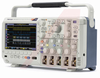
Oscilloscope, 2 Channels, 100 MHz - 70136917 - Allied Electronics, Inc.
Fort Worth, TX, USA
Oscilloscope, 2 Channels, 100 MHz
70136917
Oscilloscope, 2 Channels, 100 MHz 70136917
The Power to Solve Problems Quickly The MSO2000 and DPO2000 Series digital phosphor oscilloscopes (DPOs) deliver the performance and tools you need to visualize your signals and find answers quickly. The DPO2000 Series are the first oscilloscopes to provide 1 M points of usable record length on all channels, serial trigger and decode analysis options, a variable low-pass filter that also allows you to see signal details to the oscilloscope's full bandwidth and all in a compact form factor. The MSO2000 Series adds 16 integrated digital channels, enabling you to visualize and time correlate analog and digital signals on a single instrument. This integration extends triggering functionality across all 20 channels which is ideal for debugging mixed analog and digital designs. Key Performance Specifications 100 MHz and 200 MHz Bandwidth Models 2- or 4-Analog Channels 16 Digital Channels Sample Rates Up to 1 GS/s on All Channels 1 Mega Sample Record Length on All Channels 5,000 wfm/s Maximum Waveform Capture Rate Suite of Advanced Triggers Serial Bus Trigger and Decode I2C, SPI, CAN, LIN, and RS-232/422/485/UART Serial Triggering, Decode, and Analysis Options Available Ease of Use Features Wave Inspector® Navigation and Search Provides Unprecedented Efficiency in Waveform Analysis FilterVu™ Variable Low-Pass Filter Allows for Removal of Unwanted Signal Noise While Still Capturing High-Frequency Events 7 inch (180 mm) Bright, Widescreen, TFT-LCD Color Display USB 2.0 on Front Panel for Quick and Easy Data Storage USB 2.0 Device Port on Rear Panel for Direct PC Control of Oscilloscope Using USBTMC or Direct Printing to Any PictBridge® Compatible Printer Plug'n'Play PC Connectivity and Analysis Software Solutions TekVPI® Probe Interface Supports Active, Differential and Current Probes for Automatic Scaling and Units Small Footprint and Light Weight — Only 5.3 inch (134 mm) Deep and 7 lb 14 Oz (3.6 kg) Mixed Signal Design and Analysis (MSO2000 Series) Ability to Time Correlate Up to 4-Analog and 16-Digital Channels Parallel Bus Trigger and Analysis Multichannel Setup and Hold Triggering Next-Generation Digital Waveform Display

The Power to Solve Problems Quickly
The MSO2000 and DPO2000 Series digital phosphor oscilloscopes (DPOs) deliver the performance and tools you need to visualize your signals and find answers quickly. The DPO2000 Series are the first oscilloscopes to provide 1 M points of usable record length on all channels, serial trigger and decode analysis options, a variable low-pass filter that also allows you to see signal details to the oscilloscope's full bandwidth and all in a compact form factor. The MSO2000 Series adds 16 integrated digital channels, enabling you to visualize and time correlate analog and digital signals on a single instrument. This integration extends triggering functionality across all 20 channels which is ideal for debugging mixed analog and digital designs.
Key Performance Specifications

  • 100 MHz and 200 MHz Bandwidth Models
  • 2- or 4-Analog Channels
  • 16 Digital Channels
  • Sample Rates Up to 1 GS/s on All Channels
  • 1 Mega Sample Record Length on All Channels
  • 5,000 wfm/s Maximum Waveform Capture Rate
  • Suite of Advanced Triggers
    Serial Bus Trigger and Decode
  • I2C, SPI, CAN, LIN, and RS-232/422/485/UART Serial Triggering, Decode, and Analysis Options Available
    Ease of Use Features
  • Wave Inspector® Navigation and Search Provides Unprecedented Efficiency in Waveform Analysis
  • FilterVu™ Variable Low-Pass Filter Allows for Removal of Unwanted Signal Noise While Still Capturing High-Frequency Events
  • 7 inch (180 mm) Bright, Widescreen, TFT-LCD Color Display
  • USB 2.0 on Front Panel for Quick and Easy Data Storage
  • USB 2.0 Device Port on Rear Panel for Direct PC Control of Oscilloscope Using USBTMC or Direct Printing to Any PictBridge® Compatible Printer
  • Plug'n'Play PC Connectivity and Analysis Software Solutions
  • TekVPI® Probe Interface Supports Active, Differential and Current Probes for Automatic Scaling and Units
  • Small Footprint and Light Weight — Only 5.3 inch (134 mm) Deep and 7 lb 14 Oz (3.6 kg)
    Mixed Signal Design and Analysis (MSO2000 Series)
  • Ability to Time Correlate Up to 4-Analog and 16-Digital Channels
  • Parallel Bus Trigger and Analysis
  • Multichannel Setup and Hold Triggering
  • Next-Generation Digital Waveform Display
Supplier's Site

Technical Specifications

  ValueTronics International, Inc. Allied Electronics, Inc.
Product Category Oscilloscopes Oscilloscopes
Product Number DPO2012 70136917
Product Name Digital Oscilloscope Oscilloscope, 2 Channels, 100 MHz
Bandwidth 100 MHz 100 MHz
Unlock Full Specs
to access all available technical data

Similar Products

Isolated Handheld Digital Oscilloscopes - SHS1062 - Siglent Technologies NA, Inc.
Specs
Bandwidth 60 MHz
Number of Input Channels 2 (# channels)
Host Interface USB
View Details
UPO1202 200MHz 2Ch Digital Storage Oscilloscope - UPO1202 - Uni-Trend US
Specs
Bandwidth 200 MHz
Number of Input Channels 2 (# channels)
Host Interface USB; USB, LAN, VGA, AUX
View Details
Oscilloscopes - 7250410 - RS Components, Ltd.
RS Components, Ltd.
Specs
Features Has Display
View Details
Active Tuners - MT1000HF4 - Maury Microwave
Specs
Bandwidth 1000 MHz
View Details