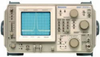
The 492P is a 21 GHz Spectrum Analyzer from Tektronix. A spectrum analyzer measures the power of spectrums of known and unknown signals. Spectrum analyzers collect information such as the magnitude of an input signal compared to its frequency. As a frequency analyzer, spectrum analyzers’ main use is to document and analyze electrical input signals as well as spectral compositions of other signals.
Additional Features:
Frequency Range: 50 kHz to 21 GHz-expandable to 220 GHz
Dynamic Range: 80 dB
Resolution bandwidth of 1 MHz to 1 kHz in decade steps, plus an autoposition
Continuous-Resolutio
n Frequency tuning combines synthesized settability and accuracy with analog feel
Wide viewable dynamic range; as much as 90 dB with 10 Hz to 3 MHz resolution bandwidth
Built-in frequency counters provide frequency determination to within 0.0000001%
Sensitivities to -134 dBm
Built-in intelligence for signal processing/marker functions
Push button occupied-bandwidth and noise-normalization functions
Macro capability with nonvolatile memory to simplify and speed up commonly used routines
Optional Switch-selectable 50/75-ohm Impedances
Nonvolatile memory for up to 9 waveforms and 10 front panel settings
GPIB programmability with Tek codes and formats for standardized Bus operation
Optional MATE/CIIL Compatibility for Military Applications
Ergonomically-design
ed front panel controls
Direct Screen data plots without a controller
Ruggedized for harsh field environments
The Tektronix 492P Spectrum Analyzer offers a broad selection of features and benefits to meet wide-ranging needs for laboratory-level frequency domain spectrum analysis. All units provide full IEEE-488 (GPIB) programmability, which means you can change front-panel settings, read data from the CRT display, and send waveforms from internal digital source memory to other GPIB devices.
The 492P is built to rugged MIL-T-28800C environmental specifications, and can withstand transportation shock and vibration to a remote site, or they can simply be moved from the engineering lab to the production floor with complete confidence in measurement accuracy.
The 492P is a 21 GHz Spectrum Analyzer from Tektronix. A spectrum analyzer measures the power of spectrums of known and unknown signals. Spectrum analyzers collect information such as the magnitude of an input signal compared to its frequency. As a frequency analyzer, spectrum analyzers’ main use is to document and analyze electrical input signals as well as spectral compositions of other signals.
Additional Features:
- Frequency Range: 50 kHz to 21 GHz-expandable to 220 GHz
- Dynamic Range: 80 dB
- Resolution bandwidth of 1 MHz to 1 kHz in decade steps, plus an autoposition
- Continuous-Resolution Frequency tuning combines synthesized settability and accuracy with analog feel
- Wide viewable dynamic range; as much as 90 dB with 10 Hz to 3 MHz resolution bandwidth
- Built-in frequency counters provide frequency determination to within 0.0000001%
- Sensitivities to -134 dBm
- Built-in intelligence for signal processing/marker functions
- Push button occupied-bandwidth and noise-normalization functions
- Macro capability with nonvolatile memory to simplify and speed up commonly used routines
- Optional Switch-selectable 50/75-ohm Impedances
- Nonvolatile memory for up to 9 waveforms and 10 front panel settings
- GPIB programmability with Tek codes and formats for standardized Bus operation
- Optional MATE/CIIL Compatibility for Military Applications
- Ergonomically-designed front panel controls
- Direct Screen data plots without a controller
- Ruggedized for harsh field environments
The Tektronix 492P Spectrum Analyzer offers a broad selection of features and benefits to meet wide-ranging needs for laboratory-level frequency domain spectrum analysis. All units provide full IEEE-488 (GPIB) programmability, which means you can change front-panel settings, read data from the CRT display, and send waveforms from internal digital source memory to other GPIB devices.
The 492P is built to rugged MIL-T-28800C environmental specifications, and can withstand transportation shock and vibration to a remote site, or they can simply be moved from the engineering lab to the production floor with complete confidence in measurement accuracy.