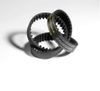
ContiTech AG Automotive Aftermarket Belts Timing Belts

Description
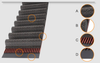
Timing belts enable synchronous positive-fit power transmission in car engines. Their task: To drive camshafts, injection pumps, balancer shafts and other ancillary components. The high quality of the ContiTech timing belts guarantees perfect performance. Design and function A timing belt consists essentially of: A) Polyamide fabric, sometimes also on the belt backing B + D) Synthetic rubber, sometimes fiber-reinforced C) Tension member made of glass-fiber The timing belt controls the precise combustion process in the engine: It drives the camshaft which in turn controls the valves. Its function is particularly important because, if the camshaft and the crankshaft do not run synchronously, the engine will not work. In the worst-case scenario the valves and pistons can collide at full speed with each other in the engine. This results in engine failure! The timing belt often also takes on additional tasks such as driving the fuel injection pump, the water pump or the balancer shaft. Notes Handling: Timing belts must not be creased since this will cause the glass-fiber tension members to break inside the belt. The belt™s load-carrying capacity is then no longer assured and it can tear. Consequence: Engine failure. Replacement interval: Timing belts are subject to aging and wear. They therefore have to be regularly checked and replaced. The checking and replacement intervals are always specified by the vehicle manufacturer and must be complied with. Storage: Store in a dry, dust-free and cool place (ideally 15-25°C) Avoid direct sunlight Avoid contact with all liquids (oil, water etc.) Maximum storage period: 5 years from date of production Tips: Leave timing belt in its original packaging until ready for use ContiTech offers a wide range of special tools for fitting When changing the timing belt, you should also change the tensioning pulley and idlers and, possibly, the water pump as a precaution. ContiTech offers complete timing belt kits for this purpose.
Description
Timing belts enable synchronous positive-fit power transmission in car engines. Their task: To drive camshafts, injection pumps, balancer shafts and other ancillary components. The high quality of the ContiTech timing belts guarantees perfect performance. Design and function A timing belt consists essentially of: A) Polyamide fabric, sometimes also on the belt backing B + D) Synthetic rubber, sometimes fiber-reinforced C) Tension member made of glass-fiber The timing belt controls the precise combustion process in the engine: It drives the camshaft which in turn controls the valves. Its function is particularly important because, if the camshaft and the crankshaft do not run synchronously, the engine will not work. In the worst-case scenario the valves and pistons can collide at full speed with each other in the engine. This results in engine failure! The timing belt often also takes on additional tasks such as driving the fuel injection pump, the water pump or the balancer shaft. Notes Handling: Timing belts must not be creased since this will cause the glass-fiber tension members to break inside the belt. The belt™s load-carrying capacity is then no longer assured and it can tear. Consequence: Engine failure. Replacement interval: Timing belts are subject to aging and wear. They therefore have to be regularly checked and replaced. The checking and replacement intervals are always specified by the vehicle manufacturer and must be complied with. Storage: Store in a dry, dust-free and cool place (ideally 15-25°C) Avoid direct sunlight Avoid contact with all liquids (oil, water etc.) Maximum storage period: 5 years from date of production Tips: Leave timing belt in its original packaging until ready for use ContiTech offers a wide range of special tools for fitting When changing the timing belt, you should also change the tensioning pulley and idlers and, possibly, the water pump as a precaution. ContiTech offers complete timing belt kits for this purpose.

Suppliers

Company
Product
Description
Supplier Links
Automotive Aftermarket Belts - Timing Belts - ContiTech AG
Hanover, Germany
Automotive Aftermarket Belts
Timing Belts
Automotive Aftermarket Belts Timing Belts
Timing belts enable synchronous positive-fit power transmission in car engines. Their task: To drive camshafts, injection pumps, balancer shafts and other ancillary components. The high quality of the ContiTech timing belts guarantees perfect performance. Design and function A timing belt consists essentially of: A) Polyamide fabric, sometimes also on the belt backing B + D) Synthetic rubber, sometimes fiber-reinforced C) Tension member made of glass-fiber The timing belt controls the precise combustion process in the engine: It drives the camshaft which in turn controls the valves. Its function is particularly important because, if the camshaft and the crankshaft do not run synchronously, the engine will not work. In the worst-case scenario the valves and pistons can collide at full speed with each other in the engine. This results in engine failure! The timing belt often also takes on additional tasks such as driving the fuel injection pump, the water pump or the balancer shaft. Notes Handling: Timing belts must not be creased since this will cause the glass-fiber tension members to break inside the belt. The belt™s load-carrying capacity is then no longer assured and it can tear. Consequence: Engine failure. Replacement interval: Timing belts are subject to aging and wear. They therefore have to be regularly checked and replaced. The checking and replacement intervals are always specified by the vehicle manufacturer and must be complied with. Storage: Store in a dry, dust-free and cool place (ideally 15-25°C) Avoid direct sunlight Avoid contact with all liquids (oil, water etc.) Maximum storage period: 5 years from date of production Tips: Leave timing belt in its original packaging until ready for use ContiTech offers a wide range of special tools for fitting When changing the timing belt, you should also change the tensioning pulley and idlers and, possibly, the water pump as a precaution. ContiTech offers complete timing belt kits for this purpose.
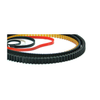
Timing belts enable synchronous positive-fit power transmission in car engines. Their task: To drive camshafts, injection pumps, balancer shafts and other ancillary components. The high quality of the ContiTech timing belts guarantees perfect performance.
Design and function A timing belt consists essentially of:
A) Polyamide fabric, sometimes also on the belt backing
B + D) Synthetic rubber, sometimes fiber-reinforced
C) Tension member made of glass-fiber
The timing belt controls the precise combustion process in the engine: It drives the camshaft which in turn controls the valves. Its function is particularly important because, if the camshaft and the crankshaft do not run synchronously, the engine will not work. In the worst-case scenario the valves and pistons can collide at full speed with each other in the engine. This results in engine failure!
The timing belt often also takes on additional tasks such as driving the fuel injection pump, the water pump or the balancer shaft.
Notes Handling:
Timing belts must not be creased since this will cause the glass-fiber tension members to break inside the belt. The belt™s load-carrying capacity is then no longer assured and it can tear. Consequence: Engine failure.
Replacement interval:
Timing belts are subject to aging and wear. They therefore have to be regularly checked and replaced. The checking and replacement intervals are always specified by the vehicle manufacturer and must be complied with.
Storage:

  • Store in a dry, dust-free and cool place (ideally 15-25°C)
  • Avoid direct sunlight
  • Avoid contact with all liquids (oil, water etc.)
  • Maximum storage period: 5 years from date of production

Tips:

  • Leave timing belt in its original packaging until ready for use
  • ContiTech offers a wide range of special tools for fitting
  • When changing the timing belt, you should also change the tensioning pulley and idlers and, possibly, the water pump as a precaution. ContiTech offers complete timing belt kits for this purpose.

Supplier's Site

Technical Specifications

  ContiTech AG
Product Category Timing Belts (metric)
Product Number Timing Belts
Product Name Automotive Aftermarket Belts
Belt Material Rubber
Unlock Full Specs
to access all available technical data

Similar Products

Timing Belts - 1821277 - RS Components, Ltd.
RS Components, Ltd.
Specs
Metric Pitch 5mm
Belt Width 9 mm (0.3543 inch)
Belt Length 1420 mm (55.91 inch)
View Details
2 mm (GT3) Pitch, 465 Teeth, 3mm wide Single Sided Neoprene Belt with Fiberglass Cords - A36R51M465030 - Stock Drive Products & Sterling Instrument - SDP/SI
Specs
Metric Pitch GT 2mm
Belt Width 3 mm (0.1181 inch)
Belt Material Neoprene
View Details
Industrial Timing Belt -  - Hangzhou Chinabase Machinery Co., Ltd.
Hangzhou Chinabase Machinery Co., Ltd.
Specs
Metric Pitch T 2.5mm; T 5mm; T 10mm; T 20mm; AT 5mm; AT 10mm; AT 20mm
Belt Material Rubber
View Details
Timing Belt, 3mm HTD Pitch, TruMotion -  - York Industries, Inc.
Specs
Metric Pitch HTD 3mm
Belt Width 6 to 15 mm (0.2362 to 0.5906 inch)
Belt Length 87 to 1956 mm (3.43 to 77.01 inch)
View Details