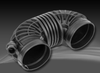
Intake curved hose for connecting an air filter on the body to a turbocharger
Due to the high airflow rate, an air flow-optimizing inner hose contour is important to keep pressure loss low. This also positively affects the hose's acoustic behavior.
Depending on the filter concept, behind the air filter the hoses must withstand vacuums to -180 mbar (i.e. absolute 820 mbar) without collapsing. Additional reinforcement improves vacuum resistance.
The custom fold design ensures excellent flexibility for decoupling the air filter and engine. This ensures constant vacuum stability during driving.
If the hose leads directly from the air filter to the turbocharger, the right material ensures high temperature resistance for the connection to the turbocharger.
UV and ozone resistance and/or resistance to the effects of chemical media is characteristic for elastomers.
Optional design details
Air intake for diesel and gasoline engines with additional exits
Mount for temperature sensors
Noise damping
Elastomer
Operating temperature
CR
-40°C to +100°C (max. 120°C)
EPDM
-40°C to +110°C (max. 130°C)
ECO (unleaded) according ELV 2000/53/EG
-40°C to +120°C (max. 140°C)
EPDM (peroxid.)
-40°C to +150°C (max. 170°C)
AEM
-40°C to +160°C (max. 180°C)
Intake curved hose for connecting an air filter on the body to a turbocharger
Due to the high airflow rate, an air flow-optimizing inner hose contour is important to keep pressure loss low. This also positively affects the hose's acoustic behavior.
Depending on the filter concept, behind the air filter the hoses must withstand vacuums to -180 mbar (i.e. absolute 820 mbar) without collapsing. Additional reinforcement improves vacuum resistance.
The custom fold design ensures excellent flexibility for decoupling the air filter and engine. This ensures constant vacuum stability during driving.
If the hose leads directly from the air filter to the turbocharger, the right material ensures high temperature resistance for the connection to the turbocharger.
UV and ozone resistance and/or resistance to the effects of chemical media is characteristic for elastomers.
Optional design details
- Air intake for diesel and gasoline engines with additional exits
- Mount for temperature sensors
- Noise damping
| Elastomer | Operating temperature |
|---|
| CR | -40°C to +100°C (max. 120°C) |
| EPDM | -40°C to +110°C (max. 130°C) |
| ECO (unleaded) according ELV 2000/53/EG | -40°C to +120°C (max. 140°C) |
| EPDM (peroxid.) | -40°C to +150°C (max. 170°C) |
| AEM | -40°C to +160°C (max. 180°C) |