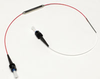
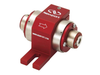
Conoptics manufactures a family of modular Faraday rotators and interchangeable accessories which can be combined to perform various isolation functions. A basic optical isolator is shown in Figure 1. Light from a presumed well polarized laser source enters an aligned beamsplitting polarizer from the left. It then proceeds through a Faraday rotator which is tuned to 45° for the particular laser wavelength. Only one magnet is shown but, whether a single magnet or a three magnet array is used, its major field component is parallel to the optical propagation direction. Light returning from any downstream reflecting surface undergoes an additional 45° rotation in its backward pass through the glass. It is now polarized orthogonal to the forward beam and is rejected by the polarizer.
Faraday Rotators
The Faraday rotators included in the 700 Series consist of one or more high flux NIB permanent magnets and a terbium glass element. Tuning is accomplished by moving the glass between regions of high and low field strength. An important feature of the Conoptics design is that the glass does not rotate as it is moved thereby eliminating the possibility of transmitted beam nutation due to residual wedge. Polarization rotation is a function not only of the axial magnetic field strength, but also of the glass length, L, and its Verdet constant, V. More precisely, on axis where z is along the propagation direct.The value of V is strongly wavelength dependent and diminishes rapidly as wavelength increases. In order to avoid the need for extending the length of glass elements to achieve 45° rotation at long wavelengths, the local field strength must be increased by using combinations of magnets with opposing fields. The Model 713, 714, and 715, while outwardly quite large, have only a fraction of their lengths filled with glass. The magnet array design is intended to increase axial field strength but also affects the field radial uniformity. Only relatively small volumes along the axis of the magnet array offer sufficiently low gradients. Furthermore, tuning the rotator (changing Zo in equation 1) by definition means moving the glass into a region of lower integrated axial field strength and higher gradients. It is generally recommended, therefore, that for best isolation ratio, a model be chosen in which the intended operating wavelength is near the upper end of the tuning range. A strong absorption peak at approximately 490nm is typical of terbium glass. At wavelengths larger that 500 nm absorption is low and the models listed are capable of operation with more than 6 watts average power. Operation at 488 nm is not recommended but a special unit operable at 458 nm is available. TABLE 1 lists the specifications of standard Conoptics Faraday rotators. The isolation ratio (extinction) is dependent on the type of polarizer(s) used, the operating wavelength in relation to the tuning range, and beam diameter
| Conoptics, Inc. | |
|---|---|
| Product Category | Optical Isolators |
| Product Number | 715 |
| Product Name | 700 Series |