Com-Power Corporation Dipole Antenna AD-100A

Description
The AD-100A is a 1 GHz dipole antenna from Com-Power. A state-of-the-art antenna preamplifier can enhance the performance of electronic test equipment with a bad or weak signal. Antennas boost signals and can overcome signal losses related to splitters and junctions. Additional Features: Frequency Range: 30 MHz to 1 GHz Polarization: Linear Nominal Impedance: 50ω RF Connectors: BNC-type (female) Min. Element Length: 2.6 inches [6.6 cm] Max. Element Length: 114 inches [290 cm] Isotropic Gain: 1.6 dBi VSWR: less than 1.5:1 Specifications: ANSI, CISPR, EN, ETSI, etc. Weight 15 lbs. (6.8 kg) (including baluns, elements & case) Adjustable (Tunable) Elements Dipoles considered “reference antenna” Rugged Carrying/Storage Case for transport and protected storage Three-year Standard Warranty The AD-100A is a Half-Wave Tuned Dipole Antenna Set, complete with custom carrying/storage case. The set includes the four standard antenna balans described in ANSI C63.5, along with all of the necessary antenna elements for the frequency range of 30 MHz to 1 GHz. This frequency range is divided into four subranges, corresponding to the frequency range of each individual balan. Calibration Per ANSI C63.4 & CISPR 16-1-4, no calibration of half-wave dipoles is required beyond verification of balun loss (<0.5 dB) and VSWR (<1.5:1). Antenna factors are instead determined by calculation. For a theoretical “loss-less” half-wave dipole: “Loss-less” Dipole Factor = 20*log(Freq. in MHz) - 31.9 In order to account for the loss of the balun: Dipole Factor = 20*log(Freq. in MHz) - 31.9 + Balun Loss (dB) Dipole Factor = 20*log(Freq. in MHz) - 31.9 + 0.5 NIST Traceable or 17025 Accredited Calibration of the AD-100 Tuned Dipole Set is, however, available upon request. Application Dipole antennas are considered to be the reference (or standard) antenna. They are still the preferred antennas for discrete frequency field strength measurements associated with Normalized Site Attenuation (NSA) calibrations of Open Area Test Sites (OATS) and Semi-Anechoic Chambers (SAC), and for most radiated electromagnetic interference (EMI) compliance tests. Also, they are the only type of antenna that is to be used for calibration of broadband antennas (such as biconical dipoles log periodic dipole arrays, etc.) when employing the reference antenna method described in ANSI C63.5: 2006. Dipoles are also used as the “substitution antenna” for Effective Radiated Power (ERP) and/or Effective Isotropic Radiated Power (EIRP) tests of intentional radiators (RF transmitters). Construction The AD-100A Tuned Dipole Antenna Set is designed based on the Reference Antenna Example Drawings given in Appendix E of ANSI C63.5: 2006. As part of the manufacturing process, the insertion loss of each balun is verified to be less than 0.5 dB, and the VSWR less than 1.5:1 with the elements tuned to resonance at a low, middle and high end of each balun’s respective frequency range. The antennas are designed for durability using high quality materials. This makes the AD-100A set the ideal choice for use in laboratory environments.
Datasheet
Description
The AD-100A is a 1 GHz dipole antenna from Com-Power. A state-of-the-art antenna preamplifier can enhance the performance of electronic test equipment with a bad or weak signal. Antennas boost signals and can overcome signal losses related to splitters and junctions. Additional Features: Frequency Range: 30 MHz to 1 GHz Polarization: Linear Nominal Impedance: 50ω RF Connectors: BNC-type (female) Min. Element Length: 2.6 inches [6.6 cm] Max. Element Length: 114 inches [290 cm] Isotropic Gain: 1.6 dBi VSWR: less than 1.5:1 Specifications: ANSI, CISPR, EN, ETSI, etc. Weight 15 lbs. (6.8 kg) (including baluns, elements & case) Adjustable (Tunable) Elements Dipoles considered “reference antenna” Rugged Carrying/Storage Case for transport and protected storage Three-year Standard Warranty The AD-100A is a Half-Wave Tuned Dipole Antenna Set, complete with custom carrying/storage case. The set includes the four standard antenna balans described in ANSI C63.5, along with all of the necessary antenna elements for the frequency range of 30 MHz to 1 GHz. This frequency range is divided into four subranges, corresponding to the frequency range of each individual balan. Calibration Per ANSI C63.4 & CISPR 16-1-4, no calibration of half-wave dipoles is required beyond verification of balun loss (<0.5 dB) and VSWR (<1.5:1). Antenna factors are instead determined by calculation. For a theoretical “loss-less” half-wave dipole: “Loss-less” Dipole Factor = 20*log(Freq. in MHz) - 31.9 In order to account for the loss of the balun: Dipole Factor = 20*log(Freq. in MHz) - 31.9 + Balun Loss (dB) Dipole Factor = 20*log(Freq. in MHz) - 31.9 + 0.5 NIST Traceable or 17025 Accredited Calibration of the AD-100 Tuned Dipole Set is, however, available upon request. Application Dipole antennas are considered to be the reference (or standard) antenna. They are still the preferred antennas for discrete frequency field strength measurements associated with Normalized Site Attenuation (NSA) calibrations of Open Area Test Sites (OATS) and Semi-Anechoic Chambers (SAC), and for most radiated electromagnetic interference (EMI) compliance tests. Also, they are the only type of antenna that is to be used for calibration of broadband antennas (such as biconical dipoles log periodic dipole arrays, etc.) when employing the reference antenna method described in ANSI C63.5: 2006. Dipoles are also used as the “substitution antenna” for Effective Radiated Power (ERP) and/or Effective Isotropic Radiated Power (EIRP) tests of intentional radiators (RF transmitters). Construction The AD-100A Tuned Dipole Antenna Set is designed based on the Reference Antenna Example Drawings given in Appendix E of ANSI C63.5: 2006. As part of the manufacturing process, the insertion loss of each balun is verified to be less than 0.5 dB, and the VSWR less than 1.5:1 with the elements tuned to resonance at a low, middle and high end of each balun’s respective frequency range. The antennas are designed for durability using high quality materials. This makes the AD-100A set the ideal choice for use in laboratory environments.
Datasheet

Suppliers

Company
Product
Description
Supplier Links
Dipole Antenna - AD-100A - ValueTronics International, Inc.
Elgin, IL, USA
Dipole Antenna
AD-100A
Dipole Antenna AD-100A
The AD-100A is a 1 GHz dipole antenna from Com-Power. A state-of-the-art antenna preamplifier can enhance the performance of electronic test equipment with a bad or weak signal. Antennas boost signals and can overcome signal losses related to splitters and junctions. Additional Features: Frequency Range: 30 MHz to 1 GHz Polarization: Linear Nominal Impedance: 50ω RF Connectors: BNC-type (female) Min. Element Length: 2.6 inches [6.6 cm] Max. Element Length: 114 inches [290 cm] Isotropic Gain: 1.6 dBi VSWR: less than 1.5:1 Specifications: ANSI, CISPR, EN, ETSI, etc. Weight 15 lbs. (6.8 kg) (including baluns, elements & case) Adjustable (Tunable) Elements Dipoles considered “reference antenna” Rugged Carrying/Storage Case for transport and protected storage Three-year Standard Warranty The AD-100A is a Half-Wave Tuned Dipole Antenna Set, complete with custom carrying/storage case. The set includes the four standard antenna balans described in ANSI C63.5, along with all of the necessary antenna elements for the frequency range of 30 MHz to 1 GHz. This frequency range is divided into four subranges, corresponding to the frequency range of each individual balan. Calibration Per ANSI C63.4 & CISPR 16-1-4, no calibration of half-wave dipoles is required beyond verification of balun loss (<0.5 dB) and VSWR (<1.5:1). Antenna factors are instead determined by calculation. For a theoretical “loss-less” half-wave dipole: “Loss-less” Dipole Factor = 20*log(Freq. in MHz) - 31.9 In order to account for the loss of the balun: Dipole Factor = 20*log(Freq. in MHz) - 31.9 + Balun Loss (dB) Dipole Factor = 20*log(Freq. in MHz) - 31.9 + 0.5 NIST Traceable or 17025 Accredited Calibration of the AD-100 Tuned Dipole Set is, however, available upon request. Application Dipole antennas are considered to be the reference (or standard) antenna. They are still the preferred antennas for discrete frequency field strength measurements associated with Normalized Site Attenuation (NSA) calibrations of Open Area Test Sites (OATS) and Semi-Anechoic Chambers (SAC), and for most radiated electromagnetic interference (EMI) compliance tests. Also, they are the only type of antenna that is to be used for calibration of broadband antennas (such as biconical dipoles log periodic dipole arrays, etc.) when employing the reference antenna method described in ANSI C63.5: 2006. Dipoles are also used as the “substitution antenna” for Effective Radiated Power (ERP) and/or Effective Isotropic Radiated Power (EIRP) tests of intentional radiators (RF transmitters). Construction The AD-100A Tuned Dipole Antenna Set is designed based on the Reference Antenna Example Drawings given in Appendix E of ANSI C63.5: 2006. As part of the manufacturing process, the insertion loss of each balun is verified to be less than 0.5 dB, and the VSWR less than 1.5:1 with the elements tuned to resonance at a low, middle and high end of each balun’s respective frequency range. The antennas are designed for durability using high quality materials. This makes the AD-100A set the ideal choice for use in laboratory environments.

The AD-100A is a 1 GHz dipole antenna from Com-Power. A state-of-the-art antenna preamplifier can enhance the performance of electronic test equipment with a bad or weak signal. Antennas boost signals and can overcome signal losses related to splitters and junctions.

Additional Features:

  • Frequency Range: 30 MHz to 1 GHz
  • Polarization: Linear
  • Nominal Impedance: 50Ω
  • RF Connectors: BNC-type (female)
  • Min. Element Length: 2.6 inches [6.6 cm]
  • Max. Element Length: 114 inches [290 cm]
  • Isotropic Gain: 1.6 dBi
  • VSWR: less than 1.5:1
  • Specifications: ANSI, CISPR, EN, ETSI, etc.
  • Weight 15 lbs. (6.8 kg) (including baluns, elements & case)
  • Adjustable (Tunable) Elements
  • Dipoles considered “reference antenna”
  • Rugged Carrying/Storage Case for transport and protected storage
  • Three-year Standard Warranty

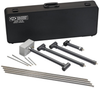
The AD-100A is a Half-Wave Tuned Dipole Antenna Set, complete with custom carrying/storage case. The set includes the four standard antenna balans described in ANSI C63.5, along with all of the necessary antenna elements for the frequency range of 30 MHz to 1 GHz. This frequency range is divided into four subranges, corresponding to the frequency range of each individual balan.

Calibration

Per ANSI C63.4 & CISPR 16-1-4, no calibration of half-wave dipoles is required beyond verification of balun loss (<0.5 dB) and VSWR (<1.5:1). Antenna factors are instead determined by calculation.

For a theoretical “loss-less” half-wave dipole:

  • “Loss-less” Dipole Factor = 20*log(Freq. in MHz) - 31.9

In order to account for the loss of the balun:

  • Dipole Factor = 20*log(Freq. in MHz) - 31.9 + Balun Loss (dB)
  • Dipole Factor = 20*log(Freq. in MHz) - 31.9 + 0.5

NIST Traceable or 17025 Accredited Calibration of the AD-100 Tuned Dipole Set is, however, available upon request.

Application

Dipole antennas are considered to be the reference (or standard) antenna. They are still the preferred antennas for discrete frequency field strength measurements associated with Normalized Site Attenuation (NSA) calibrations of Open Area Test Sites (OATS) and Semi-Anechoic Chambers (SAC), and for most radiated electromagnetic interference (EMI) compliance tests. Also, they are the only type of antenna that is to be used for calibration of broadband antennas (such as biconical dipoles log periodic dipole arrays, etc.) when employing the reference antenna method described in ANSI C63.5: 2006.

Dipoles are also used as the “substitution antenna” for Effective Radiated Power (ERP) and/or Effective Isotropic Radiated Power (EIRP) tests of intentional radiators (RF transmitters).

Construction

The AD-100A Tuned Dipole Antenna Set is designed based on the Reference Antenna Example Drawings given in Appendix E of ANSI C63.5: 2006. As part of the manufacturing process, the insertion loss of each balun is verified to be less than 0.5 dB, and the VSWR less than 1.5:1 with the elements tuned to resonance at a low, middle and high end of each balun’s respective frequency range. The antennas are designed for durability using high quality materials. This makes the AD-100A set the ideal choice for use in laboratory environments.
Supplier's Site Datasheet

Technical Specifications

  ValueTronics International, Inc.
Product Category Antennas
Product Number AD-100A
Product Name Dipole Antenna
Primary Frequency Range 1000.0 MHz
Unlock Full Specs
to access all available technical data

Similar Products

RF, Antenna centric solutions - BGSX24MU16 - Infineon Technologies AG
Specs
Primary Frequency Range 100.0 to 5000.0 MHz
View Details
Antennas - 2108971-3 - TE Connectivity
TE Connectivity
Specs
Applications UWB
Pattern Type Omni directional
Polarization Linear
View Details
4 suppliers
Antenna - 758-974 - WAGO
Specs
Primary Frequency Range 617.0 to 6000.0 MHz
View Details
3 suppliers
Multi-Band Antennas - 2097257 - RS Components, Ltd.
Specs
Applications Multi-band
Primary Frequency Range 698.0 to 4000.0 MHz
Gain 3 dB
View Details