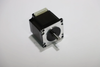
Changzhou Fulling Motor Co., Ltd Permanent Magnet Stepping Motor 20PM18-0506A

Description
Often referred to as a “tin can” or“ can stack” motor the permanent magnet step motor is a low cost and low resolution type motor with typical step angles of 7.5 to 15° (48 – 24steps/revolution) PM motors as the name implies have permanent magnets added to the motor structure.The rotor no longer has teeth as with the VR motor. Instead the rotor is magnetized with alternating north and south poles situated in a straight line parallel to the rotor shaft. These magnetized rotor poles provide an increased magnetic flux intensity and because of this the PM motor exhibits improved torque characteristics when compared with the VR type.

Suppliers

Company
Product
Description
Supplier Links
Permanent Magnet  Stepping Motor - 20PM18-0506A - Changzhou Fulling Motor Co., Ltd
Changzhou, China
Permanent Magnet Stepping Motor
20PM18-0506A
Permanent Magnet Stepping Motor 20PM18-0506A
Often referred to as a “tin can” or“ can stack” motor the permanent magnet step motor is a low cost and low resolution type motor with typical step angles of 7.5 to 15° (48 – 24steps/revolution) PM motors as the name implies have permanent magnets added to the motor structure.The rotor no longer has teeth as with the VR motor. Instead the rotor is magnetized with alternating north and south poles situated in a straight line parallel to the rotor shaft. These magnetized rotor poles provide an increased magnetic flux intensity and because of this the PM motor exhibits improved torque characteristics when compared with the VR type.

Often referred to as a “tin can” or“ can stack” motor the permanent magnet step motor is a low cost and low resolution type motor with typical step angles of 7.5 to 15° (48 – 24steps/revolution) PM motors as the name implies have permanent magnets added to the motor structure.The rotor no longer has teeth as with the VR motor. Instead the rotor is magnetized with alternating north and south poles situated in a straight line parallel to the rotor shaft. These magnetized rotor poles provide an increased magnetic flux intensity and because of this the PM motor exhibits improved torque characteristics when compared with the VR type.

Supplier's Site

Technical Specifications

  Changzhou Fulling Motor Co., Ltd
Product Category Stepper Motors (rotary)
Product Number 20PM18-0506A
Product Name Permanent Magnet Stepping Motor
DC Voltage Range 5.0 VDC
Current per Phase 0.5000 amps
Number of Leads 6 #
Holding Torque 1 In-oz (1 N-cm)
Rotor Inertia 1.42E-5 oz-in-sec² (1.00E-4 kg-cm²)
Unlock Full Specs
to access all available technical data

Similar Products

Brushless DC-Servomotors Series 1660 ... BHT 2 Pole Technology -  - FAULHABER MICROMO
Specs
DC Voltage Range 48.0 VDC
Torque Constant 1.94 in-oz/amp (13.7 mN-m/amp)
Rotor Inertia 1.70E-5 oz-in-sec² (1.20E-4 kg-cm²)
View Details
Servo motor - EMMS-AS-100-L-HV-RR-S1 - Festo Corporation
Specs
DC Voltage Range 565.0 VDC
Continuous Current 3.79 amps
Continuous Torque 55.7 In-lbs (64.18 kg-cm)
View Details
 - PST.57HB3220-001 Stepper motor - Shenzhen Power Motor Industrial Co., Ltd.
Shenzhen Power Motor Industrial Co., Ltd.
Specs
Step Angle 1.80 degrees
Continuous Current 2 amps
Rotor Inertia 0.0042 oz-in-sec² (0.0298 kg-cm²)
View Details
Sealed Stepper Motor - TorquePower™ TP23 - ElectroCraft
Specs
Stepper Construction Permanent Magnet
DC Voltage Range 34.0 VDC
Current per Phase 4 amps
View Details