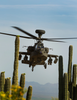
The AH-64 Apache is the world’s most advanced multi-role combat helicopter and is used by the U.S. Army and a growing number of international defense forces. Boeing has delivered more than 2,100 Apaches to customers around the world since the aircraft entered production. The U.S. Army Apache fleet has accumulated (as of Jan 2015) more than 3.9 million flight hours since the first AH-64A was delivered to the U.S. Army in 1984.
AH-64 Apache Quick Facts
Boeing produced 937 AH-64A Apaches between 1984 and 1997. Some remain in service today, and have:
Two high-performance turboshaft engines and maximum cruise speed of 284 kph
Laser, infrared, and other systems (including target acquisition designation sight/pilot night vision sensor) to locate, track, and attack targets
A combination of laser-guided precision Hellfire missiles, 70mm rockets, and a 30mm automatic cannon with up to 1,200 high-explosive, dual-purpose ammunition rounds
Boeing’s AH-64D Apache and the AH-64D Apache Longbow have numerous enhancements, including:
Longer-range weapons accuracy and all-weather/night fighting
Detection of objects (moving or stationary) without being detected
Classification and threat-prioritizatio
n of up to 128 targets in less than a minute
Integrated sensors, networking, and digital communications for situational awareness, management of the combat arena in real time, and digital transmission of images and target locations to joint operations battlefield commanders
AH-64E Apache Technical Specifications
Length
58.17 ft (17.73 m)
Height
15.24 ft (4.64 m)
Wing Span
17.15 ft (5.227 m)
Primary Mission Gross Weight
15,075 lb (6,838 kg)
Vertical Rate of Climb
More than 2,000 ft per minute
Maximum Rate of Climb
More than 2,800 ft per minute
Maximum Level Flight Speed
More than 150 knots (279 kilometers per hour)
The AH-64 Apache is the world’s most advanced multi-role combat helicopter and is used by the U.S. Army and a growing number of international defense forces. Boeing has delivered more than 2,100 Apaches to customers around the world since the aircraft entered production. The U.S. Army Apache fleet has accumulated (as of Jan 2015) more than 3.9 million flight hours since the first AH-64A was delivered to the U.S. Army in 1984.
AH-64 Apache Quick Facts
Boeing produced 937 AH-64A Apaches between 1984 and 1997. Some remain in service today, and have:
- Two high-performance turboshaft engines and maximum cruise speed of 284 kph
- Laser, infrared, and other systems (including target acquisition designation sight/pilot night vision sensor) to locate, track, and attack targets
- A combination of laser-guided precision Hellfire missiles, 70mm rockets, and a 30mm automatic cannon with up to 1,200 high-explosive, dual-purpose ammunition rounds
Boeing’s AH-64D Apache and the AH-64D Apache Longbow have numerous enhancements, including:
- Longer-range weapons accuracy and all-weather/night fighting
- Detection of objects (moving or stationary) without being detected
- Classification and threat-prioritization of up to 128 targets in less than a minute
- Integrated sensors, networking, and digital communications for situational awareness, management of the combat arena in real time, and digital transmission of images and target locations to joint operations battlefield commanders
AH-64E Apache Technical Specifications
|
Length | 58.17 ft (17.73 m) |
|
Height | 15.24 ft (4.64 m) |
|
Wing Span | 17.15 ft (5.227 m) |
|
Primary Mission Gross Weight | 15,075 lb (6,838 kg) |
|
Vertical Rate of Climb | More than 2,000 ft per minute |
|
Maximum Rate of Climb | More than 2,800 ft per minute |
|
Maximum Level Flight Speed | More than 150 knots (279 kilometers per hour) |