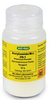
30 g, 29:1 mixture of 99.9% pure acrylamide and bis-acrylamide powder
Polyacrylamide is a commonly used electrophoretic matrix formed by free radical polymerization of acrylamide and a comonomer crosslinker such as bis-acrylamide (bis). Reliable electrophoresis results depend on the reproducibility of this reaction, making highly purified starting reagents an important factor in gel quality. Bio-Rad's 99.9% pure acrylamide undergoes rigorous purification and testing to ensure the quality necessary for uniform polymerization. Acrylamide is available in three forms to meet the needs of every laboratory:
Acrylamide powders — acrylamide and bis-acrylamide powders allow adjustment of concentration and acrylamide/bis ratio
Premixed acrylamide/bis powders — premeasured amounts allow stock solutions from 30 to 50% to be prepared directly in the bottle by adding the indicated amount of water
Acrylamide solutions — available in two ready-to-use concentrations (30% and 40%) and in three acrylamide/bis ratios (19:1, 29:1, and 37.5:1)
Pore Size Determination: %T and %C Polyacrylamide gels are described in terms of two parameters that determine pore size. The total monomer concentration, or %T, is defined as:
%T = (grams acrylamide + grams crosslinker)/total volume (ml) x 100%
The weight percentage of crosslinker, or %C, is defined as:
%C = grams crosslinker/(grams acrylamide + grams crosslinker) x 100%
By varying these two parameters, the pore size of the gel can be optimized to give the best separation and resolution for the molecule of interest.
For help in determining the best %T and %C for your application, refer to the Polyacrylamide Gel Selection Guide, which includes examples of migration patterns of proteins on gels of different compositions, or contact Bio-Rad Technical Support.
Store acrylamide solutions at 4°C. All other reagents should be stored at room temperature, dry, and away from direct sunlight.
30 g, 29:1 mixture of 99.9% pure acrylamide and bis-acrylamide powder
Polyacrylamide is a commonly used electrophoretic matrix formed by free radical polymerization of acrylamide and a comonomer crosslinker such as bis-acrylamide (bis). Reliable electrophoresis results depend on the reproducibility of this reaction, making highly purified starting reagents an important factor in gel quality. Bio-Rad's 99.9% pure acrylamide undergoes rigorous purification and testing to ensure the quality necessary for uniform polymerization. Acrylamide is available in three forms to meet the needs of every laboratory:
- Acrylamide powders — acrylamide and bis-acrylamide powders allow adjustment of concentration and acrylamide/bis ratio
- Premixed acrylamide/bis powders — premeasured amounts allow stock solutions from 30 to 50% to be prepared directly in the bottle by adding the indicated amount of water
- Acrylamide solutions — available in two ready-to-use concentrations (30% and 40%) and in three acrylamide/bis ratios (19:1, 29:1, and 37.5:1)
Pore Size Determination: %T and %C
Polyacrylamide gels are described in terms of two parameters that determine pore size. The total monomer concentration, or %T, is defined as:
%T = (grams acrylamide + grams crosslinker)/total volume (ml) x 100%
The weight percentage of crosslinker, or %C, is defined as:
%C = grams crosslinker/(grams acrylamide + grams crosslinker) x 100%
By varying these two parameters, the pore size of the gel can be optimized to give the best separation and resolution for the molecule of interest.
For help in determining the best %T and %C for your application, refer to the Polyacrylamide Gel Selection Guide, which includes examples of migration patterns of proteins on gels of different compositions, or contact Bio-Rad Technical Support.
Store acrylamide solutions at 4°C. All other reagents should be stored at room temperature, dry, and away from direct sunlight.