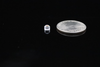
Avantier Inc. Aspheric Lens

Description
An aspheric lens is an optical lens with a non spherical surface profile; its surfaces are not portions of a sphere or cylinder. There are many types of aspheric lenses with various geometries. Unlike spheric lenses, they do not have a constant radius of curvature. They are designed to eliminate almost all spherical aberration, and by focusing light to a small point they drastically decrease the amount of blur and so improve image quality. Using aspheric lenses typically results in more compact assemblies as there are fewer aberrations to be corrected for. Aspheric Lenses At Avantier At Avantier, we manufacture a wide variety of aspheric lenses for applications from smartphones to lasers and fiber optics, from research and industry to medicine. Our lenses are available with anti-reflection coatings or in uncoated forms, in glass, crystalline, or plastic substrates. State of the art grinding and polishing equipment, including computer-controlled precision polishing devices and magneto-rheological finishing (MRF) technology, enable us to ensure that the surface quality is optimized for your application. Types of Aspheric Lens An aspheric lens may have any of a number of geometries. Most aspheric lenses are rotationally symmetric but have a more complex front surface. Unlike a spherical lens, the curvature changes with the distance from the optical axis. Another way of putting this would be to say that the radius of curvature varies radially from the center of the lens. Typically, the further from the optic axis, the weaker the curvature. A lens that does not have these symmetries is typically called a free-form optic. Aspheric lenses are defined by their surface profile (sag of the surface parallel to the optical axis) or by means of orthogonal coefficients Qbfs and Qcon. Qbfs quantifies the RMS slope departure of your aspheric lens from a best fit sphere, and Qcon quantifies the sag departure from a base conic.
Request a Quote
Description
An aspheric lens is an optical lens with a non spherical surface profile; its surfaces are not portions of a sphere or cylinder. There are many types of aspheric lenses with various geometries. Unlike spheric lenses, they do not have a constant radius of curvature. They are designed to eliminate almost all spherical aberration, and by focusing light to a small point they drastically decrease the amount of blur and so improve image quality. Using aspheric lenses typically results in more compact assemblies as there are fewer aberrations to be corrected for. Aspheric Lenses At Avantier At Avantier, we manufacture a wide variety of aspheric lenses for applications from smartphones to lasers and fiber optics, from research and industry to medicine. Our lenses are available with anti-reflection coatings or in uncoated forms, in glass, crystalline, or plastic substrates. State of the art grinding and polishing equipment, including computer-controlled precision polishing devices and magneto-rheological finishing (MRF) technology, enable us to ensure that the surface quality is optimized for your application. Types of Aspheric Lens An aspheric lens may have any of a number of geometries. Most aspheric lenses are rotationally symmetric but have a more complex front surface. Unlike a spherical lens, the curvature changes with the distance from the optical axis. Another way of putting this would be to say that the radius of curvature varies radially from the center of the lens. Typically, the further from the optic axis, the weaker the curvature. A lens that does not have these symmetries is typically called a free-form optic. Aspheric lenses are defined by their surface profile (sag of the surface parallel to the optical axis) or by means of orthogonal coefficients Qbfs and Qcon. Qbfs quantifies the RMS slope departure of your aspheric lens from a best fit sphere, and Qcon quantifies the sag departure from a base conic.
Request a Quote

Suppliers

Company
Product
Description
Supplier Links
Aspheric Lens -  - Avantier Inc.
North Plainfield, NJ, United States
Aspheric Lens
Aspheric Lens
An aspheric lens is an optical lens with a non spherical surface profile; its surfaces are not portions of a sphere or cylinder. There are many types of aspheric lenses with various geometries. Unlike spheric lenses, they do not have a constant radius of curvature. They are designed to eliminate almost all spherical aberration, and by focusing light to a small point they drastically decrease the amount of blur and so improve image quality. Using aspheric lenses typically results in more compact assemblies as there are fewer aberrations to be corrected for. Aspheric Lenses At Avantier At Avantier, we manufacture a wide variety of aspheric lenses for applications from smartphones to lasers and fiber optics, from research and industry to medicine. Our lenses are available with anti-reflection coatings or in uncoated forms, in glass, crystalline, or plastic substrates. State of the art grinding and polishing equipment, including computer-controlled precision polishing devices and magneto-rheological finishing (MRF) technology, enable us to ensure that the surface quality is optimized for your application. Types of Aspheric Lens An aspheric lens may have any of a number of geometries. Most aspheric lenses are rotationally symmetric but have a more complex front surface. Unlike a spherical lens, the curvature changes with the distance from the optical axis. Another way of putting this would be to say that the radius of curvature varies radially from the center of the lens. Typically, the further from the optic axis, the weaker the curvature. A lens that does not have these symmetries is typically called a free-form optic. Aspheric lenses are defined by their surface profile (sag of the surface parallel to the optical axis) or by means of orthogonal coefficients Qbfs and Qcon. Qbfs quantifies the RMS slope departure of your aspheric lens from a best fit sphere, and Qcon quantifies the sag departure from a base conic.

An aspheric lens is an optical lens with a non spherical surface profile; its surfaces are not portions of a sphere or cylinder. There are many types of aspheric lenses with various geometries. Unlike spheric lenses, they do not have a constant radius of curvature. They are designed to eliminate almost all spherical aberration, and by focusing light to a small point they drastically decrease the amount of blur and so improve image quality. Using aspheric lenses typically results in more compact assemblies as there are fewer aberrations to be corrected for.

Aspheric Lenses At Avantier

At Avantier, we manufacture a wide variety of aspheric lenses for applications from smartphones to lasers and fiber optics, from research and industry to medicine. Our lenses are available with anti-reflection coatings or in uncoated forms, in glass, crystalline, or plastic substrates. State of the art grinding and polishing equipment, including computer-controlled precision polishing devices and magneto-rheological finishing (MRF) technology, enable us to ensure that the surface quality is optimized for your application.

Types of Aspheric Lens

An aspheric lens may have any of a number of geometries. Most aspheric lenses are rotationally symmetric but have a more complex front surface. Unlike a spherical lens, the curvature changes with the distance from the optical axis. Another way of putting this would be to say that the radius of curvature varies radially from the center of the lens.

Typically, the further from the optic axis, the weaker the curvature. A lens that does not have these symmetries is typically called a free-form optic.
Aspheric lenses are defined by their surface profile (sag of the surface parallel to the optical axis) or by means of orthogonal coefficients Qbfs and Qcon. Qbfs quantifies the RMS slope departure of your aspheric lens from a best fit sphere, and Qcon quantifies the sag departure from a base conic.

Supplier's Site

Technical Specifications

  Avantier Inc.
Product Category Optical Lenses
Product Name Aspheric Lens
Lens Type Aspheric
Unlock Full Specs
to access all available technical data

Similar Products

High-Quality Plano-Convex Lenses -  - Avantier Inc.
Specs
Lens Type Aspheric; Spherical Lens
Center Thickness 0.0500 mm (0.0020 inch)
Materials BK7 Glass; Germanium
View Details
High-Quality Plano-Convex Lenses -  - Avantier Inc.
Specs
Lens Type Aspheric; Spherical Lens
Center Thickness 0.0500 mm (0.0020 inch)
Materials BK7 Glass; Germanium
View Details
Custom Germanium Lenses -  - Avantier Inc.
Specs
Materials Germanium
View Details