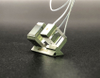
BBO is one of the electro-optic material choices for high average power EO Q-Switch applications. BBO has significant advantages over other materials in terms of laser power handling abilities, temperature stability, and substantial freedom from piezoelectric ringing. Because it relies on the electro optic effect, switching time - aided by the low capacitance of the EO Q-Switch is very fast. The wide transparency range of BBO allows it to be used in diverse applications.
EO Q-Switches are transverse field devices. Low electro-optical coefficient of BBO results in high operating voltages. The quarter-wave voltage is proportional to the ratio of electrode spacing and crystal length. As a result, a smaller aperture device has lower quarter-wave voltage. However, even for 3mm aperture devices quarter-wave voltage is as high as 3.4KV @ 1064 nm. Double crystal design is employed in order to reduce required voltages and allowing operation in half-wave mode with fast switching times.
High repetition rate
High peak power damage resistance
Low absorption
UV transmission
Low acoustic noise
High repetition rate DPSS Q-switch
High repetition rate regenerative amplifier control
Cavity dumping
Beam chopper
BBO is one of the electro-optic material choices for high average power EO Q-Switch applications. BBO has significant advantages over other materials in terms of laser power handling abilities, temperature stability, and substantial freedom from piezoelectric ringing. Because it relies on the electro optic effect, switching time - aided by the low capacitance of the EO Q-Switch is very fast. The wide transparency range of BBO allows it to be used in diverse applications.
EO Q-Switches are transverse field devices. Low electro-optical coefficient of BBO results in high operating voltages. The quarter-wave voltage is proportional to the ratio of electrode spacing and crystal length. As a result, a smaller aperture device has lower quarter-wave voltage. However, even for 3mm aperture devices quarter-wave voltage is as high as 3.4KV @ 1064 nm. Double crystal design is employed in order to reduce required voltages and allowing operation in half-wave mode with fast switching times.
- High repetition rate
- High peak power damage resistance
- Low absorption
- UV transmission
- Low acoustic noise
- High repetition rate DPSS Q-switch
- High repetition rate regenerative amplifier control
- Cavity dumping
- Beam chopper