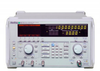
The MG3641A is a 1.04 GHz sweep generator from Anritsu. A sweep generator is a tool engineers use to generate sinusoidal outputs while testing electronic equipment. The output will automatically have its frequency varied or swept between frequencies. A sweep is one complete cycle of a frequency variation. Engineers use sweep signal generators as test equipment, mostly to measure responses of filters, amplifiers, and electrical components.
Additional Features:
Frequency range: 125 kHz to 1040 MHz
0.01 Hz, 0.01 dB setting resolution
High signal purity (–100 dBc spurious)
Versatile modulation functions
A unique low-noise YIG oscillator produces a high-purity signal with SSB phase noise of better than –130 dBc/Hz (1 GHz, 20 kHz offset) making this MG3641A signal generator excellent for interference testing of radio receivers and as sources for various local and reference signals.
Anritsu synthesizer technology permits frequencies to be set with a resolution of 0.01 Hz across the full frequency range. And the non-harmonic spurious is better than –100 dBc for reliable measurement at any frequency.
The MG3641A is a 1.04 GHz sweep generator from Anritsu. A sweep generator is a tool engineers use to generate sinusoidal outputs while testing electronic equipment. The output will automatically have its frequency varied or swept between frequencies. A sweep is one complete cycle of a frequency variation. Engineers use sweep signal generators as test equipment, mostly to measure responses of filters, amplifiers, and electrical components.
Additional Features:
- Frequency range: 125 kHz to 1040 MHz
- 0.01 Hz, 0.01 dB setting resolution
- High signal purity (–100 dBc spurious)
- Versatile modulation functions
A unique low-noise YIG oscillator produces a high-purity signal with SSB phase noise of better than –130 dBc/Hz (1 GHz, 20 kHz offset) making this MG3641A signal generator excellent for interference testing of radio receivers and as sources for various local and reference signals.
Anritsu synthesizer technology permits frequencies to be set with a resolution of 0.01 Hz across the full frequency range. And the non-harmonic spurious is better than –100 dBc for reliable measurement at any frequency.